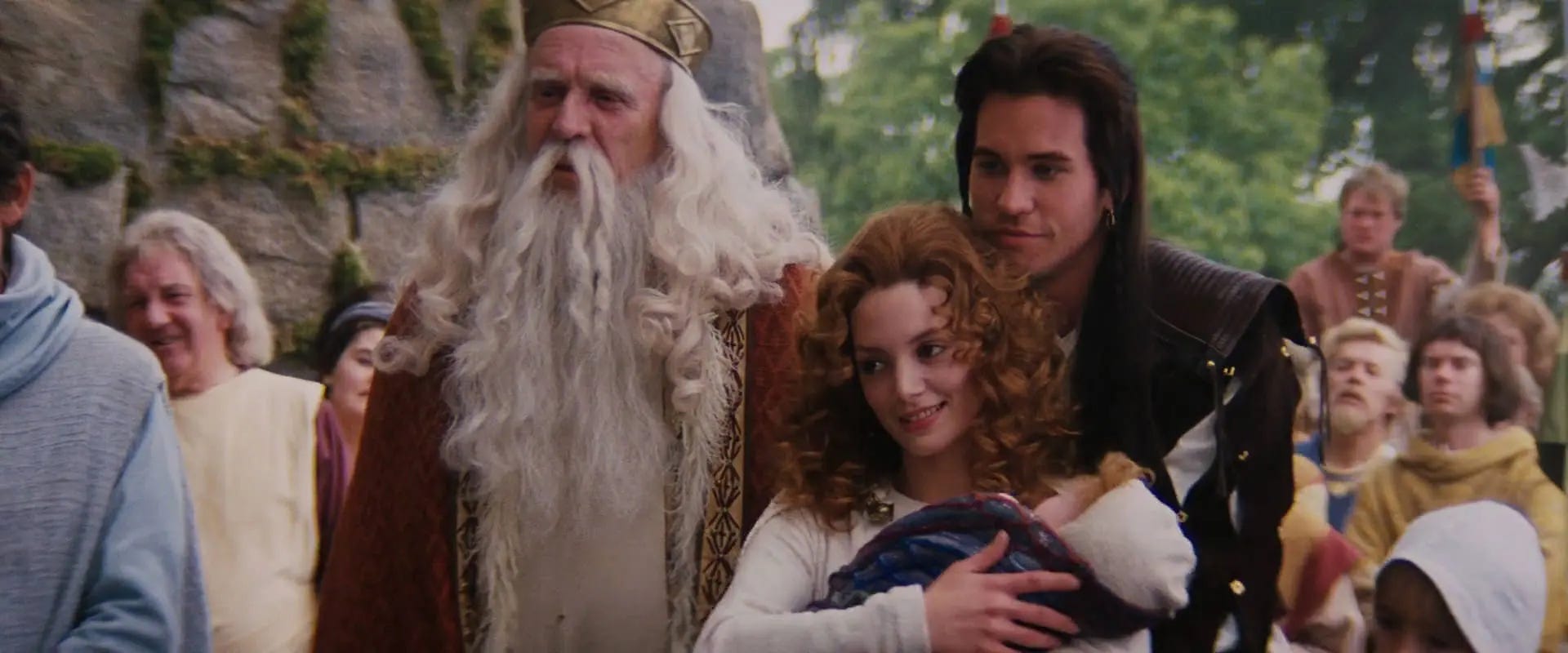

WILLOW (1988) opened the door to two new possibilities. Cast as a swashbuckler who brandishes a rude and surly sensibility, Val Kilmer would be booked to play Jim Morrison in The Doors (1990) as a direct result of this movie. Next, Industrial Light & Magic advanced the art of digital compositing, in service of one standout scene, permitting a longer scene in The Abyss (1989) which then made Terminator 2: Judgment Day (1991) possible. This is to say that what’s most wonderful about Willow would pay off down the line, in films with a more consistent vision as well as a less derivative one.
During his writing process for Star Wars (1977)–when his script went by such rejected titles as Journal of the Whills and The Adventures of Luke Starkiller–George Lucas had the notion of making his hero a little person, the idea being that the evil Galactic Empire would be toppled by an individual who based on appearances would seem the least likely to lead such an uprising. Luke Skywalker instead became a restless teenager with a need for speed and his sights on the horizon, a character similar to Lucas as a teenager, growing up in Modesto, California. As a writer/ producer, he would work the idea of a warrior as powerful as he was diminutive into The Empire Strikes Back (1980) with Master Yoda, but Lucas never let go of his desire to make a fantasy adventure with a little person in the lead. In 1985, he came to Los Angeles to pitch Ron Howard what he had of an idea. Howard had graduated from acting in the ensemble of Lucas’s breakout film American Graffiti (1973) to seven seasons playing Richie Cunningham on the fifties-era sitcom Happy Days. More or less retiring his acting career in 1980, Howard quickly established himself as one of the more sought-after film directors in the business. In his first feature, Howard introduced movie audiences to Michael Keaton with Night Shift (1982), made Tom Hanks a star in Splash (1984), and directed Don Ameche to an Academy Award for Best Supporting Actor in Cocoon (1985), all commercial hits.
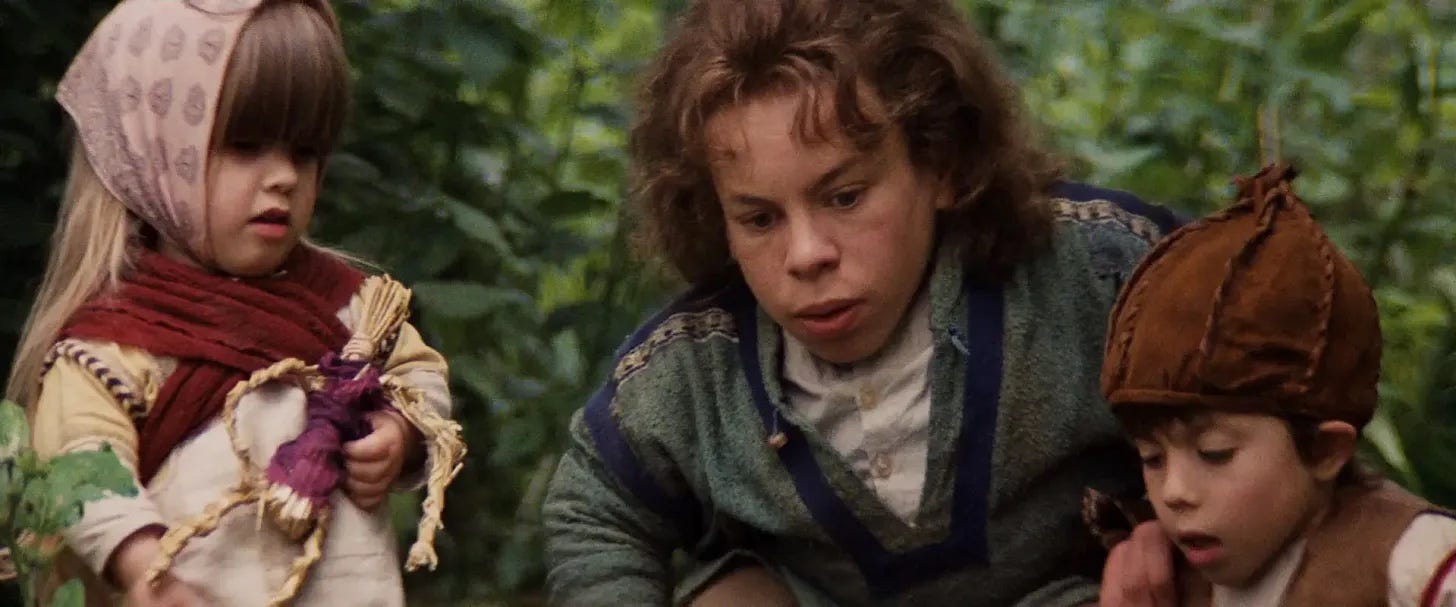
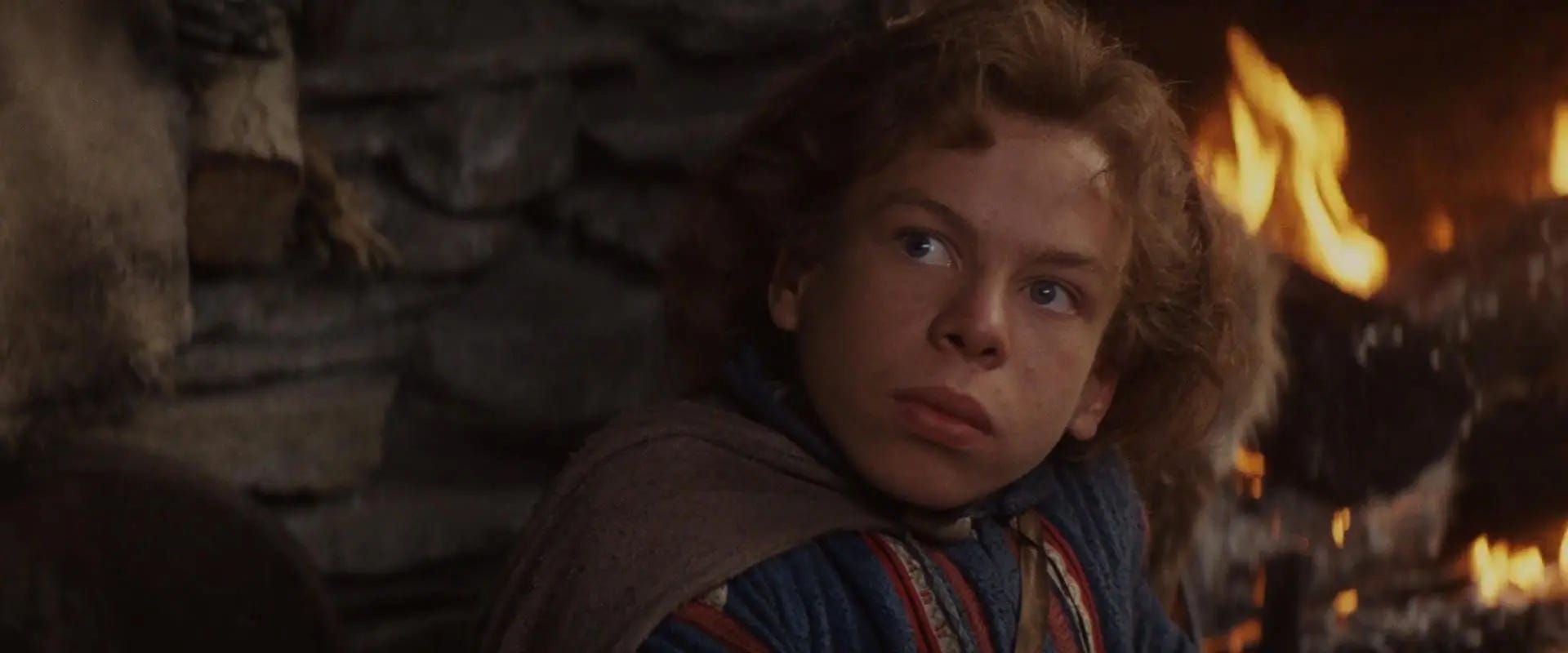
Preparing to meet with George Lucas to discuss what sounded like a fantasy adventure in the spirit of J.R.R. Tolkien’s The Lord of the Rings books, Howard phoned Toronto to speak with Bob Dolman. A writer on SCTV, Dolman had met Howard in 1983 for a television pilot Dolman had written and Howard directed called Little Shots, about the misadventures of a group of junior high school kids (Joey Lawrence, Soleil Moon Frye and before he was cast as “Chunk” in The Goonies, Jeff Cohen, were part of the gang). The pilot hadn’t been picked up for series, but Dolman was working with Howard on the screenplay for what would become Far and Away (1992). Before he got back to his epic about Irish immigrants and the Oklahoma Land Rush, Howard was game to work with George Lucas again and challenge himself by directing an epic fantasy. Lucas asked him to suggest a writer, and Howard nominated Dolman. Meeting at Howard’s office on the Twentieth Century Fox lot, Lucas laid out a sketchy story predicated mostly on feeling, and at that point, existing only in his head. By their second meeting, Lucas provided a three-page story treatment, a necessary document that would not only secure Lucas a story credit, but guarantee him merchandising rights. Titled Willow, the piece took place in a fantasy world where two armies stand in opposition and a dwarf named Willow Ufgood must transport a baby prophesied to destroy an evil king.
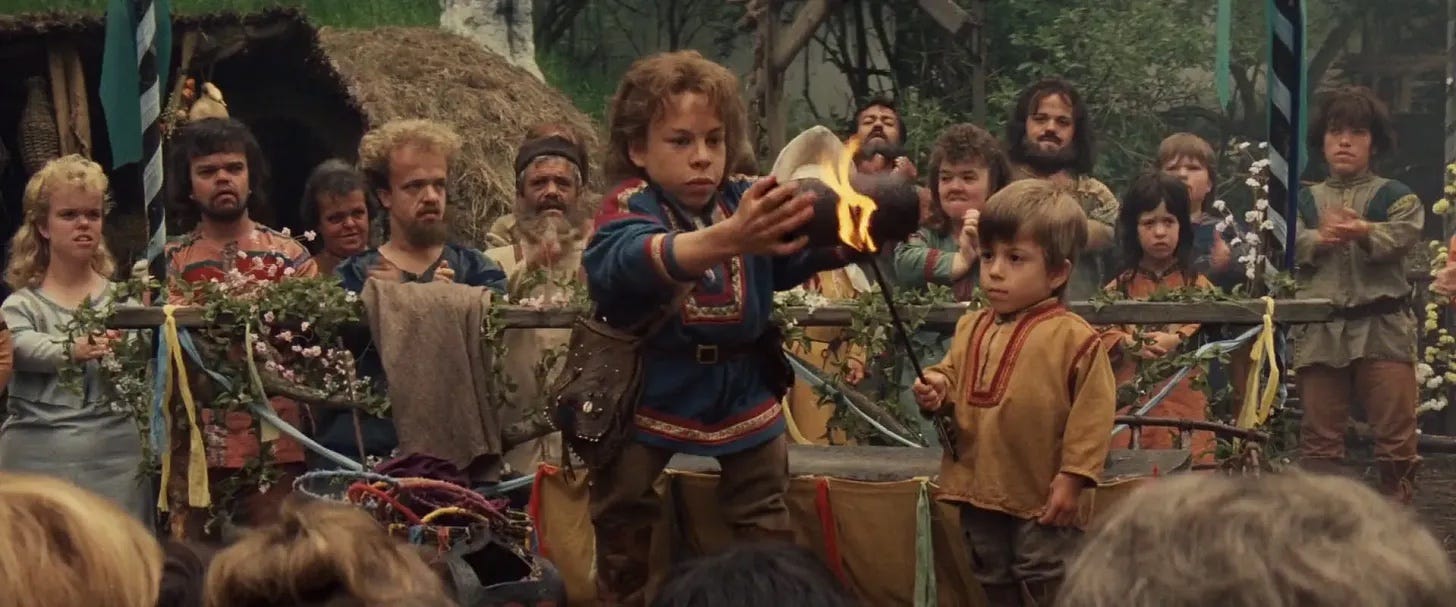
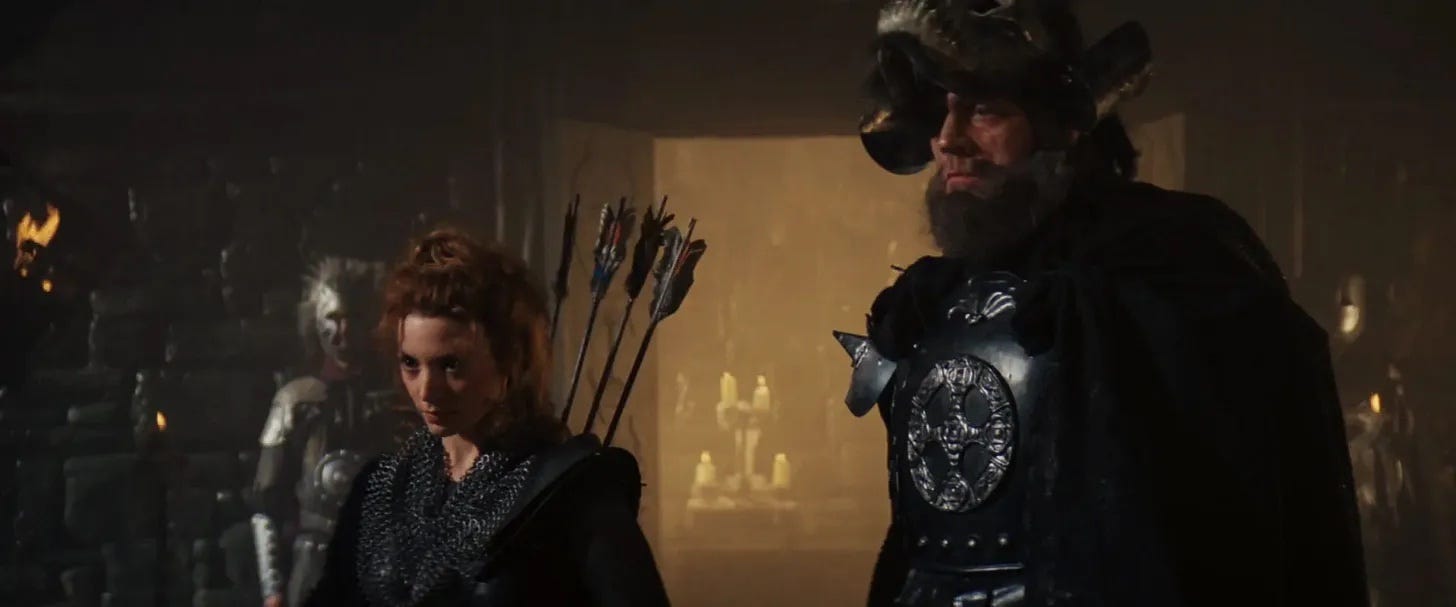
Willow Ufgood, who Lucas described as a “willfully good” person, seemed to Bob Dolman like a character he’d tire of writing quickly, and the screenwriter had never trafficked in fantasy or adventure. But Lucas read the teleplay Dolman had written for WKRP In Cincinnati, and told Dolman that he liked the detail he’d brought to the show’s characters. As executive producer, Lucas maintained that he’d handle the fantasy adventure, Ron Howard would direct, and Dolman would script the details. They considered their target audience to be a twelve-year-old boy, and Lucas proposed they draw up forty-five scenes–three acts, fifteen scenes per act–their ideal viewer would want to see. Howard participated in script meetings before departing for Pennsylvania in the summer of 1985 to direct Michael Keaton in the comedy Gung Ho (1986). By the time Howard was ready to focus on his next project, Dolman was at Skywalker Ranch in Marin County, California writing Willow in an office right next to Lucas (the WGA would award screenplay credit to Bob Dolman, from a story by George Lucas). The screenwriter fancied a pre-patriarchal society mostly run by women. Considering the evil king in Lucas’s treatment too similar to Darth Vader in Star Wars, Dolman proposed an evil queen, a sorceress opposing a good, exiled sorceress for the fate of an infant princess. Dolman gave the evil queen a daughter named Sorsha, an architect of war who’d be turned away from treachery by love. By contrast, his male characters–the dwarf Willow and the bandit Madmartigan–would start off as meek and disgraced and seek to fulfill their potential, as a magician and swordsman, respectively.
Over the span of a year, Dolman wrote a draft and six revisions of Willow. Despite a torrent of fantasy films in the 1980s, the film industry had come to regard the genre warily. Clash of the Titans (1981) and The Dark Crystal (1982) had performed reasonably well commercially, but Dragonslayer (1981), Krull (1983) and Legend (1985) had not, while Lucas’s collaboration with Jim Henson, Labyrinth (1986) was completely ignored in theaters. Rather than finance the picture through bank loans and retain ownership of the negative–as he planned to with Indiana Jones and the Last Crusade (1989)--Lucas split the risk in a co-financing deal with MGM, whose chairman, Alan Ladd Jr., had been the one to sell Twentieth Century Fox on Star Wars while he was president of Twentieth Century Fox. For Willow, MGM came in for half the film’s $35 million budget in exchange for theatrical and TV rights. Covering the other half, Lucasfilm retained home video and pay TV rights, selling those to RCA/ Columbia Pictures Home Video for $15 million. By virtue of Ron Howard developing the script, Imagine Entertainment, the company he’d co-founded in 1985 and went public with the following year, was credited “in association with” Lucasfilm. Nigel Wooll, a veteran production manager on films like Force 10 From Navarone (1978), Reds (1981) and Krull, assumed duties as producer. Joe Johnston, a concept artist and effects technician on Star Wars who became one of the pioneers of Industrial Light & Magic–remaining with the effects house rather than launching his own–and was being nudged by Lucas toward directing, took on the roles of second unit director/ associate producer.
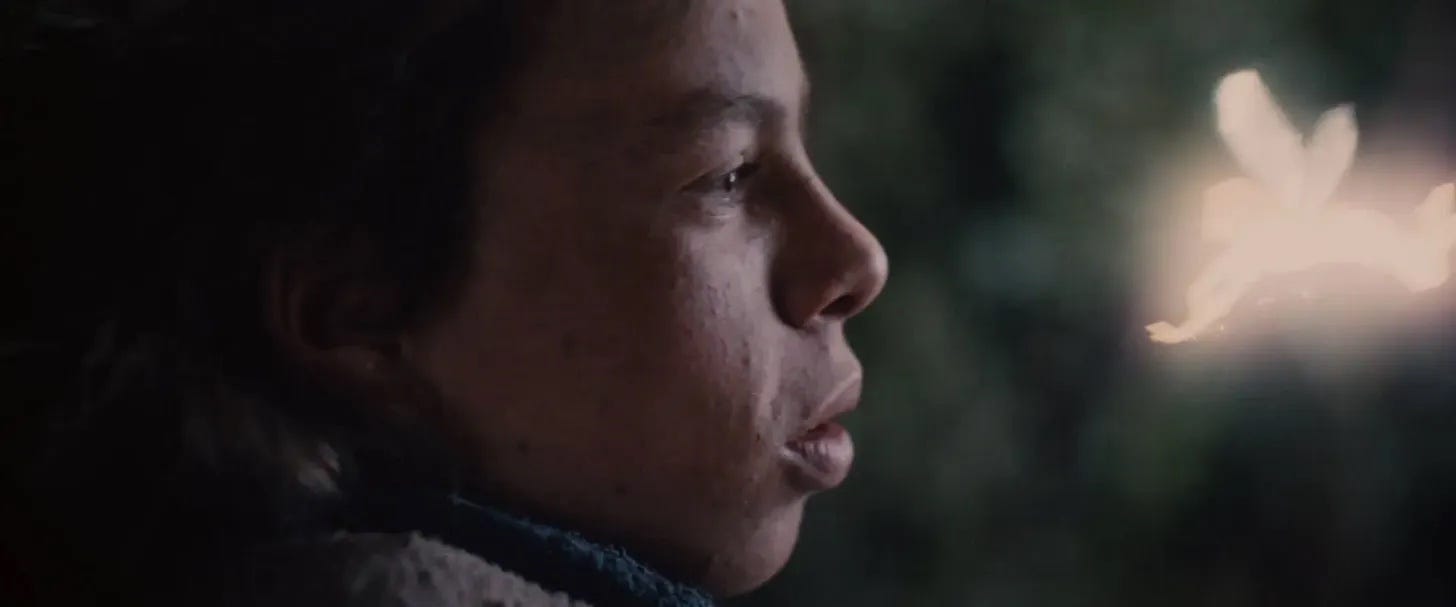
Warwick Davis, a 17-year-old actor who’d played Wicket the Ewok in Return of the Jedi (1983), was cast in the title role, with Val Kilmer and Joanne Whalley joining him as Madmartigan and Sorsha, respectively. Jean Marsh, who’d played the witch Mombi in Return To Oz (1985), was cast as the evil queen, Bavmorda, and Patricia Hayes, who’d appeared as the state’s witness in A Fish Called Wanda (1988) who Michael Palin’s character keeps trying to kill, was cast as Fin Raziel, the good sorceress, who spends much of the film transforming into different animals. Shooting commenced in April 1987 at Elstree Studios in England, where interiors were filmed over twelve weeks. The Nelwyn village and cart chase were shot in the forests of nearby Hertfordshire. The production moved to a slate quarry in North Wales to film exteriors for Bavmorda’s fortress, Nockmoor Castle. The search for snowfall in the summer took the show to Queenstown, New Zealand, alpine scenes shot on the summit of Mount Cardona. The more elaborate special effects–such as those featuring actors Rick Overton and Kevin Pollak as nine inch tall tricksters called Brownies–were filmed at ILM in Marin County. Leading the effects team were Dennis Muren, Michael McAlister and Phil Tippett. Miniature and optical effects wizards, Muren was a photographic innovator at ILM, while Tippett was heir to Ray Harryhausen in the field of stop-motion puppetry.
Willow was produced in what would be the twilight of visual effects generated on celluloid and the dawn of the digital age. For a scene in which Fin Raziel transforms into a variety of beasts, Muren proposed they might be able to accomplish this in one seamless shot by using computers. At the time, ILM’s computer graphics department had five or six men in it. A programmer named Doug Smythe was drafted to write software that could generate what became known as “morphing,” Smythe credited with inventing a term that became commonplace in film, commercials and music video. With Star Wars on hiatus and Indiana Jones expected to conclude as a trilogy, many in the film industry pondered whether George Lucas was ending his run as an independent hitmaker. Before Labyrinth found its audience on home video (courtesy twelve-year-old girls), Lucas’s production of Howard the Duck (1986), which he’d reluctantly agreed to help promote with his name, was a widely mocked disaster. Lucas’s critics snickered through a teaser trailer MGM debuted for Willow in November 1987, finding it vague and pretentious. Some forecast the movie would share the fate of Howard the Duck.
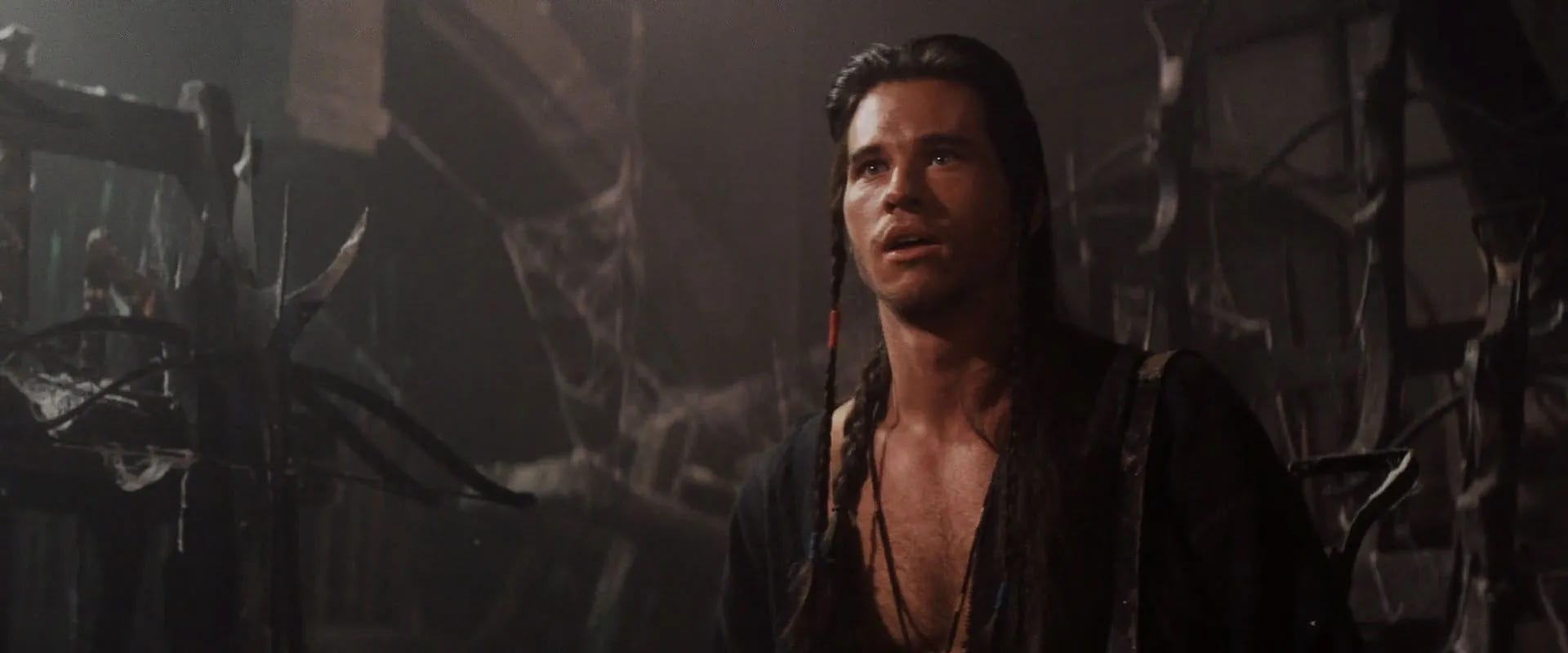
Opening May 20, 1988 on 1,024 screens in the U.S., Willow got off to a rough start, with critics going strongly negative. On Siskel & Ebert & The Movies, Gene Siskel and Roger Ebert cast “two downturned thumbs.” Ebert capped his commentary by stating, “Instead of Three Men and a Baby you could’ve called this movie A Warrior, A Dwarf, Two Brownies and a Baby. But the baby is basically just dragged along as a trophy and the movie misses a bet, which would’ve been to play up the everyday troubles that these characters have caring for the child. Instead, the kid is simply made unbreakable and waterproof, and the characters slog on through an endless landscape.” Siskel chimed in, “When you watch this film, you’re seeing–there is no clear vision. There’s no breaking of any new ground. I wasn’t surprised by anything in this film. And I found it tedious. And I’m particularly finding the whole genre a little bit tedious because if George Lucas and Ron Howard–Ron Howard made Cocoon–they can’t come up with anything fresh in this genre, I think it’s wiped out.” Writing in LA Weekly, film critic John Powers seconded that. “This mega-budget snoozer from Lucasfilm will almost certainly ring the death knell for movies that seek to bring sword and sorcery to the screen … Director Ron Howard probably does as well as anybody could with such worn-out material (there’s one great effect of a transubstantiating sorceress) but you spend your time remembering the scenes that Lucas ransacked to ‘create’ the story.” Without legitimate competition, Willow opened #1 at the box office and held its own against the early summer’s big films–“Crocodile” Dundee II and Rambo III following in into theaters Memorial Day weekend–to carve out its own niche, spending seven weekends among the top ten grossing films in the U.S.
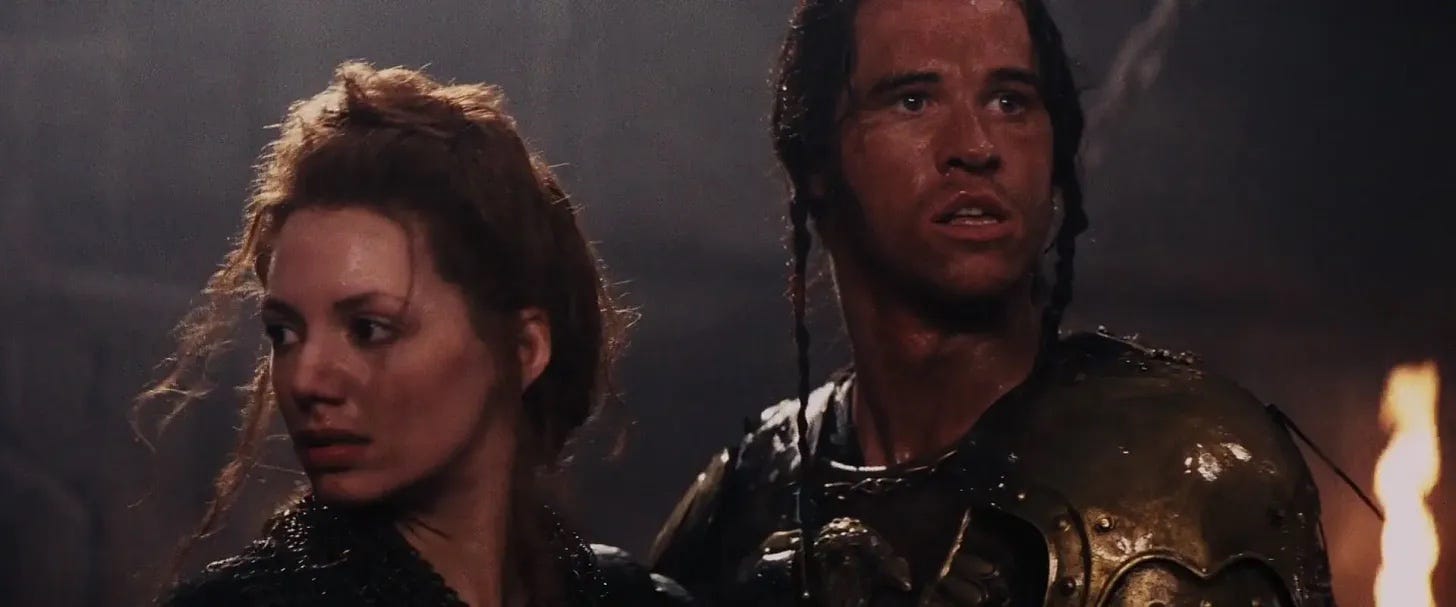
One constant as Ron Howard embarked on a career as a film director is what a delight it was to watch the leading men in most of his movies. Committed, often high key, they bound off the screen. It’s almost as if Howard, who gained stardom as a child actor, playing Opie Taylor on all eight seasons of The Andy Griffith Show, is living vicariously through the roles he dreamed of being offered as an adult, forever Richie Cunningham, never Fonzie. Imagine Entertainment having produced the comedy Real Genius (1985), Howard knew what he had in Val Kilmer, and the actor swings from the rafters in Willow, a terrestrial buccaneer we have no choice but trust, hoping his character finds something more socially redeeming than larceny, or PG-rated womanizing, to devote his wits to. As a screen couple, Kilmer and Joanne Whalley even look better on film than Harrison Ford and Carrie Fisher in the Star Wars trilogy, unencumbered by cheap wardrobe or some questionable hair. This is a couple we’re ready to follow anywhere. That becomes difficult as the story’s flaws pile up. Whether Warwick Davis was a good actor or had the potential to prove it on film, the role he’s thrown here didn’t help. His character is surrounded by people, all of which are taller than he is–even in his village–and as a venturing hero, Willow is reduced to waddling after or yelling at other characters for attention, a weak position for a hero to operate in. Dolman and Howard aren’t living vicariously through this character, or know how to make Lucas’s little goodwill ambassador compelling.
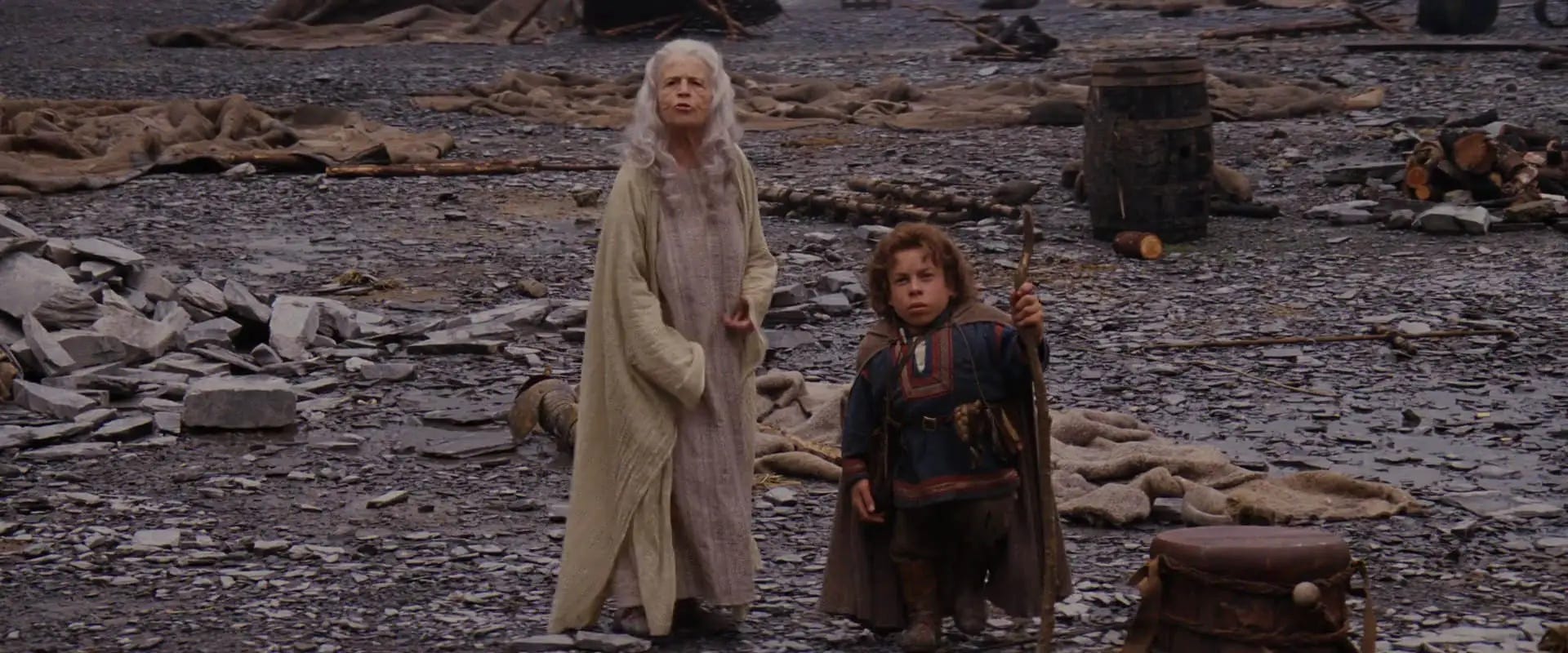
Needing a strong villain to rescue the movie, we instead have Bavmorta, a poor copy of the Evil Queen in Snow White and the Seven Dwarfs (1937) and Maleficent in Sleeping Beauty (1959) with none of their menace. A sorceress as powerful as she is wouldn’t require a human army, and like Davis, Jean Marsh isn’t given anything remotely interesting to do. Another problem is the baby, Elora Danan (Lucas and Dolman get points for cool-sounding names, something fantasy filmmakers struggle with). The toddler is carried across Creation, but there’s absolutely nothing special about her. Those who come into contact with the baby don’t change in discernible ways. She’s in the picture because the American film industry was gripped in baby fever, Three Men and a Baby the highest grossing movie of 1987. Here, the kid is simply a prop. Borrowing from a source less obvious than The Lord of the Rings, Lucas could have put Willow on the road to challenge Bavmorta in a contest of magic, like David volunteering to fight Goliath, the dwarf improbably raising an army along the way. In another misappropriation of resources, Rick Overton and Kevin Pollak, superb comedians, are reduced to playing twig-sized figures scampering around the bottom of the screen, their performances buried under tribal makeup and gestures too tiny to see. The uninspired tropes leave no room for the sort of irreverence Howard and Dolman were capable of. Even the film’s novel attempt to fashion a matriarchal society is buried beneath the abundantly familiar. John Williams wasn’t available to score the picture, James Horner composing the music in broad strokes without memorable themes for the characters.
Video rental category: Fantasy
Special interest: Sword and Sorcery