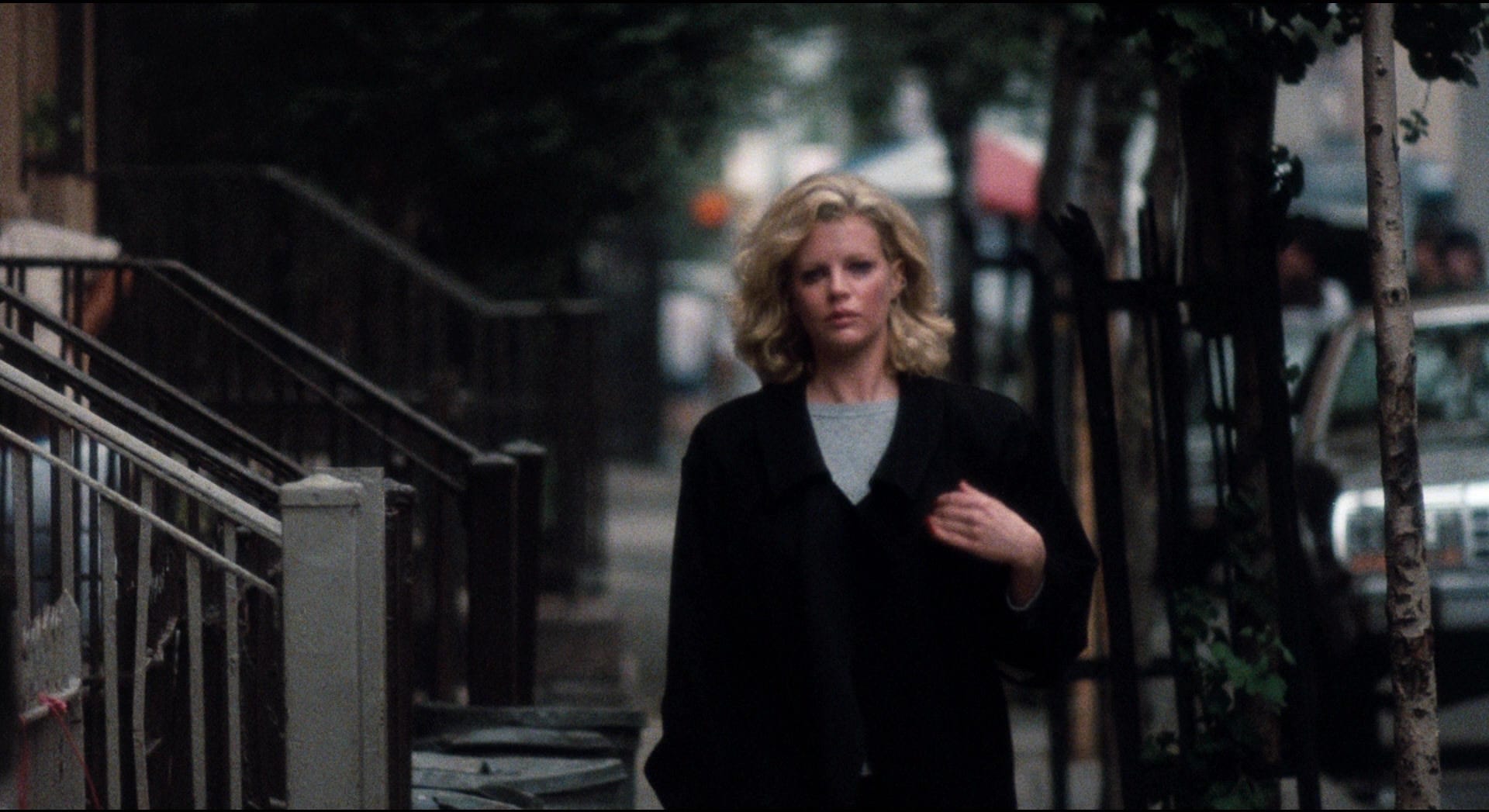
Nine ½ Weeks at 40: Part 2 of 2
Preview Disaster, Alternate Versions, Reception, Rediscovery

To get caught up, read Part 1 of 2 of my retrospective of Nine 1/2 Weeks here.
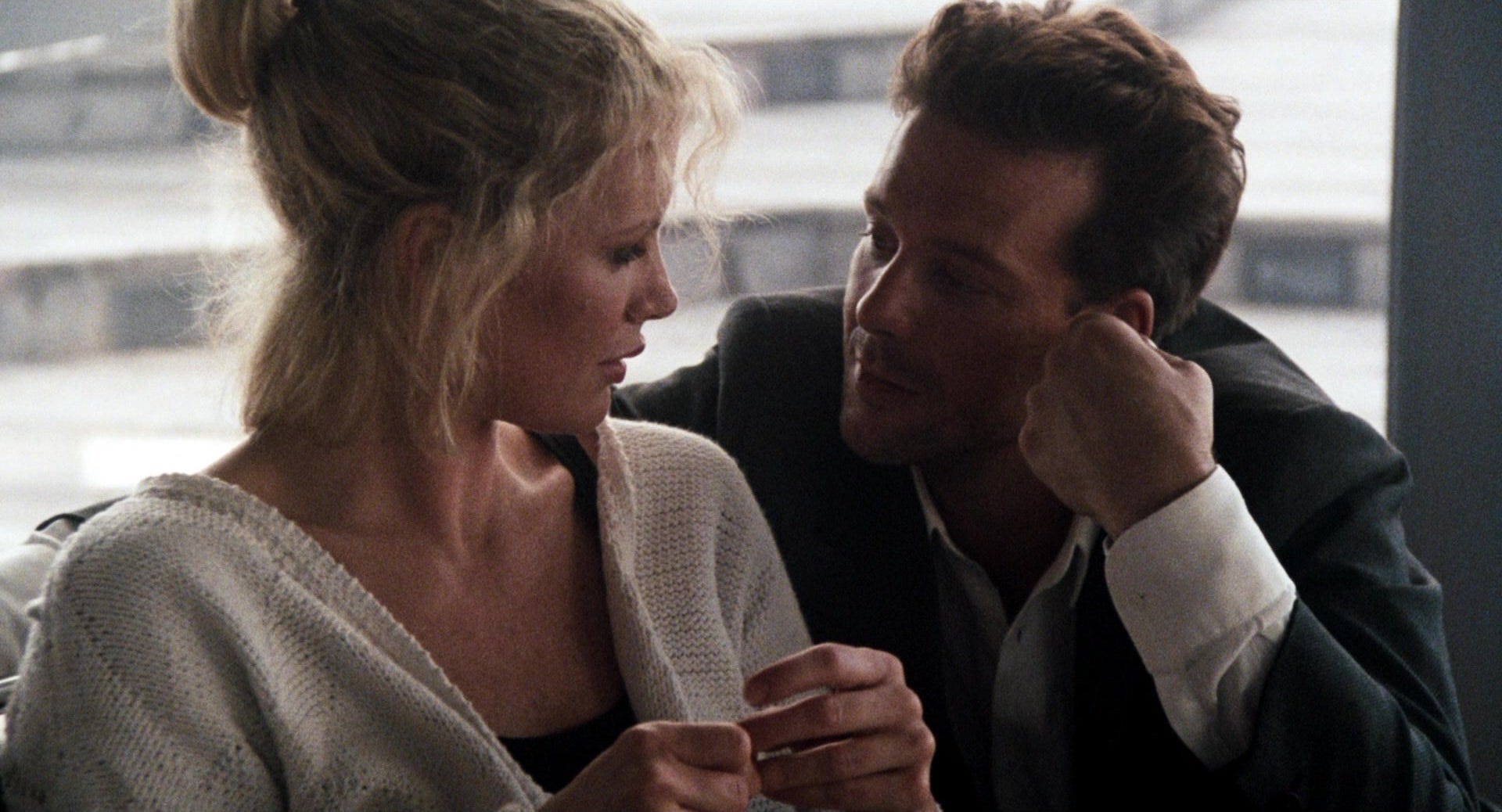
On the set of Nine 1/2 Weeks (1986), director Adrian Lyne often communicated to Kim Basinger through Mickey Rourke, leaving her in the dark and left to react to whatever Rourke did with her. Interviewed by Seth Abramovitch for an article in the Hollywood Reporter printed February 12, 2015, Lyne stated that to throw her off, Rourke would crank “Rebel Yell” by Billy Idol at full volume before cameras rolled. Basinger would not only survive the job, but later take home an Academy Award for her first and only nomination, winning the Oscar for Best Actress in L.A. Confidential (1997). Twelve years previous, American audiences were not spellbound by Nine ½ Weeks, not at test screenings. Zalman King joked, ”When the film was done, it got worse. We would have test screenings where there were a thousand people in the theater and a hundred when it was over. People were walking out in droves.” Speaking to the Hollywood Reporter in 2015, Lyne added, “When we previewed it, people were absolutely enraged. Sometimes half the theater would empty, and they’d be yelling at the screen. There was one occasion when it was actually frightening–I was sitting there with a line of sweating executives and I went and hid in the projection box. I thought to myself, ‘I don’t want to be there at the end.’”
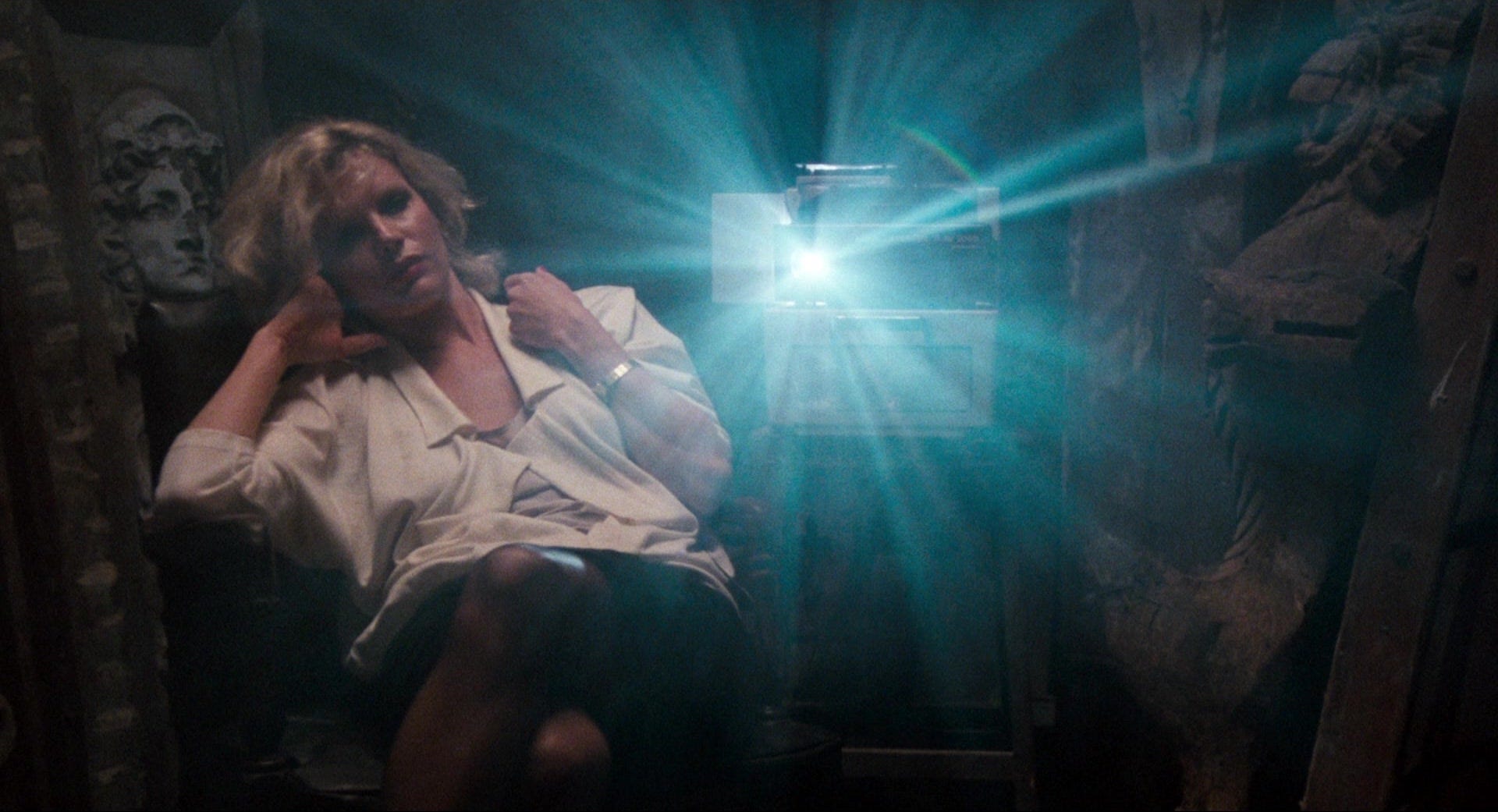
As scripted and shot, Nine ½ Weeks was to climax with Elizabeth entering what she believes is a suicide pact with John, popping pills with him, not being given a safe word or understanding the pills contain only sugar. The sick game is what finally motivates her to leave him. As for test audiences, Lyne told the New York Times in 1986, “It made them hate him too much. They hated John for doing it. They hated Elizabeth for accepting it. They hated me for making it. It made them hate the whole film.” The scene would be cut from both the American and European versions of Nine ½ Weeks. As of June 2, 1985, when Patrick Goldstein covered the film’s post-production woes for an article in the Los Angeles Times, MGM had yet to set a release date. Geffen Records had backed out of producing the soundtrack album, A&R rep John Kolodner set to assemble the artists. He was candid about his decision to quit the job. “Speaking just for myself, I found the movie to be offensive to women and I just didn’t want to be associated with the picture. I don’t care if the movie makes $100 million. I’ve washed my hands of the whole thing. I think Adrian is very talented and I respect his work, but I just couldn’t see having my name on this picture. Some people may find it titillating, but it made me nauseous.”
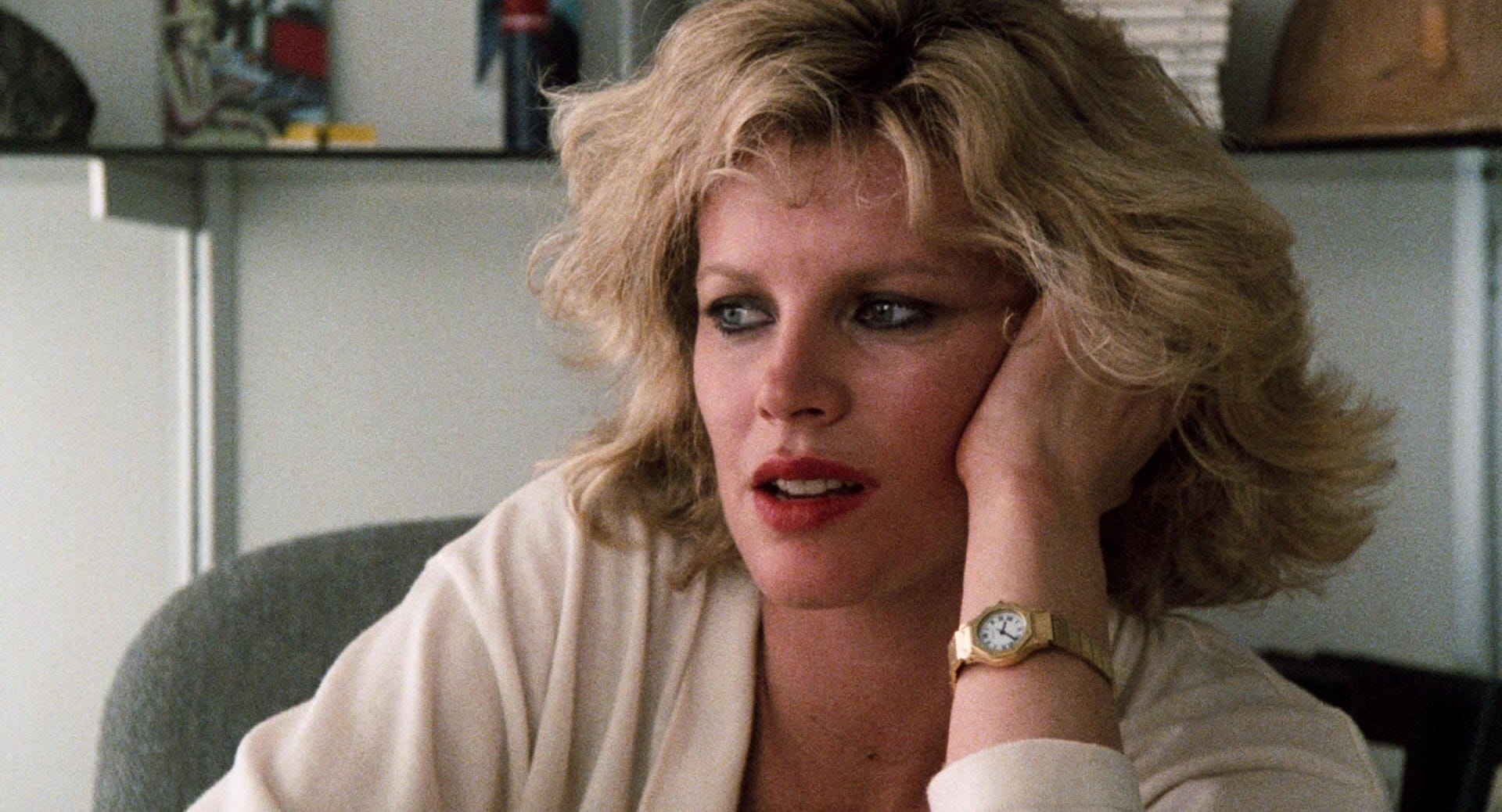
The more time the filmmakers took to trim and test versions of Nine ½ Weeks that would be palatable to theatergoers, the budget not only increased (to as much as $15 million), but music supervisor Becky Mancuso’s job became harder. Selecting and clearing the music for Footloose (1984), The Sure Thing (1985) and Real Genius (1985), her task now, as she explained to the Los Angeles Times, sounded more like triage. “A lot of the scenes that would have had logical places for music have been cut out, so it’s hard to say whether we have enough music slots left for an album. Originally, we had at least eight music slots and now we’re down to about five, and they’re still falling by the wayside.” Speaking to Pop Geeks in 2019, screenwriter Sarah Kernochan offered her appraisal of Nine ½ Weeks. “I never really liked it. I mean, I thought it was a bunch of wonderful set pieces, and was very erotic. I thought it achieved that aim, but I didn’t think, as a story, that it was strong … As a feminist also, I didn’t love it. It was quite demeaning, but on the other hand, I like that it was exploring this side of women who seem like they’ve got it together, but they have a side that wants to be dominated, and the book was very frank about that. I admired it, but it wasn’t a movie that I liked in particular.”
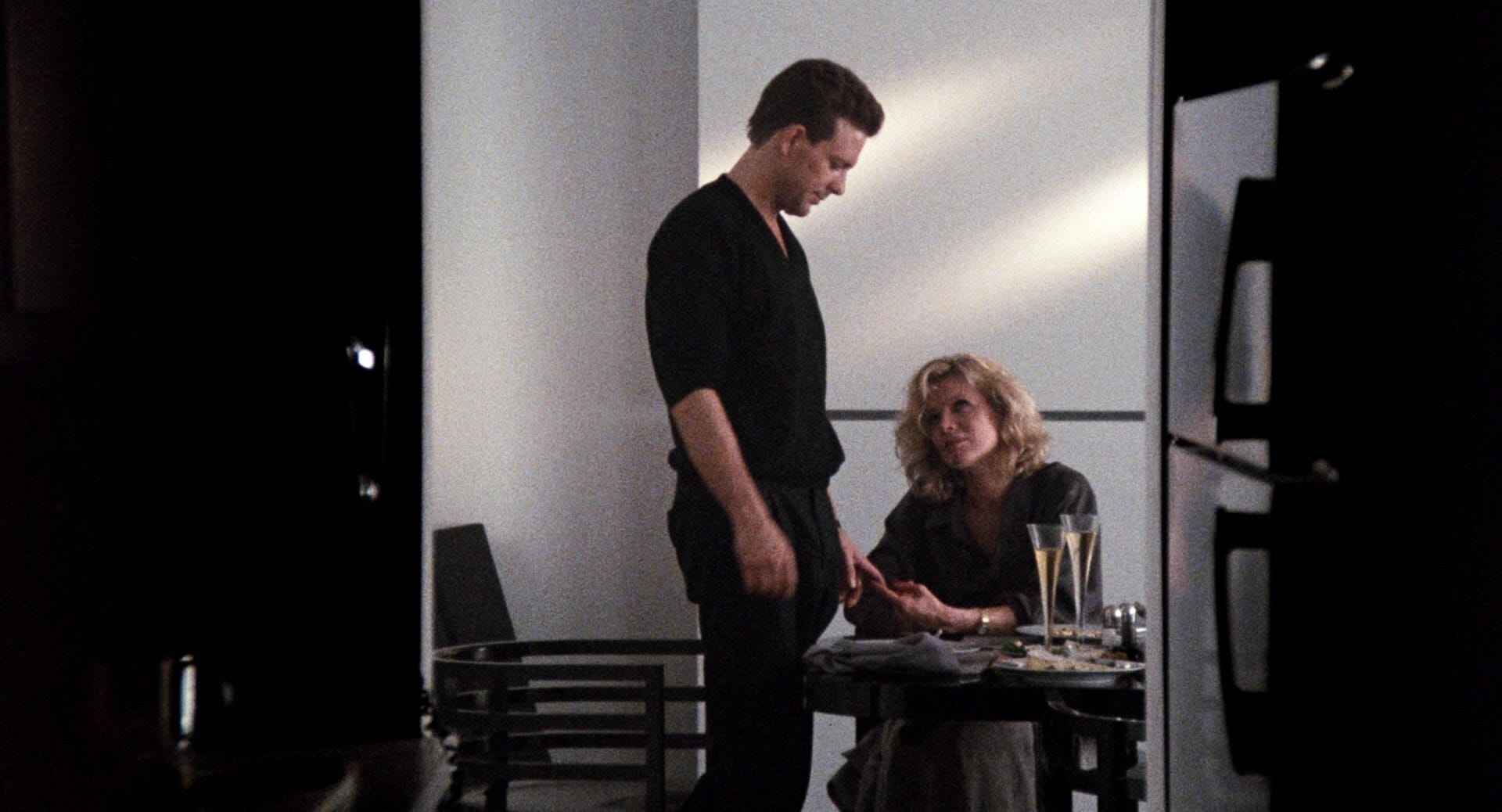
MGM settled on sneaking Nine ½ Weeks into limited release in the U.S. on February 21, 1986. February was a month in which distributors often dumped films with poor commercial prospects. January was regarded as a filmgoing graveyard, as moviegoers were watching their wallets following Christmas, students returned to school, and inclement weather depressed attendance in many markets, but February, August and September saw plenty of dumping too. Critical reaction to Nine ½ Weeks ran the gamut. In a review Roger Ebert filed for the Chicago Sun-Times, the journalist wrote, “Any story like 9 ½ Weeks risks becoming very ridiculous. The actors are taking a chance in appearing in it. Plots like this make audiences nervous, and if the movie doesn’t walk a fine line between the plausible and the bizarre, it will only find the absurd. A lot of the success of 9 ½ Weeks is because Rourke and Basinger make the characters and their relationship convincing.” Ebert, who interviewed Mickey Rourke for a piece nationally syndicated in March, gave the film three and a half stars out of four. Vincent Canby pulled no punches in his review for the New York Times. “Mr. Lyne may be onto something, though I doubt he has a clue as to what it is. Flashdance only scratched the surface of his singular vision. In 9 ½ Weeks, he has created a work that might well qualify as a truly nouveau film. Here is a movie in which actors impersonating characters are blended into the decor so completely that they take on the properties of animated products, no more or less important than exquisitely photographed strawberries. John and Elizabeth aren’t fictional creatures. They are those giant figures that model Calvin Klein underwear on Times Square billboards.”
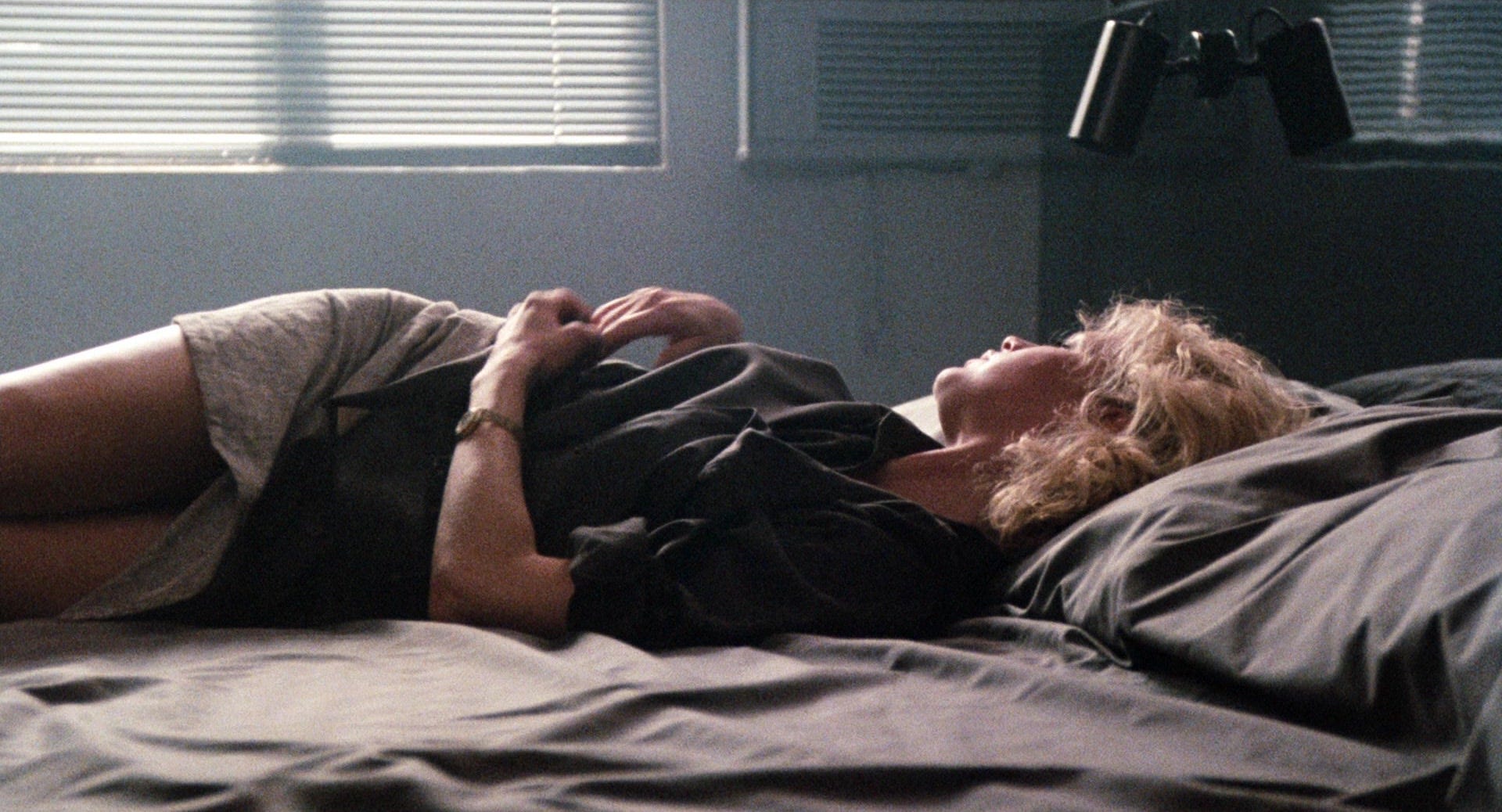
Author/ critic F.X. Feeney chimed in for L.A. Weekly. “Kim Basinger has a gift (and a beauty) comparable to Liv Ullmann’s in her Persona prime–she projects a sense that she can survive anything precisely because she surrenders so vulnerably, so completely to the demands of a given moment. Alas, like Rourke’s, her performance here seems to have had its guts cut out. We never get a sense of what this woman’s real hungers and conflicts are–or for that matter, whether she’s conflicted about anything at all.” At the box office, Nine ½ Weeks opened quietly against a handful of crowd-pleasing hits: Down and Out In Beverly Hills, F/X, Hannah and Her Sisters. Its commercial prospects were killed the following weekend, when Pretty In Pink opened and held the #1 spot at the box office for two weekends, American audiences voting with their wallets how they preferred their movie romances. The R-rated, 113-minute version of Nine ½ Weeks that played in American theaters (and is now available for streaming) was supplemented by an unrated, 116-minute cut that played for European theatergoers with, in one scene, slightly more explicit sexual content. Europeans not only turned out for Nine ½ Weeks, but did so in enough numbers for the film to perform better commercially in Europe than in the States, at that time, a rarity for an English-language picture.
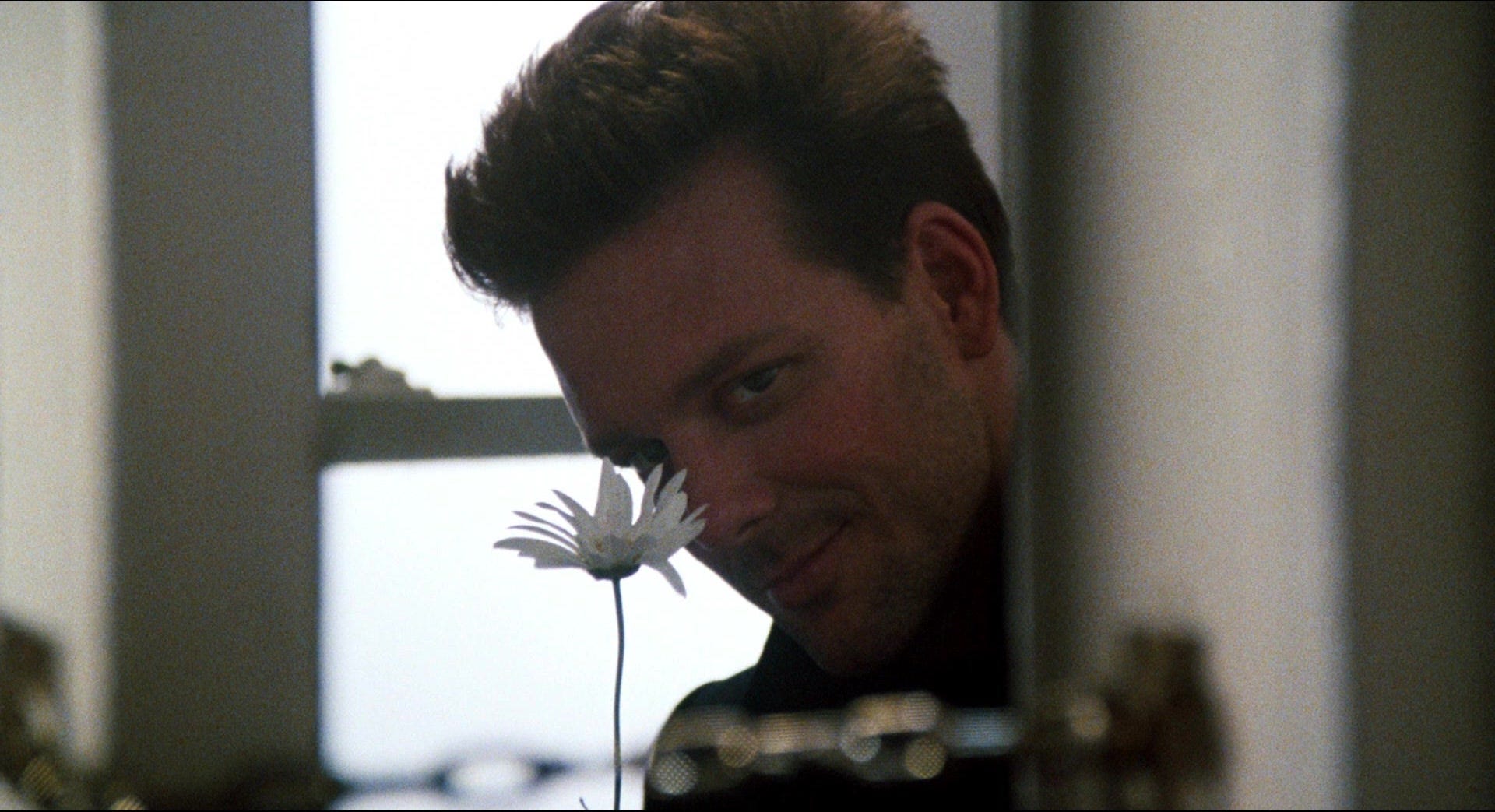
By 1992, Zalman King had not only carved out a niche for himself as a maker of erotic thrillers, but dominated that niche, as co-writer/ director of Two Moon Junction (1988), co-writer (with Patricia Knop)/ director of Wild Orchid (1989) starring Mickey Rourke, and co-writer (with Knop)/ director of a cable television movie for Showtime with an actor named David Duchovny in the lead titled Red Shoe Diaries (1992). The latter launched an anthology series airing after hours, when the prying eyes of America’s children were supposed to be shut. King observed that Americans who’d rejected a movie about sadomasochism in theaters could rent a copy on videocassette and enjoy it in the privacy of their own homes, which many did. Of Nine ½ Weeks, King told the magazine, “It was written off as a failure. But the film was harder, and better then [sic], for an American film it was really good. After the screenings it got progressively more and more watered down until it became another kind of film.” Wrapping production, Adrian Lyne spoke to Roderick Mann for an article published July 15, 1984 in the Los Angeles Times, and set the table for his film by stating, “In the original story, the woman would do absolutely everything for the man. And there was a lot of S&M with handcuffs, whips and the like. I didn’t want it like that; I didn’t want the woman to be a victim. I wanted these two people to behave as they do because of their overwhelming passion for each other. So much so that people leaving the theater will perhaps examine their own relationships and not just think, ‘I wouldn’t want to know them.’ After all, a lot of people do harbor the sneaking feeling that one day someone could come along who’d so overwhelm them that they’d drop everything. That’s what this film is all about.”
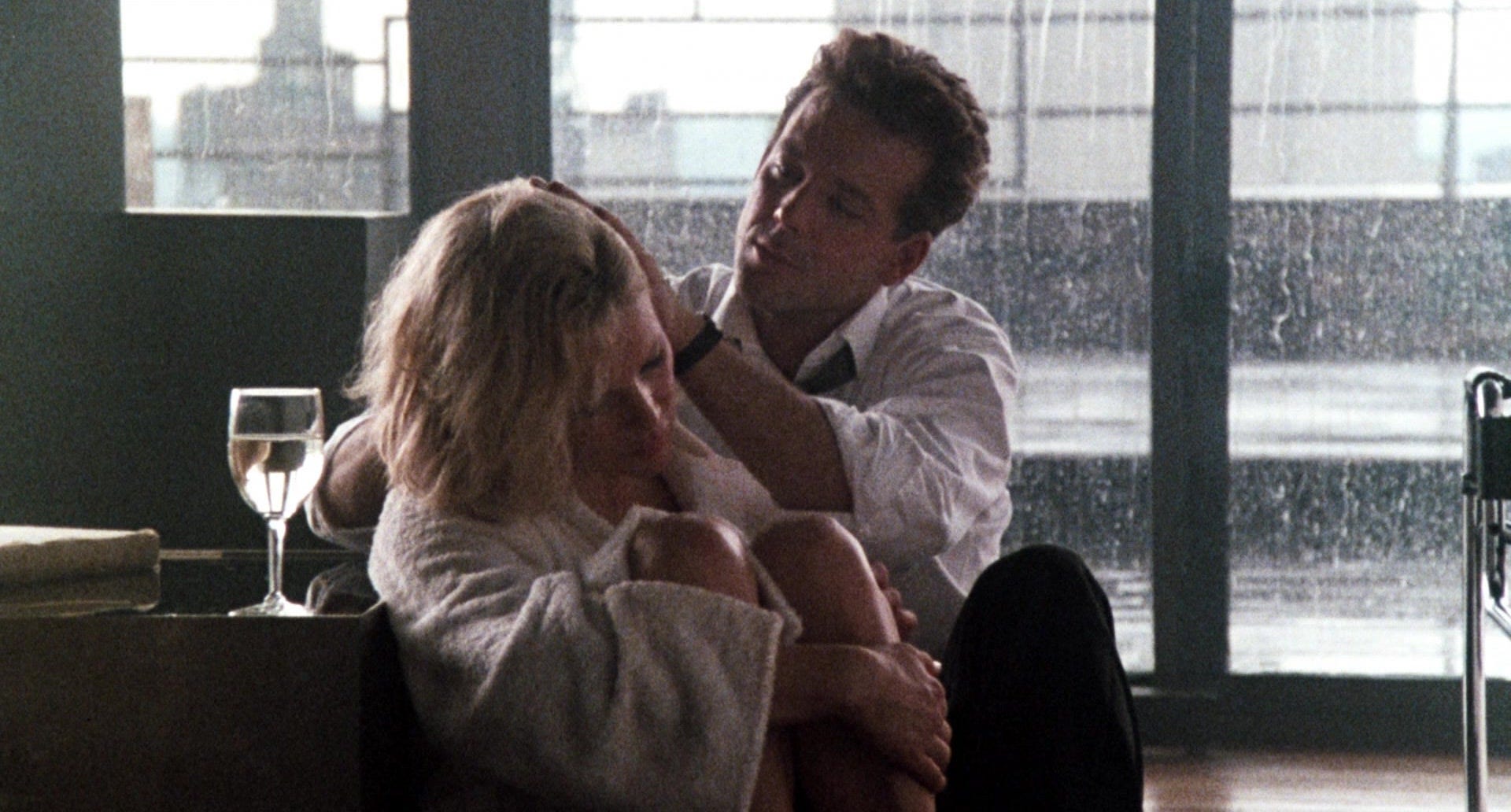
There were two doors Adrian Lyne could’ve opened with Nine ½ Weeks, and either might’ve revealed a story, perhaps even a compelling one. Door #1 would’ve been to fashion Elizabeth McNeill in the guise that author Elizabeth McNeill was presented to readers: a corporate executive, ten years removed from college, someone whose professional success has left her empty and susceptible to surrendering control to a dominant man, even in ways that become harmful. Given the strong sexual content, it’s unlikely a boss leading lady like Sigourney Weaver or Meryl Streep would’ve been interested if they were even available, which leads to Door #2. That would’ve been to depict Elizabeth as a post-graduate, whose drive to compete with men in the business world has been recently forged. She meets a man whose need to dominate women should repel her, but instead, she finds herself unable to live without him, leading two lives until one of them breaks. There are glimpses of that film in the one Lyne was allowed to make, but Nine ½ Weeks has been sharpened down to a pitiful nub where it matters most. It’s missing too many scenes, some of which were written, others shot.
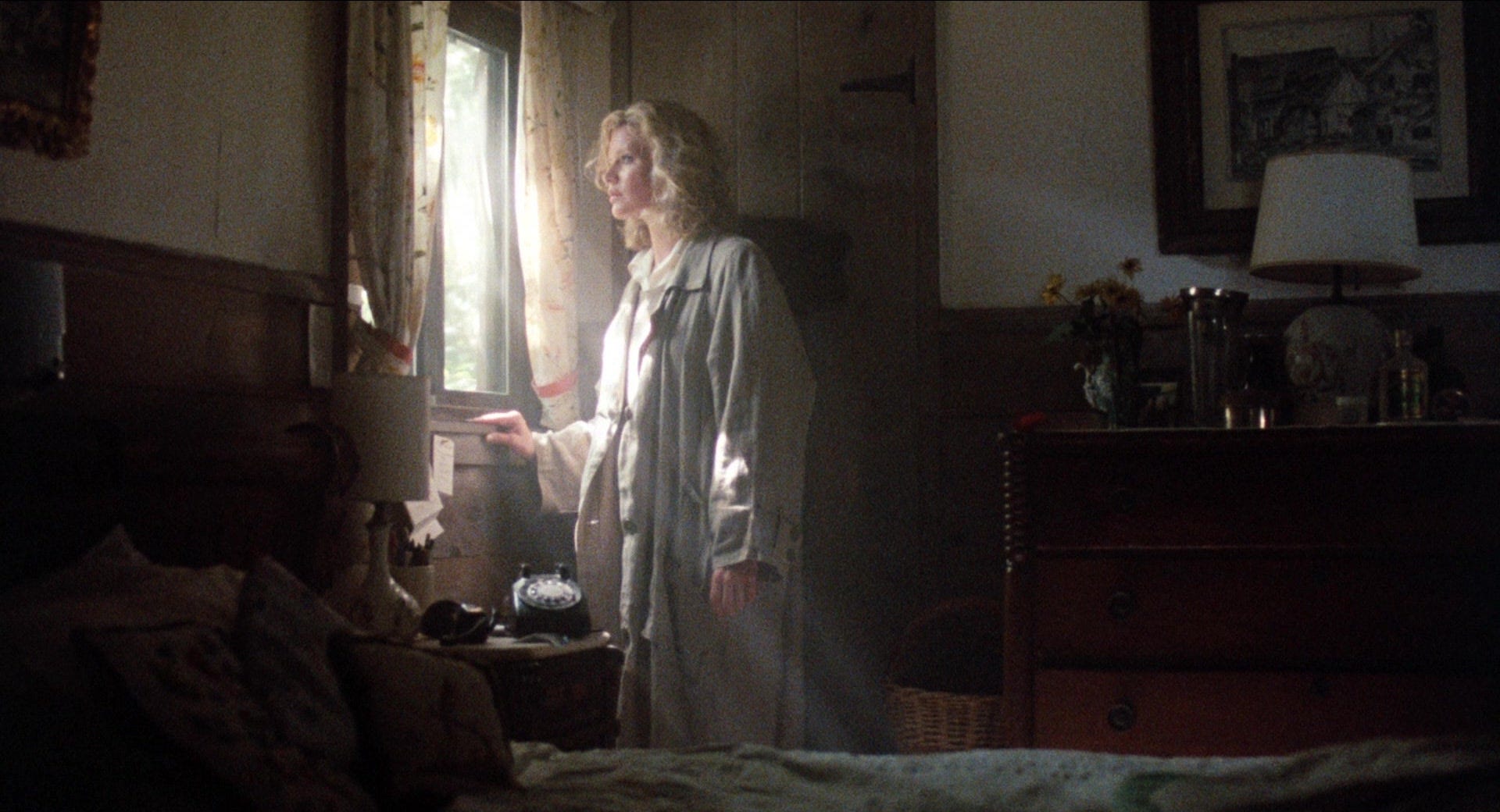
One of those missing scenes needed Elizabeth to introduce John to her friends. Christine Baranski would’ve been good as a condescending mentor, and the end credits reveal that she’s actually in the movie, fifth billed (behind Margaret Whitton and David Marguiles as Elizabeth’s co-worker and boss, respectively). Baranski’s performance has been left almost entirely on the cutting room floor. For a movie about time, the chronology of Elizabeth and John’s relationship is confusing. They go from a casual lunch to holding hands to undressing in front of each other to having sex, as if reels had been loaded backwards. The casting doesn’t really fit the picture Lyne is trying to make. Mickey Rourke is sexually charismatic, but not in the way Zalman King or Lyne seem to think. The danger is your eighteen-year-old daughter staying out late with Mickey Rourke, not your boss. For a man a woman like Elizabeth would take a two and a half hour executive lunch to be thrown around by, Scott Glenn or James Remar would’ve been ideal, the courser, the better. In terms of location scouting and lighting, Nine ½ Weeks does look every bit as dazzling as Flashdance. This was a time in cinema when two other directors whose background was British commercials–Ridley Scott and Tony Scott–were in friendly competition with Lyne as to who could light a set more evocatively.
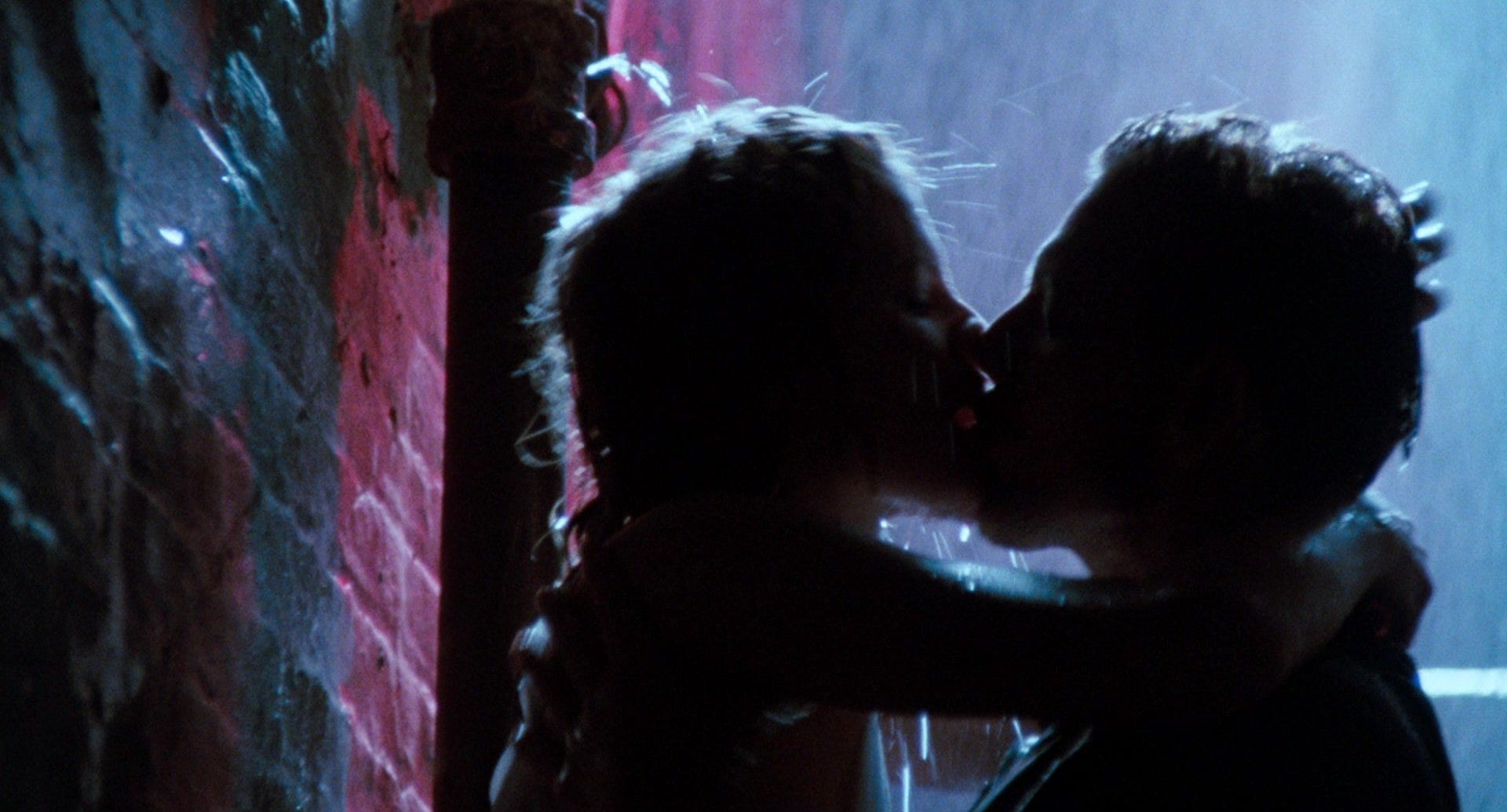
With Blade Runner (1982) and The Hunger (1983) as his visual comps, Nine ½ Weeks has Lyne making a case for having the best eye among his competition. Using Manhattan as a backlot, he has some of the most photogenic alleyways in North America at his disposal, and is determined to portray sexual activity anywhere but a bed. That’s commendable, and the U.S. needed an unapologetically kinky movie in the mid-eighties, but in an effort to cut everything that was distasteful to test audiences, the end product has been reduced to a sizzle reel. Kim Basinger’s goofiness was sporadically put to use in film, mostly in mediocre comedies by veteran directors, like Blind Date (1987), Nadine (1987) and My Stepmother Is An Alien (1988). Her performance in Nine ½ Weeks has been shrunken to a plastic doll, like Loni Anderson’s character on the sitcom WKRP In Cincinnati without any one-liners. We don’t learn Elizabeth is divorced until nearly 90 minutes into the film, when her co-worker reveals she slept with her ex-husband and the sad bastard shows up at Elizabeth’s office. Half of the curated soundtrack is terrific–”This City Never Sleeps” by The Eurythmics and “Slave To Love” by Bryan Ferry drip with modern desire and seem like they were written for the film–while the track played over the opening credits–”The Best Is Yet To Come” by Luba–frame the movie as a plucky urban female empowerment comedy, as if someone thought the music would prevent walkouts in the first ten minutes.
Video rental category: Drama
Special interest: Fatal Attraction