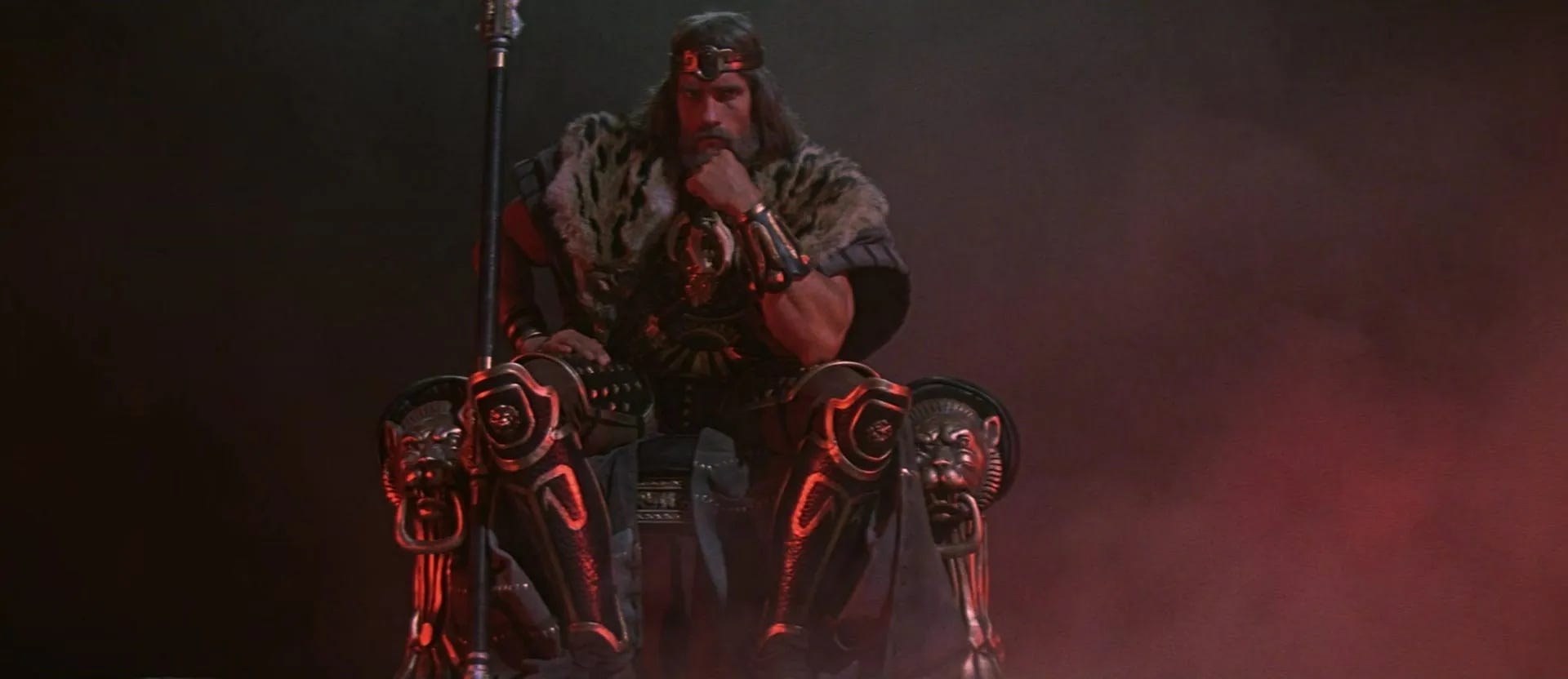
Conan the Barbarian (1982): Part 2 of 2
The Atlantean Way, Made In Spain, Scores Are In

In recognition of one of nature’s most dazzling spells–unveiling hours more light a day–Video Days celebrates March with five sword and sorcery films from another time.
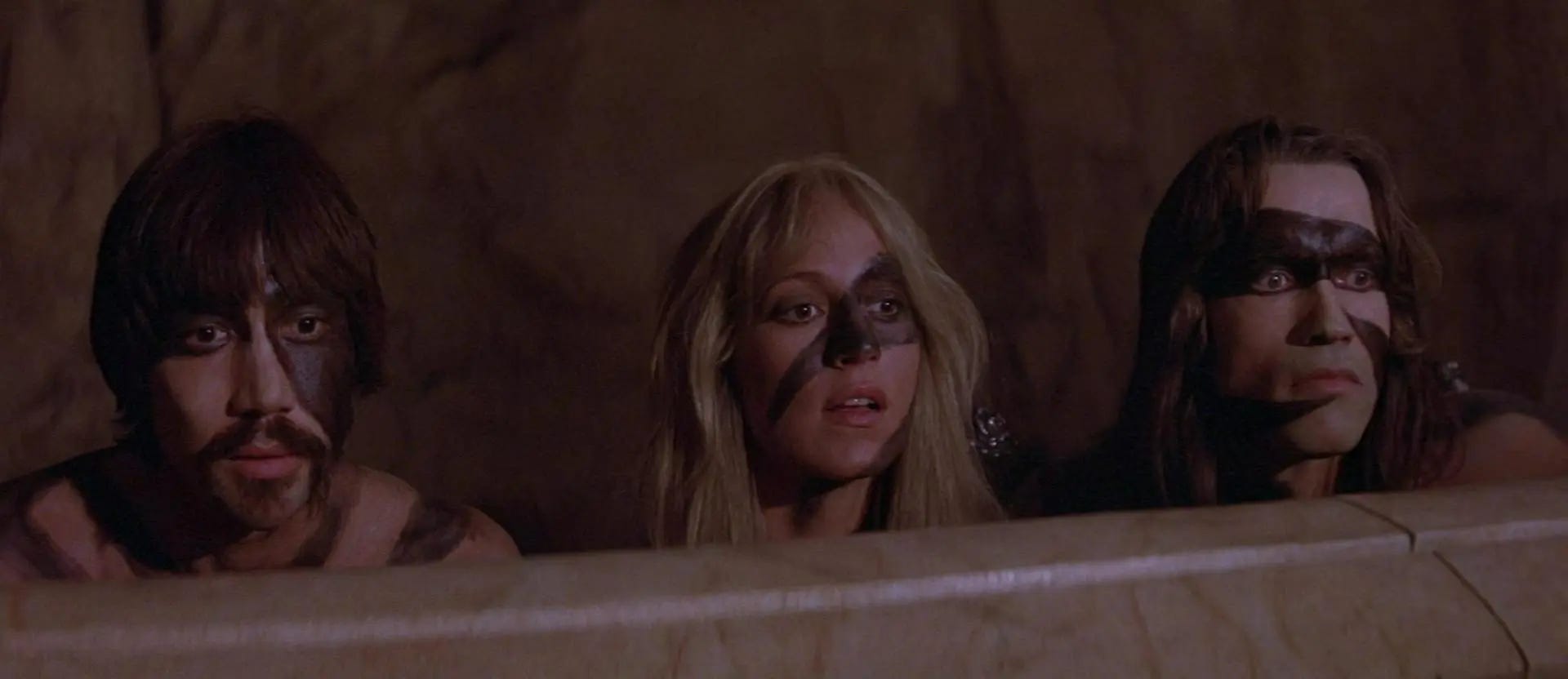
Cartoonist, conceptual artist and production designer Ron Cobb, who’d created practically everything industrial in Alien (1979) from spacecraft to astronaut helmets to company insignia, had been added to the payroll of Conan the Barbarian, sitting in on pre-production meetings and contributing tentative artwork for the weapons, wardrobe and buildings of the Hyborian Age. Cobb was available because he was actually waiting on director John Milius to return from Europe and start working with him on Half the Sky, but as Milius began to incorporate elements of his mountain man script into Conan, agreed with executive produce Dino De Laurentiis to tackle Robert E. Howard’s pulp hero next. Cobb came aboard as production designer. In the 2000 making-of documentary, he stated, “I loved the idea of inventing an architectural style you couldn’t quite identify. That was one of the things I wanted to do. You know, kind of design the snake cult so all the artifacts looked like they fit together, sort of like corporate logos and things like that.” (Cobb also appears as the Black Lotus Street Peddler who only ends up feeding Conan and Sabotai information).
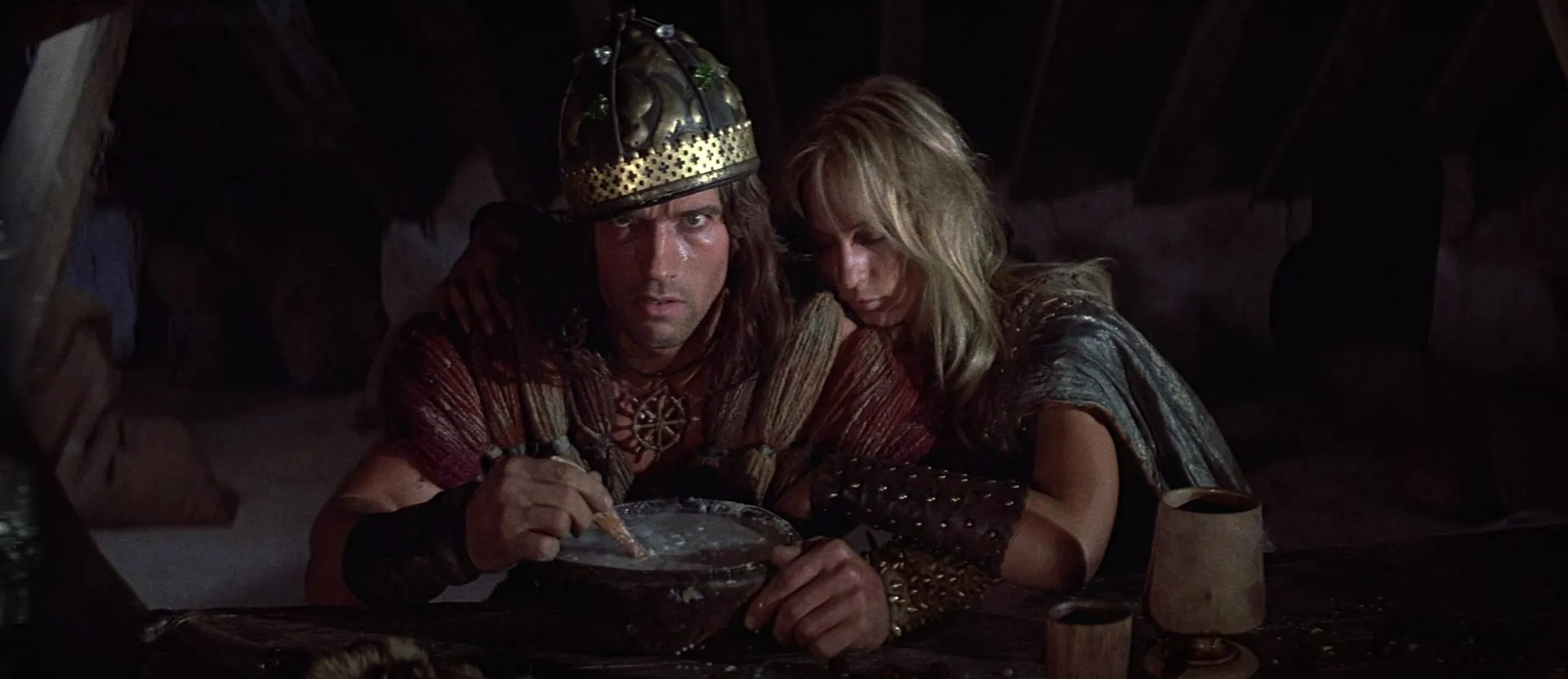
To complement Arnold Schwarzenegger, Milius cast several athletes the filmmaker felt he could coach decent performances out of, as opposed to actors who might struggle with the physical acting requirements. Milius was awestruck by a dancer named Sandahl Bergman in Bob Fosse’s musical All That Jazz (1979), exclaiming that she was a real Valkyrie. He cast her as Valeria. After handicapping most of the actors being considered for Subotai against his friend, surfing legend Gerry Lopez, Milius simply cast Lopez as the archer (Lopez would ultimately be dubbed by Japanese actor Sab Shimono). To play Thulsa Doom’s henchmen, Rexor and Thorgrim, Ben Davidson, a 6’8” retired NFL defensive end, and Sven Ole Thorsen, 6’5”, a Danish bodybuilder Schwarzenegger had trained with, were cast. The voice of Darth Vader, James Earl Jones, was cast as Thulsa Doom, and Mako as the Wizard. To mitigate Schwarzenegger’s thick accent, the decision was made for Mako to narrate Conan’s tale rather than the Austrian Oak himself. Sterling Hayden had agreed to take the small role of King Osric, who dispatches Conan, Valeria and Sabotai on their quest to rescue his daughter from Thulsa Doom, but the actor’s health led De Laurentiis to engage Max Van Sydow, who’d played Ming the Merciless for the producer in Flash Gordon (1980).
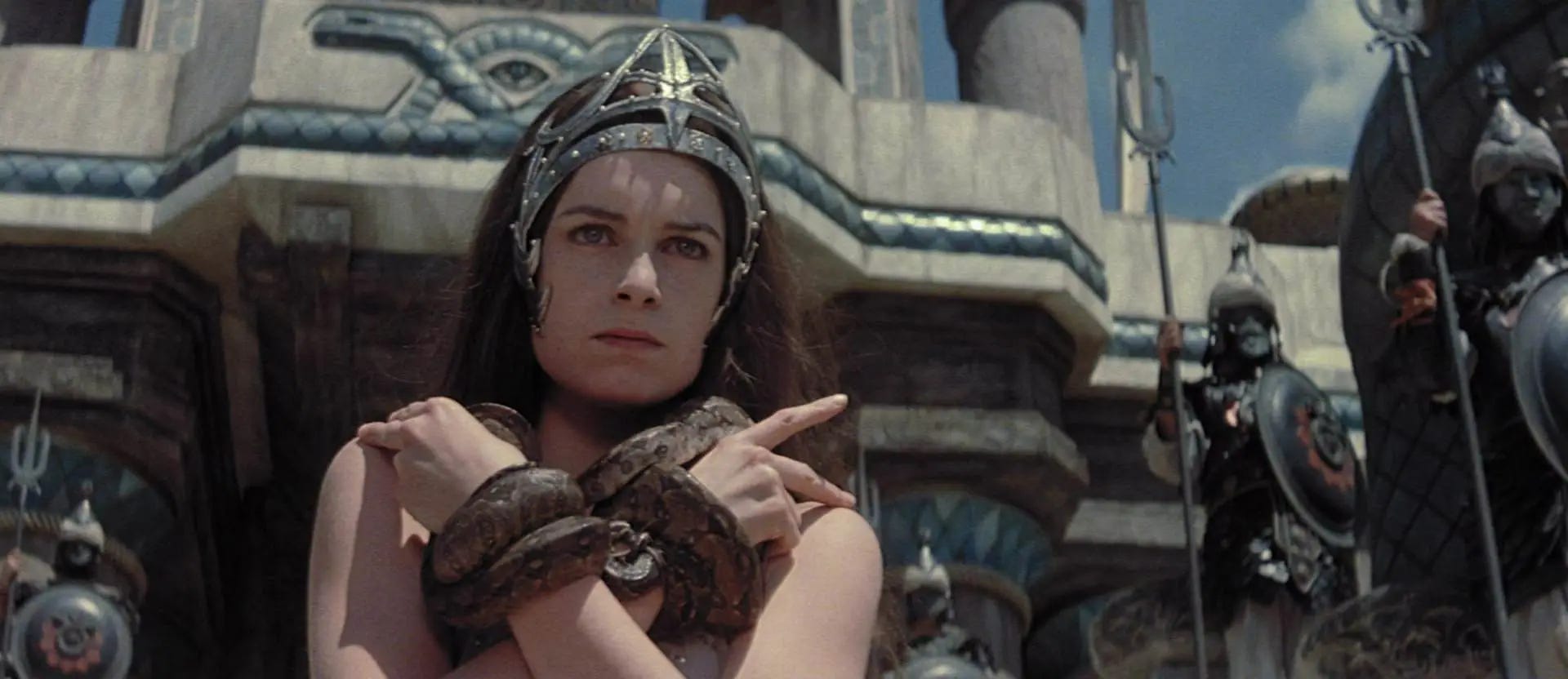
In Los Angeles, Arnold Schwarzenegger and Sandahl Bergman underwent months of training. They often spent mornings working with stunt coordinator Terry Leonard, Harrison Ford’s second double in Raiders of the Lost Ark (1981) who’d been dragged under a moving chassis for the film’s truck chase. After horseback riding and martial arts training with Leonard, the actors hit the gym by noon, including sessions with Kiyoshi Yamazaki, who instructed them in swordplay (Yamazaki also appears as the Sword Master in the film). In contrast to Sam J. Jones in Flash Gordon or Klinton Spilsbury in The Legend of the Lone Ranger (1981), who came to work so ill-prepared to carry a major motion picture that their voices were dubbed in post-production, Schwarzenegger trained with a vocal coach throughout production. Prior to filming the climactic Battle of the Mounds, Milius presented the actor with a half-page of dialogue he’d just written between Conan and Subotai. Confiding to Milius that he was struggling with his delivery, it was suggested he visit James Earl Jones in his trailer. Agreeing to help, the stage veteran asked Schwarzenegger to recite his lines. He then recommended two alternate copies be typed up for him and studied: one copy with the lines spaced in staccato fashion all the way down the length of the page, another with the lines spread sideways along the width. Learning his dialogue with unconventional line breaks had helped Jones ease into a less programmed rhythm and it worked for Schwarzenegger.
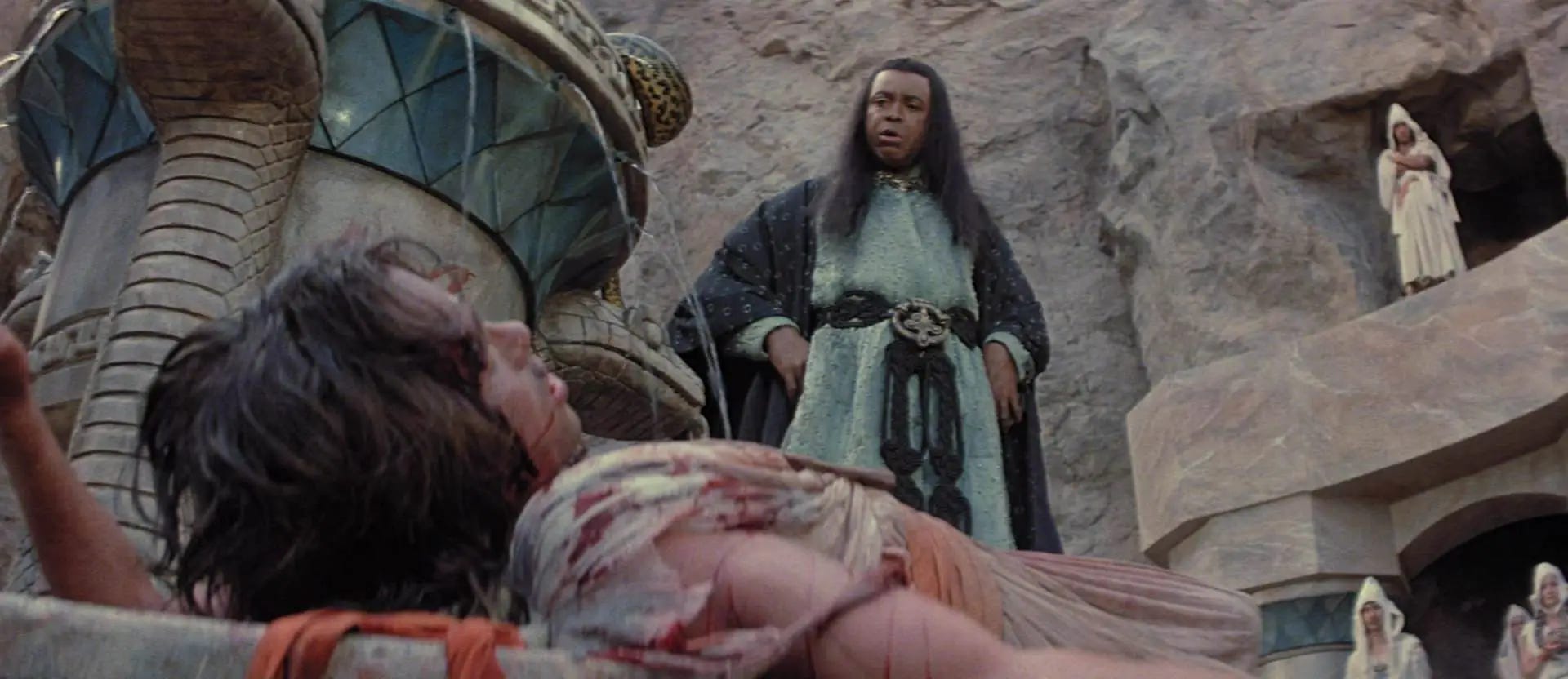
Raffaella De Laurentiis and Buzz Feitshans spent three to four months preparing to make Conan in Yugoslavia, setting summer 1981 as their release window. The political instability that swept through Belgrade following the death of strongman Josip Tito in May 1980 forced the producers to find an alternative. According to Arnold Schwarzenegger in his autobiography Total Recall, filming the picture in Italy would’ve cost $32 million, the rocky desert outside Las Vegas even more and a soundstage in Hollywood even more. Production relocated to Spain, where De Laurentiis had produced several pictures dating back to Solomon and Sheba (1959), and John Milius had used the province of Almería to stage the desert sequences for The Wind and the Lion (1975). In October 1980, it was announced that Conan the Barbarian would begin shooting in the Kingdom of Spain in January 1981 with a production budget of $22 million. The release was pushed back to December 1981. Cast and crew were housed in a hotel in central Madrid, which also served as a production hub. In temperatures of 0°F, the attack on Conan’s village was shot in the mountains near the town of Valsaín, in the province of Segovia (where Milius enthused was where the bridge in Ernest Hemingway’s For Whom the Bell Tolls was dynamited). The lair of the Witch (Cassandra Gaviola) was shot in the natural rock formations outside La Ciudad Encantada. The ancient city of “Zamora” was filmed at Fuerte El Condor (or El Condor), a large Western-style film set erected in the 1960s in the Tabernas Desert, where Schwarzenegger and Lopez were also filmed running. Thulsa Doom’s “Mountain of Power” was built in the desert terrain of El Peñon de Bernal, in the Tabernas Desert near Vicar. Many of the interiors were filmed on sets constructed at Madrid 70 Studios, a film facility in Fuenlabrada.
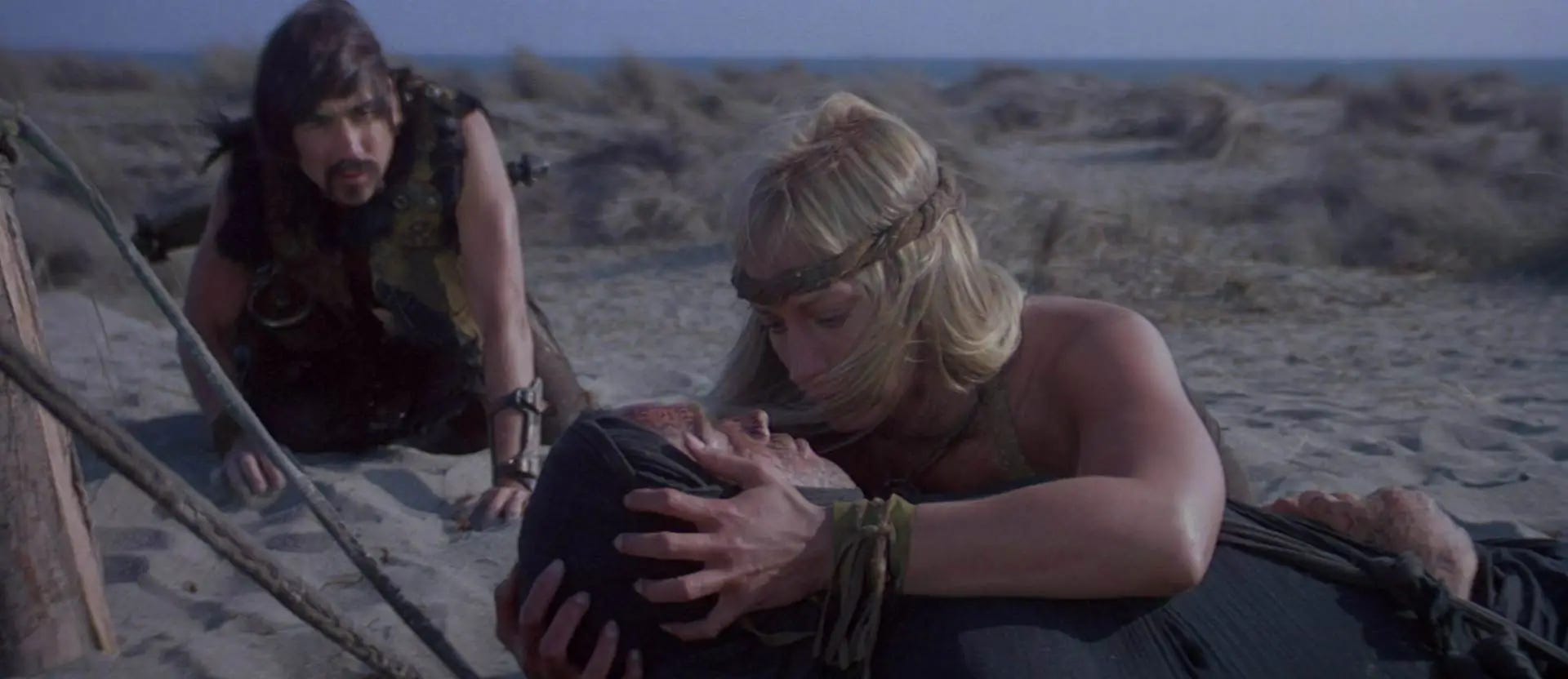
Universal Pictures chose cost and quality and appeared willing to sacrifice speed, granting John Milius more time to work on the film and moving the release of Conan the Barbarian back to summer 1982. This allowed an independently financed sword and sorcery film on nobody’s radar starring Lee Horsley, Simon MacCorkindale and Richard Lynch titled The Sword and the Sorcerer to sneak into theaters first, on April 23, 1982. Working with cost and speed and sacrificing quality, with much dialogue exchanged on cheap sets, the Group 1 release held a spot among the top ten grossing films in the U.S. for nine weekends, a hit. According to Schwarzenegger, the first test screening of Conan took place in Houston just after Valentine’s Day. On a scale of 1 to 100, the audience scored it an extraordinary 93. Universal wanted to know immediately if this was a fluke or they had a hit on their hands, arranging another screening the following night in Las Vegas and inviting Arnold to attend. His autobiography recounted, “Driving past the cineplex the next afternoon, we could see this was no ordinary screening. A line stretched around the block, and besides the comic book fans that Universal had expected, there were bodybuilders with tight shirts and bulging muscles, gays, freaks with weird hair and glasses, people wearing Conan outfits. There were some women but the crowd seemed to be mostly men, including a major contingent of bikers in full leather. Some of these guys looked ready to riot if they didn’t get in. Universal simply kept opening auditoriums, until everybody was seated–it took three to accommodate them all.” The Las Vegas test audience scored the movie the same as Houston had: 93.
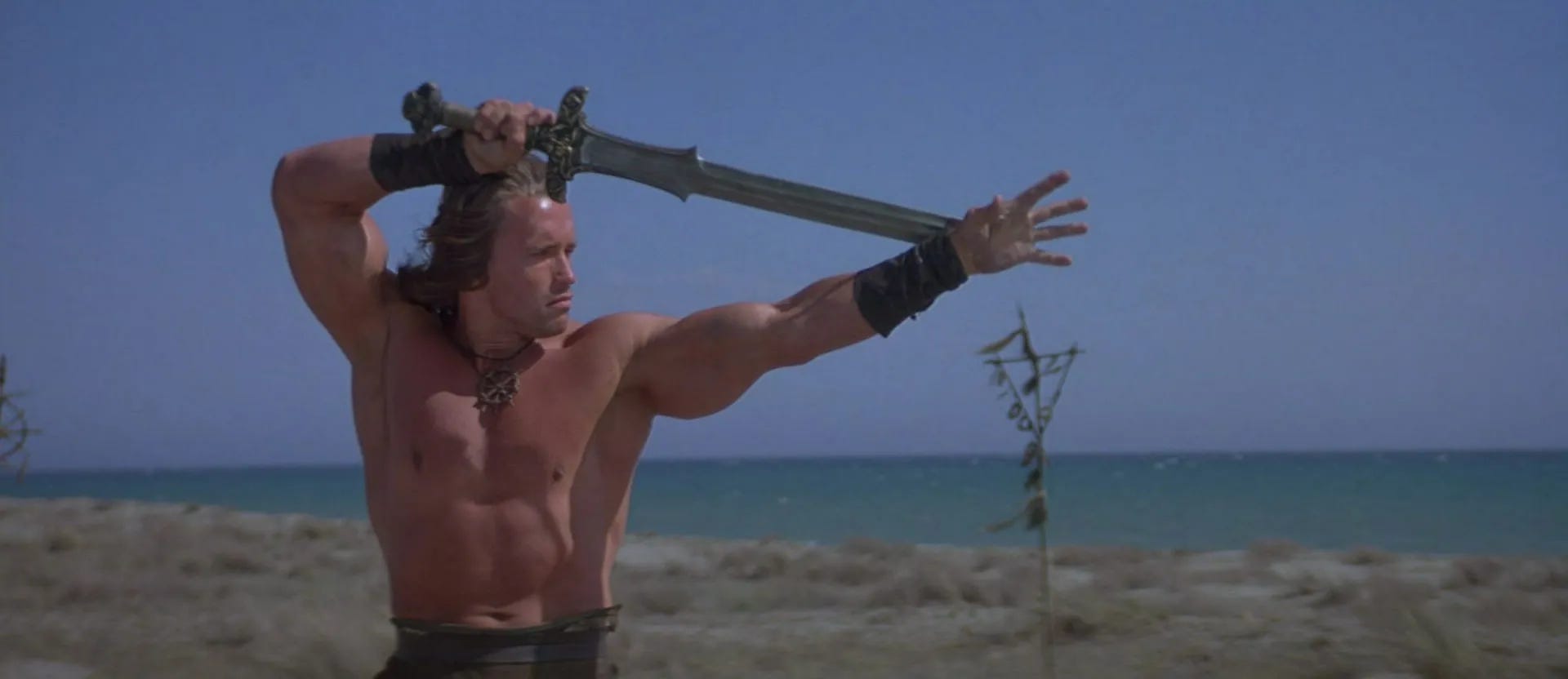
Conan the Barbarian opened May 14, 1982 in 1,395 theaters in the U.S. At that time, this was a huge release, and no other movie except E.T. The Extra Terrestrial (also from Universal) would reach more venues that year than Conan at its peak: 1,683. Perhaps as surprising as the test scores, newspaper critics leaned positive. Gene Siskel opened his review in the Chicago Tribune by mentioning George C. Scott and the actor’s commitment to the joy of acting. “ … there is the same joy in the performance of muscleman turned actor Arnold Schwarzenegger in his role as Conan the Barbarian, an avenging angel type who’s tall, swings a big sword and trusts no one. And it is Schwarzenegger’s good humor about his imposing looks and his Austrian accent that make his Conan characterization and the movie itself so much fun.” Siskel rated the film 3 stars out of 4. Writing in the Chicago Sun-Times, Roger Ebert added, “The movie’s casting is ideal. Arnold Schwarzenegger is inevitably cast as Conan, and Sandahl Bergman as Valeria. Physically, they look like artists’ conceptions of themselves. What’s nice is that they also create entertaining versions of their characters; they, and the movie, are not without humor and a certain quiet slyness that is never allowed to get out of hand. Schwarzenegger’s slight Teutonic accent is actually even an advantage, since Conan lived, of course, in the eons before American accents. The movie is a triumph of production design, set decoration, special effects and makeup. At a time when most of the big box-office winners display state-of-the-art technology, Conan ranks right up there with the best.” Ebert also graded the film 3 stars out of 4.
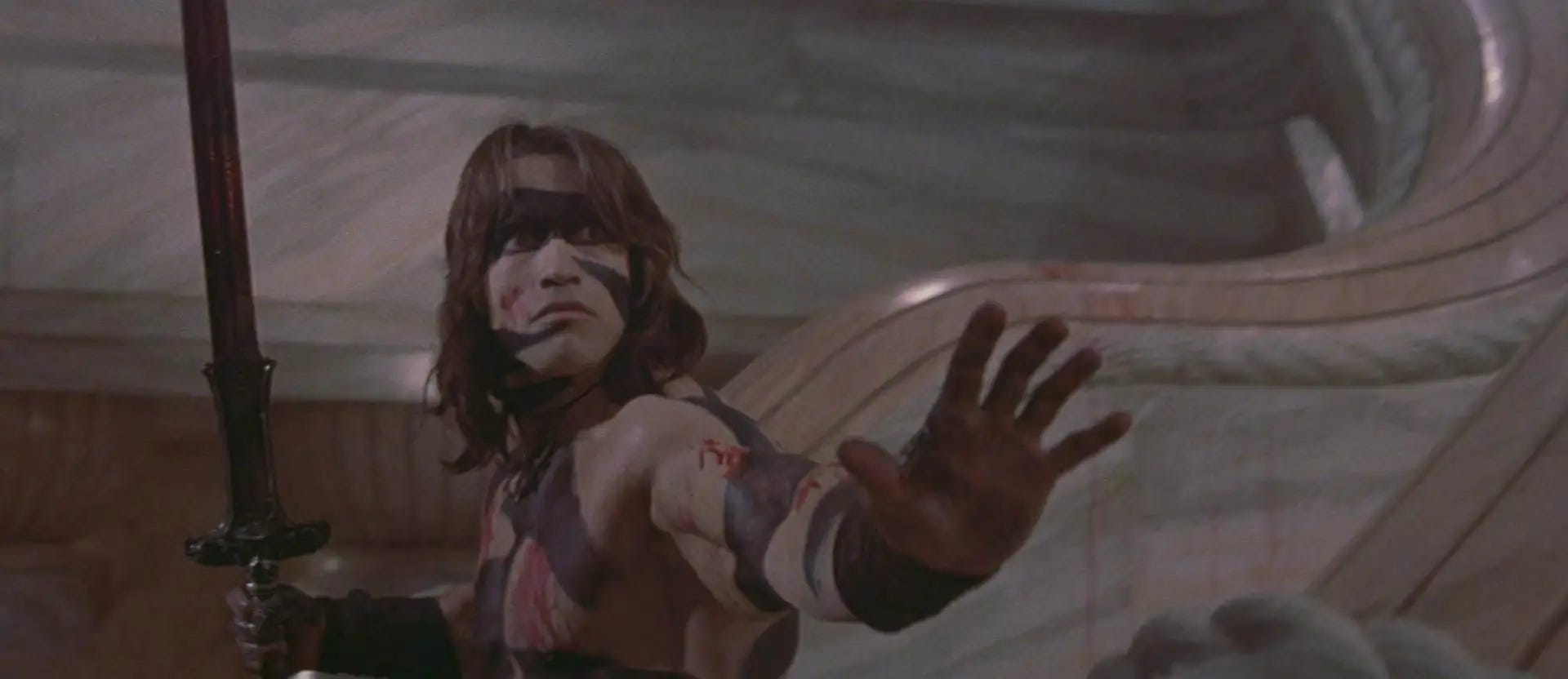
F.X. Feeney wrote in LA Weekly, “Great stuff, but also depressingly familiar stuff. Nevertheless Arnold Schwarzenegger proves himself a capable actor, combining his innate gentility with Conan’s brute directness to good effect. He gives credibility to the film’s humor. John Milius–especially in the film’s first, and best hour–directs with force and intelligence. Ron Cobb’s sets are wonderful throughout.” Conan the Barbarian opened #1 and held a spot among the top ten grossing films in the U.S. for five weekends, audiences pouring into theaters for the first of several contests between Schwarzenegger and Sylvester Stallone at the box office, with Rocky III opening #1 over Memorial Day weekend. Oliver Stone–who since turning in his script for Conan had written and directed The Hand, Ed Pressman producing the critically panned psychological horror film starring Michael Caine–did not look back on the picture or its legacy fondly, perhaps still directing it in his head. “God, it breaks my heart that Dino ended the series. He was so stupid and so short-sighted! Making the first one with Milius was bad enough, but it got by and made a little bit of money: you know, it wasn’t derided. It was silly, I thought, the way he made James Earl Jones look–it was terrible. I didn’t buy it–and there was a lot of hokey shit, especially the snake thing. And the second movie was so bad! [Conan the Destroyer, screenplay by Stanley Mann, story by Roy Thomas & Gerry Conway, produced by Raffaella De Laurentiis, directed by Richard Fleischer]. That ended the series, right there! Of course, the whole thing went into turnaround, and the other movies never got made. It was all lost due to Dino De Laurentiis. No question about it. It could’ve survived anything but him, and I’m sorry we lost it.”
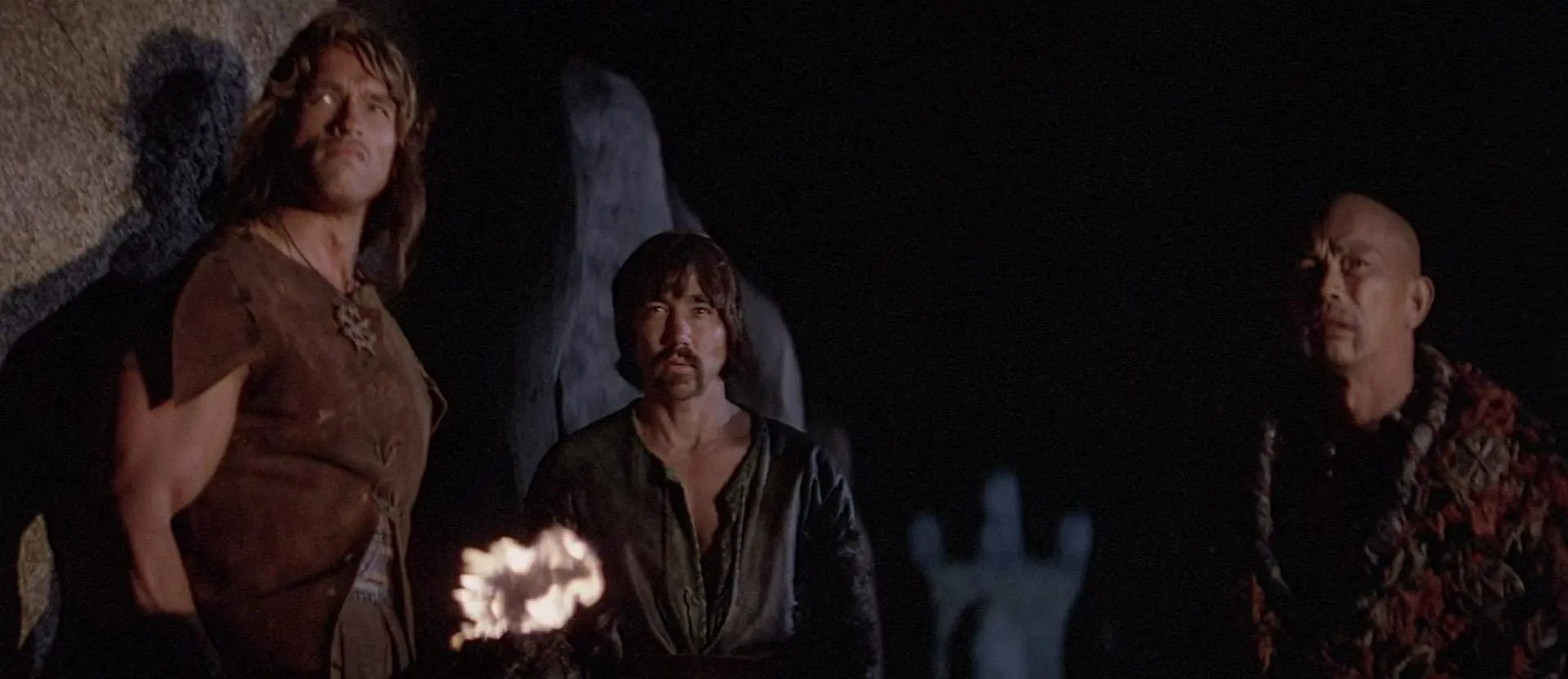
It’s difficult to put into words how much fun it was to discover Arnold Schwarzenegger on the big screen in the summer of 1982, or in the months following on videocassette. Arnold was like a star built in a lab, a world class athlete whose performing arts background set him apart from other sportsmen who’d gone into movies, from Johnny Weissmuller as Tarzan to Joe Namath as C.C. Ryder and everyone in between. Instead of being hindered by his physique or his accent, Schwarzenegger’s biceps and his voicebox, and his good humor about them, were key in making him a superstar. Edward R. Pressman–credited as an executive producer–deserves most of the credit for not only appraising this Mr. Olympia’s unique mix of dedication and playfulness, but remaining dedicated to seeing those star qualities were served by the right material, rather than exploiting the bodybuilder for a quick buck. When the Witch flings her magic powder into the hearth, or Conan contemplates the horrors Valeria suggests lie inside the Tower of Serpents, Schwarzenegger’s wonder is what sells his portrayal of a medieval warrior and makes the movie around him so enjoyable, not muscles. Before Valeria in Conan the Barbarian, there hadn’t been a dynamic female character in a sword and sorcery film, and there haven’t been many since. Sandahl Bergman’s physicality and spirit are so aligned with Schwarzenegger’s that given the choice between avenging his parents or going on sensual adventures with Valeria, it’s unconvincing Conan would choose the former except that the plot requires it.
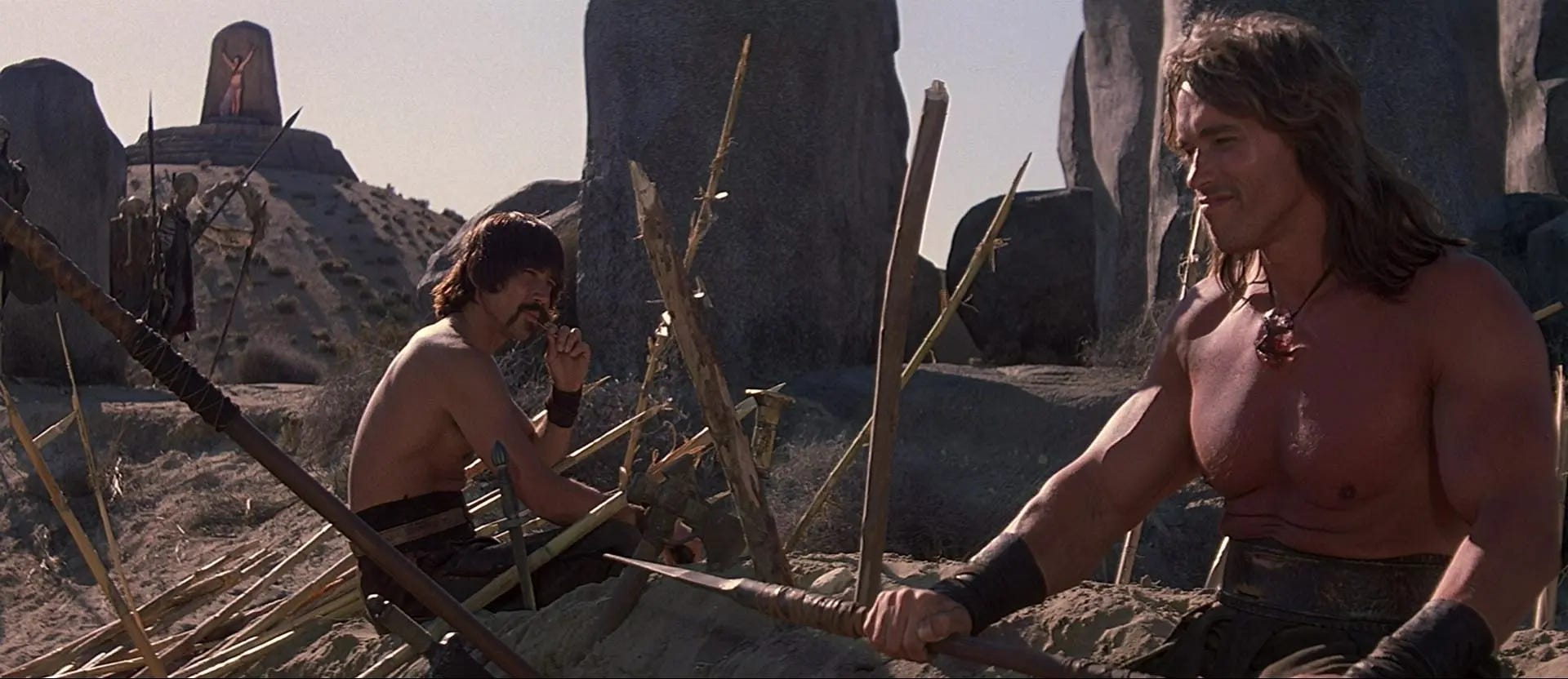
John Milius, who had a choice between serving comic book fans or trusting his sensibilities were in step with a wider audience, chose the latter, the same as Tim Burton did when he accepted the job of directing Batman (1989). Conan the Barbarian is a more exciting film. It builds a fantasy world from scratch, an alternate Eurasian antiquity, somewhere between the lost civilization of Atlantis and the steppes of Mongolia. Filmed entirely in Spain, the production utilizes the country’s diverse ecosystem of mountains, grassland, desert and coast superbly. Like Schwarzenegger, Ron Cobb would’ve had to be invented if he wasn’t available, an immensely talented designer capable of drawing up practical appliances to do unbelievable things, like the Wheel of Pain young Conan is sentenced to like a prehistoric factory job. The non-union Spanish crew and exchange rates in Spain seem to have saved Universal enough nickels to realize the best possible version of a Robert E. Howard story. Thulsa Doom’s Mountain of Power draws more followers than a Grateful Dead concert, while his palace orgy looks like a palace orgy. What Conan is missing here is his Joker. For a sorcerer, Thulsa Doom doesn’t strike fear into our hearts. Milius tries to empower him as a cult leader, but there’s little doubt once Conan hacks his way through Doom’s men the magician will hold his own. The Witch, memorably played by Filipino-American actor Cassandra Gaviola, makes a stronger impact in her two scenes. The ancient world aspects Milius is drawn to are well balanced with the fantasy elements leaking from Oliver Stone’s draft, namely the demons who come for Conan while he’s near death, sparingly depicted and cleverly animated. Along with Schwarzenegger, the film’s biggest star is composer Basil Poledouris, who provided an eccentric musical score both thunderous and forlorn when elevating the emotional content of the piece.
Video rental category: Fantasy
Special interest: Sword and Sorcery