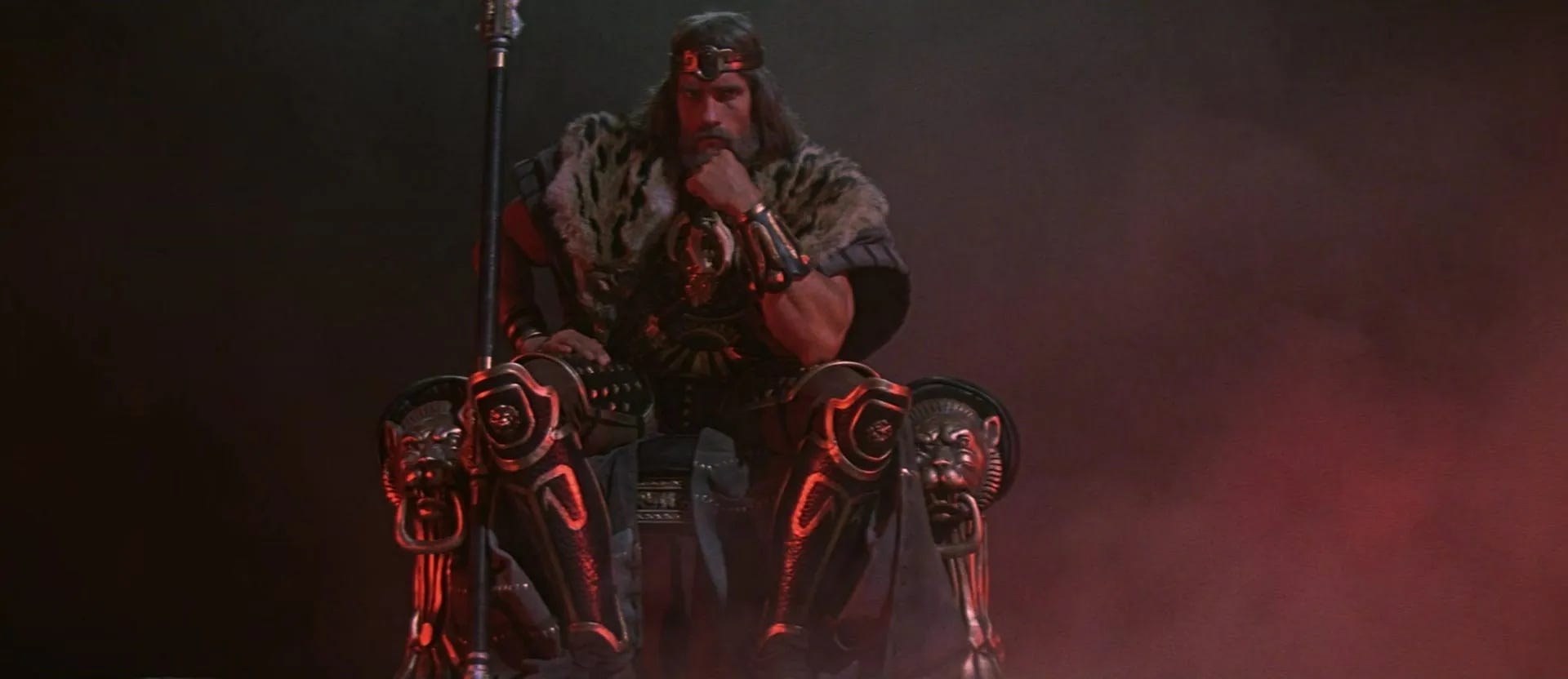

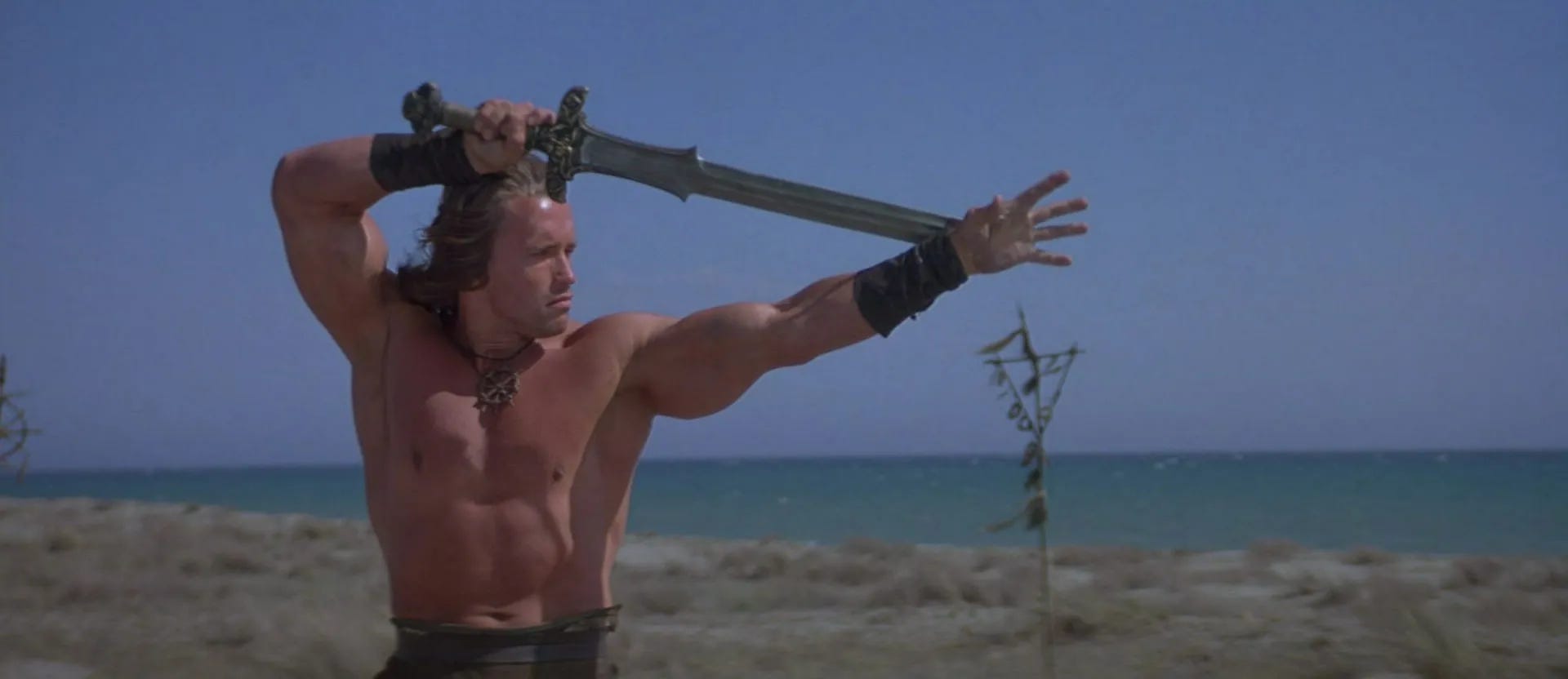
CONAN THE BARBARIAN (1982) was the opening act in a summer movie festival that in 1982 included a dozen future classics: Mad Max 2 (released as The Road Warrior on May 21 in the U.S. and Canada), Rocky III, Poltergeist, Star Trek II, E.T., Blade Runner, The Thing, The Secret of N.I.M.H., Tron, Fast Times at Ridgemont High, and An Officer and a Gentleman. Where Conan falls on that list might depend on the viewer’s awareness of the Marvel Comics line or the pulp fiction by Robert E. Howard it was adapted from, but as a fusion of sight and sound, it enthralls for much of its running time, building a world from the ground up and announcing the arrival of a major film star, perhaps the biggest in terms of musculature ever.
Robert E. Howard was born in Peaster, Texas, in 1906. An only child, his father was a traveling physician. Howard’s mother, Hester Jane Ervin Howard, the emotional center of his life, struggled with tuberculosis. Howard grew up in the oil boomtowns of the Texas Panhandle, eventually settling in Cross Plains, roughly 160 miles northwest of Austin. His mother’s love of poetry, Howard’s interest in boxing, and the hardscrabble environment of West Texas shaped his fiction, which combined fantasy, ancient settings, and heroes of formidable strength. To meet the demands of the pulp market, Howard wrote quickly. He became a defining contributor to Weird Tales during the Great Depression and also published in Argosy, Action Stories, Oriental Stories, and Sports Story Magazine. This led to a fruitful correspondence with author H.P. Lovecraft, with whom Howard often debated culture and history. Many credit Howard with founding the “sword and sorcery” genre. His characters included Solomon Kane, an English Puritan who battled witches and vampires; Red Sonya of Rogatino, a Polish-Ukrainian fighter who faced the Ottoman Turks during the Siege of Vienna in 1529; and Conan the Cimmerian, a warrior of the prehistoric Hyborian Age—a mythic era Howard placed after the fall of Atlantis and before recorded history.
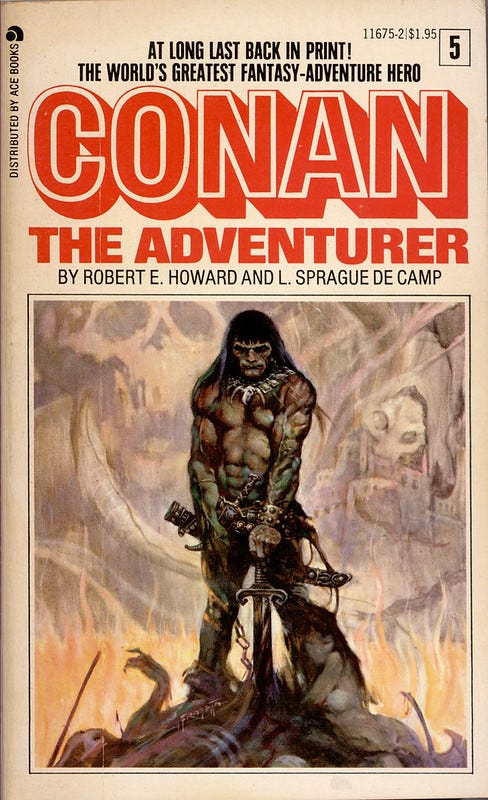
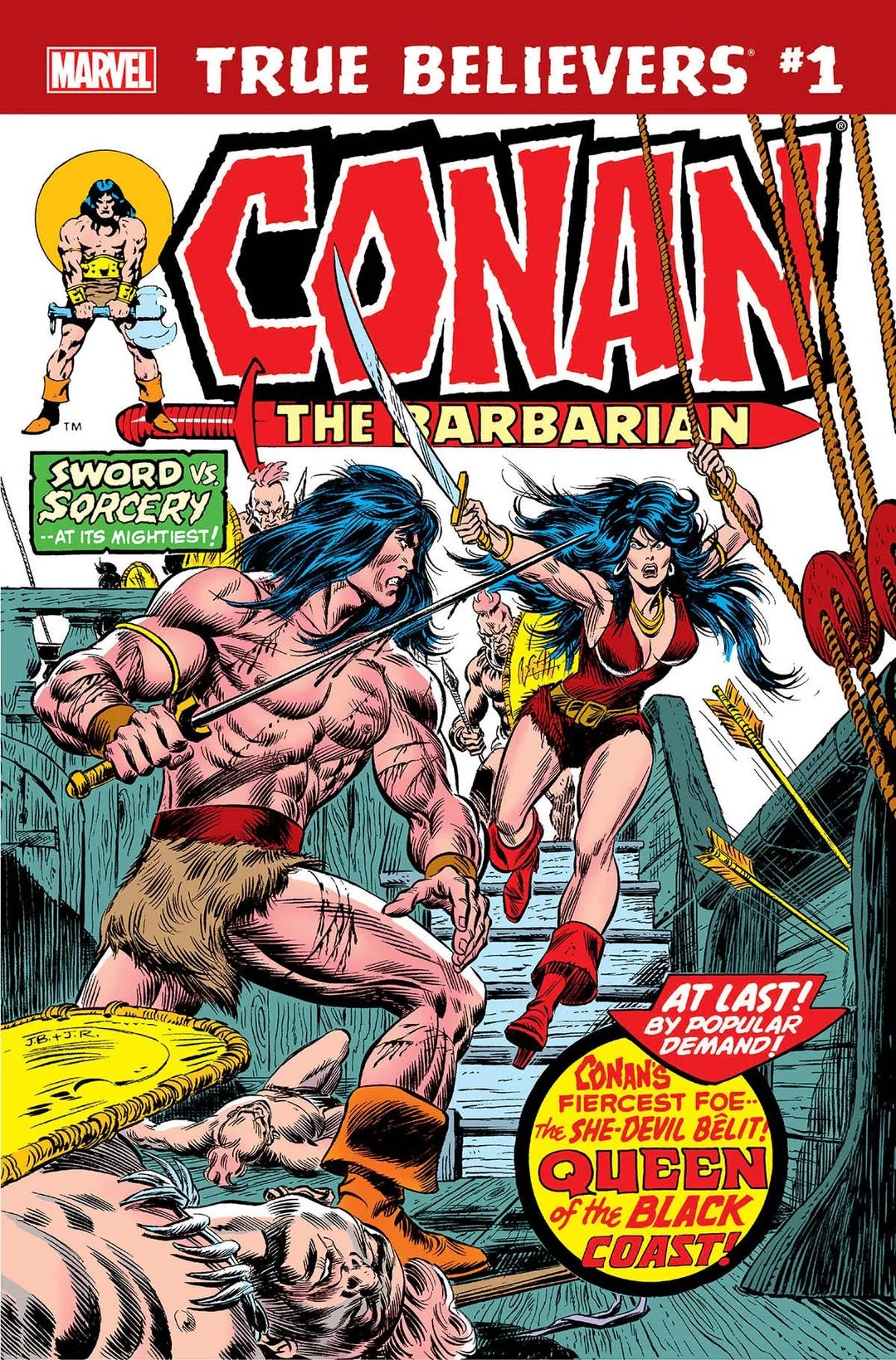
Despite his publishing success, Howard struggled with his share of inner turmoil, including an intense attachment to his ailing mother. In 1936, she slipped into her final coma, and hours before her death, Howard shot himself in the head with a revolver. He died at the age of 30. Howard’s work might have faded into obscurity if not for Lancer Books, which in 1966 published Conan the Adventurer, a collection of tales centering on the warrior, with larger-than-life cover art by Frank Frazetta that would define Conan’s look. The success of Lancer’s paperbacks led Stan Lee, seeking a popular literary character to launch a new comic line, to select Conan. With Marvel Comics associate editor Roy Thomas overseeing the writing of mostly new stories, Conan the Barbarian was one of the best selling books the publisher of The Fantastic Four, The Amazing Spider-Man and The Incredible Hulk ever printed, running for 275 issues from 1970 to 1993, captivating a new generation of fans.
Edward R. Pressman was in his early thirties and had already produced two pictures for writer/ director Brian DePalma–Sisters (1973) and Phantom of the Paradise (1974)--and in an executive producer capacity, raised financing for Badlands (1973), the acclaimed directorial debut of screenwriter Terrence Malick, which Martin Sheen and Sissy Spacek starred. In 1976, Pressman was invited to a screening of a new documentary titled Pumping Iron. The film chronicled the 1975 Mr. Olympia bodybuilding competition, in which Brooklyn’s Lou Ferrigno competed for the title against Arnold Schwarzenegger, the so-called “Austrian Oak.” The documentary helped launch personal fitness in the U.S. and introduced Schwarzenegger to a global audience. In spite of his name, accent and background, the bodybuilder had the amusing notion of launching an acting career. Arnold had been featured prominently as a weightlifter in Stay Hungry (1976), a romantic comedy starring Jeff Bridges and Sally Field. As an early demonstration of Schwarzenegger’s finesse with the international press, the Golden Globes awarded him New Star of the Year for his performance.
Pressman had invited a friend to the screening of Pumping Iron named Edward Summer, owner of Supersnipe Comic Art Emporium in Manhattan. Pressman pointed out that there had to be an appropriate film vehicle for a performer with Schwarzenegger’s gifts. In a making-of documentary produced for the 2000 DVD release of Conan the Barbarian, Pressman recalled, “And Ed immediately turned and said, ‘Well, Conan, of course!’ So he took me to his comic book store and showed me the world of Frank Frazetta and the world of Conan, which at that point I was not familiar with. And that started me on a journey–first to get the rights, and at the same time meeting Arnold. Together, we spent close to five years trying to get the film set up.” In 1977, with little more than belief and a stack of comic books, Pressman met with Schwarzenegger in Los Angeles to pitch the actor his vision: not one sword and sorcery film, but a series, a new entry to be produced every two years. Schwarzenegger had never heard of Conan, but the kinetic Frazetta illustrations Pressman showed him hooked his curiosity, while the popularity of the Marvel Comics line may have landed the actor’s attention.
The deal Arnold’s reps negotiated in the fall of 1977 was by far the most financially lucrative Schwarzenegger had ever been offered: five films, $250,000 for the first, $1,000,000 for the second, $2,000,000 for the third and so on, plus 5% of the net profits. The roughly $10 million deal was contingent on all the movies being made, of course, and Schwarzenegger refusing offers to play other Conan-like characters, as he had in his first movie, the silly Hercules In New York (1970). Schwarzenegger booked supporting roles in The Villain (1979) opposite Ann-Margret, and the TV movie The Jayne Mansfield Story (1980) with Loni Anderson, in which Schwarzenegger played Mansfield’s husband, Hungarian bodybuilder Mickey Hargitay. Pressman’s negotiations with Robert E. Howard’s estate for an option on the film rights to Conan dragged on for two years. The producer would ultimately cut the Howard estate a check for $7,500, and surrender at least $100,000 in legal fees. By that time, Pressman had engaged Edward Summer and Roy Thomas to work under the table on a story treatment. Paramount Pictures–then a powerhouse executive regime led by Barry Diller as chairman, Michael Eisner as studio president and Jeffrey Katzenberg as president of production, with Don Simpson and Dawn Steel as junior executives–agreed to put up development costs for Conan.
Paramount’s offer was predicated on Pressman bringing in a top screenwriter to adapt a script. The producer had been impressed by the writing sample from a screenwriter named Oliver Stone titled Platoon that in 1978, nobody wanted to produce. In The Oliver Stone Experience by Matt Zoller Seitz published in 2016, Stone stated, “I’d read and loved all the Conan books, and I loved the comics, and I really had a vision of this thing as a … I guess it was before all the series or franchise stuff became popular, but I’d seen the first Star Wars, so I could see a series of twelve movies! James Bond came to mind. It could have lasted, because it’s a great story! If you follow him, he starts out a nobody, he becomes king in the end, but then he walks away from the kingdom and finds more adventures. In other words, he rises to the top but he walks away, like Siddhartha, and then he becomes something else, becomes Old Conan. So the idea was really a twelve-film series, I guess like what they did later with Star Wars or The Lord of the Rings.” [Referencing an appointment at Paramount with the “murderer’s row” of Diller, Eisner, Katzenberg, Simpson and Steel at the table, Stone, an Army infantry veteran twice wounded in Vietnam, admitted to Seitz, “That was the worst meeting I ever had in the movie business.”]
Stone actually started writing before Schwarzenegger’s deal was closed and shifted gears to tailor Conan for the actor. “I could see him also as a Tarzan figure, more Edgar Rice Burroughs than Robert E. Howard, and that was the way he was drawn by Frank Frazetta. I always thought Frazetta’s Conan was a little overdone, though. There was another fellow I went to who was English, Barry Windsor-Smith. Beautiful, classical renderings, he did the original Conan comics. We got him to do the hero’s drawings in The Hand (1981).” Pressman compared Stone’s 141-page screenplay–simply titled Conan, dated August 1, 1978, based on the stories of Robert E. Howard, with later additions by L. Sprague De Camp and Lin Carter–to Dante’s Inferno. Hell on earth. In the making-of documentary, Stone stated, “I had a lot of mutants, a lot of animals. I was into DNA cloning, all that stuff, a long time ago. It really made sense. I was never able to realize it on film, that vision. I saw armies of forty, fifty thousand mutants coming at each other.” Having already bet on Terrence Malick and Brian DePalma early in their directing careers and ready to put his chips on an unproven leading man in Arnold Schwarzenegger, Pressman was willing to gamble on Oliver Stone, who wanted to direct Conan.
One proposal would have paired Stone with a co-director in Joe Alves, the production designer of Jaws (1975) and art director of Close Encounters of the Third Kind (1977), an expert in visual effects who was also interested in directing. Paramount–perhaps after their meeting with Stone–didn’t go for it. Pressman and Stone began the search for a director who could get Conan made. The producer recalled, “We spent a lot of time talking with different directors. We talked to Alan Parker. We spent a lot of time with Ridley Scott, and I remember being in London and Ridley or one of the directors we hoped would do it turned us down and we were sitting there totally dismayed not knowing what to do next.” Pressman knew that producer Dino De Laurentiis was in town at a hotel within walking distance of their own. Ready to wash their hands of Conan, Pressman and Stone sold the Italian mogul their film rights and screenplay, Paramount reimbursed for their development costs as well. This was possible because De Laurentiis reached an agreement with Ned Tanen, president of Universal Pictures, to finance and distribute Conan. Remarkably, considering the finished film, Tanen appraised Stone’s script as too violent and in need of being toned down, as well as made filmable.
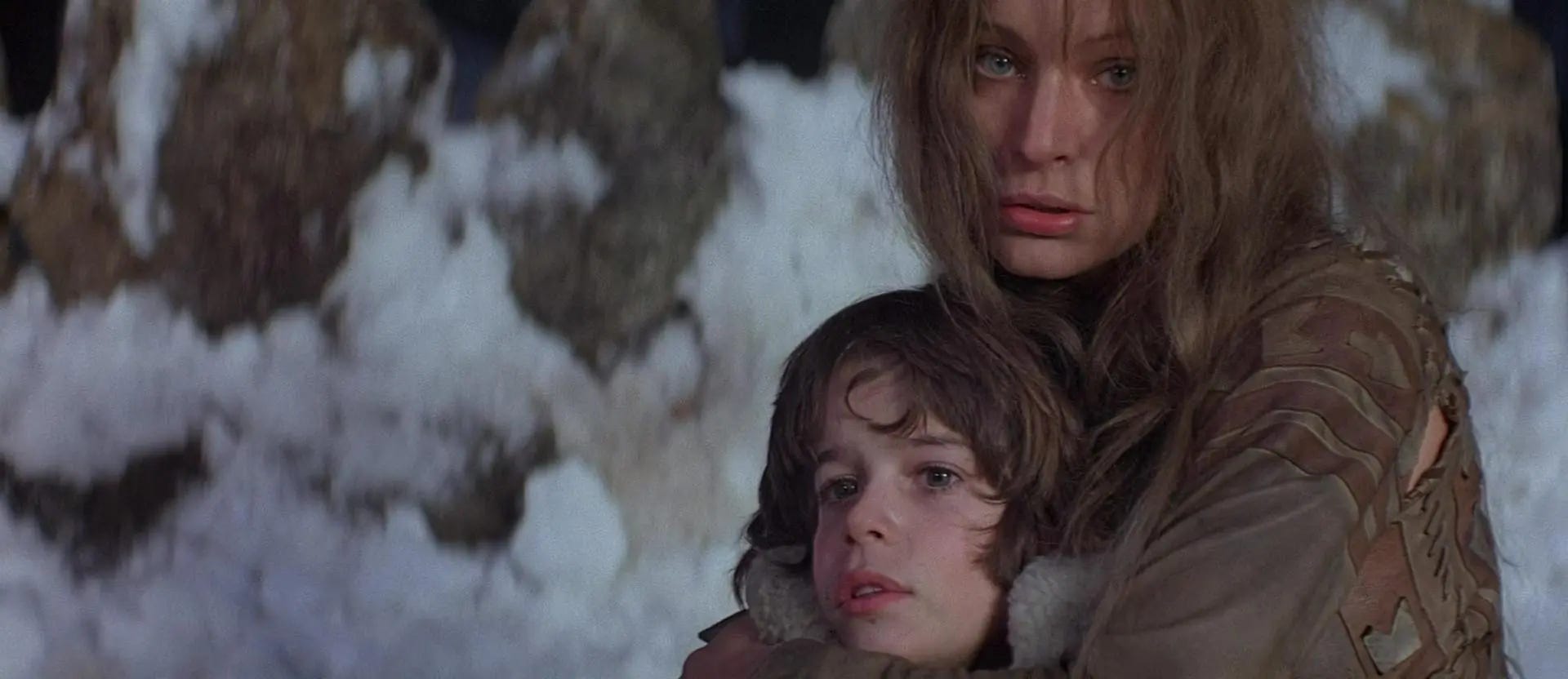
De Laurentiis was working with writer/ director/ military historian John Milius on a project titled Half the Sky about mountain man Jedediah Smith and the American frontier. He believed Milius–a larger-than-life character who’d written the initial drafts of Jeremiah Johnson (1972) and Apocalypse Now (1979)--was the man to rewrite and direct Conan. In the making-of documentary, Milius recalled, “I knew nothing of Conan the Barbarian, or Robert E. Howard or any of the books or the comic books or anything until Oliver Stone came and told me about it. The one thing I knew about, that I was aware of, was Frank Frazetta’s paintings, and of course, I love Viking things, and I’d always wanted to do a Viking movie. And I was a surfer. One of my first names was Viking Man because I had this great big sword. Oliver had already written a script and I read it and it was really inspirational, probably because it was so insane. And then I saw that I could do a movie that I really wanted to do.” Milius spent nine months reading Howard’s pulp fiction and working on his own draft, occasionally submitting material to Stone for approval, but working alone. He salvaged some elements of Stone’s feverish script: Conan surviving the massacre of his village as a boy (the heads of his father and mother impaled on pikes by the raiders), an adult Conan being seduced by a witch, a 25-foot serpent protecting a stone the thief sets out to steal, and Conan being crucified to a solitary tree.
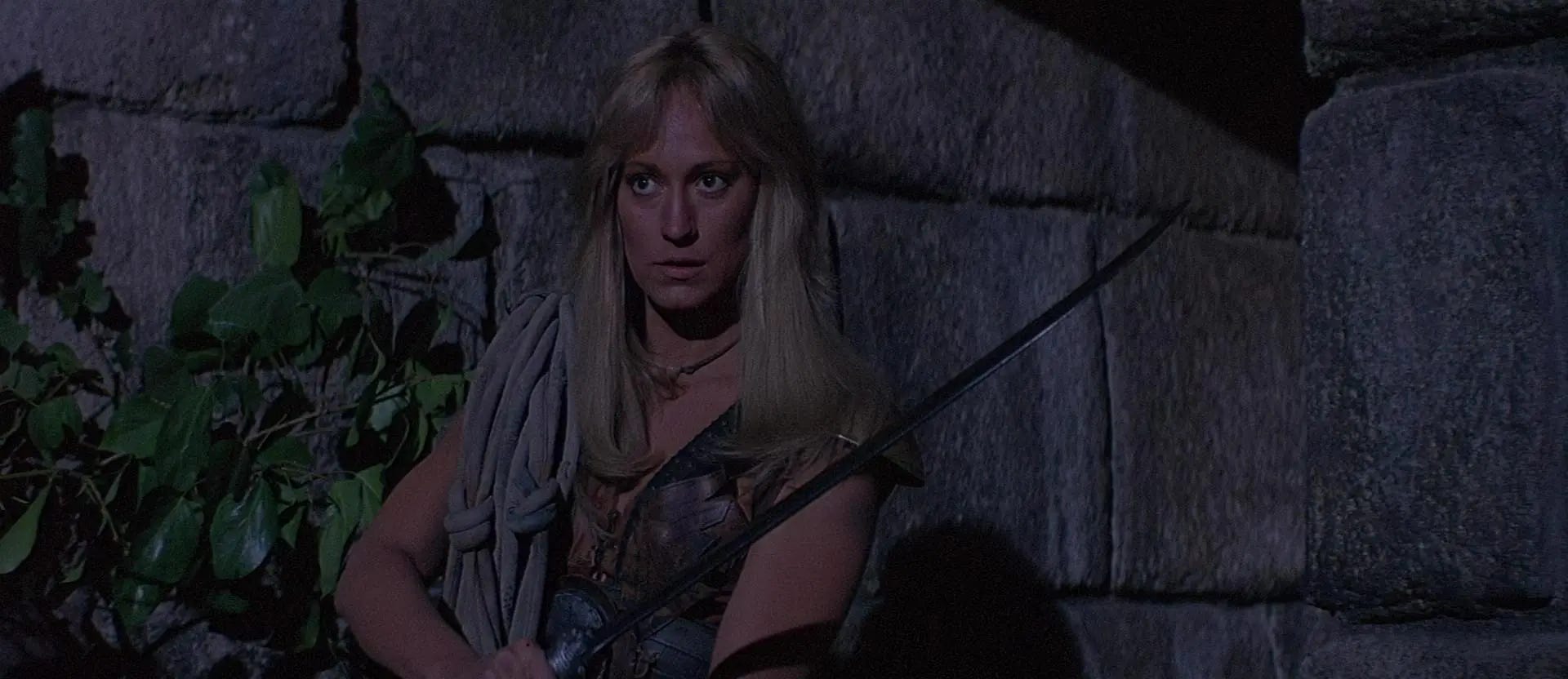
Conan’s partner in crime and lover, Valeria, was also retained. Milius picked a necromancer from Howard’s stories named Thulsa Doom to become Conan’s primary antagonist. He pruned Stone’s mutants from his script, as well as a great deal of fantasy, preferring an action film rooted in an ancient world that felt lived in. Milius’ love of samurai movies, as well as certain philosophies of Friedrich Nietzsche (“That which does not kill us makes us stronger”) filtered their way into his script, which he titled Conan the Barbarian. The WGA would award “written by” credit to John Milius and Oliver Stone, based on the character created by Robert E. Howard. Speaking of the script in 2016, Stone mused, “It ended up bastardized. He had big ideas, Dino: ‘I’m going to do the Bible!’ But Dino was lacking in vision. He fucked up Conan, and he fucked up Year of the Dragon! John had big ideas and a sort of warped vision. Dino had no vision.” The mogul’s daughter, Raffaella De Laurentiis, who’d worked as a production assistant for her father on Hurricane (1979) and was twenty-six years old at the time, was promoted to producer, sharing credit with Buzz Feitshans, who’d line produced the ambitious Big Wednesday (1978) for Milius the director and the massive 1941 (1979) for Milius the producer.
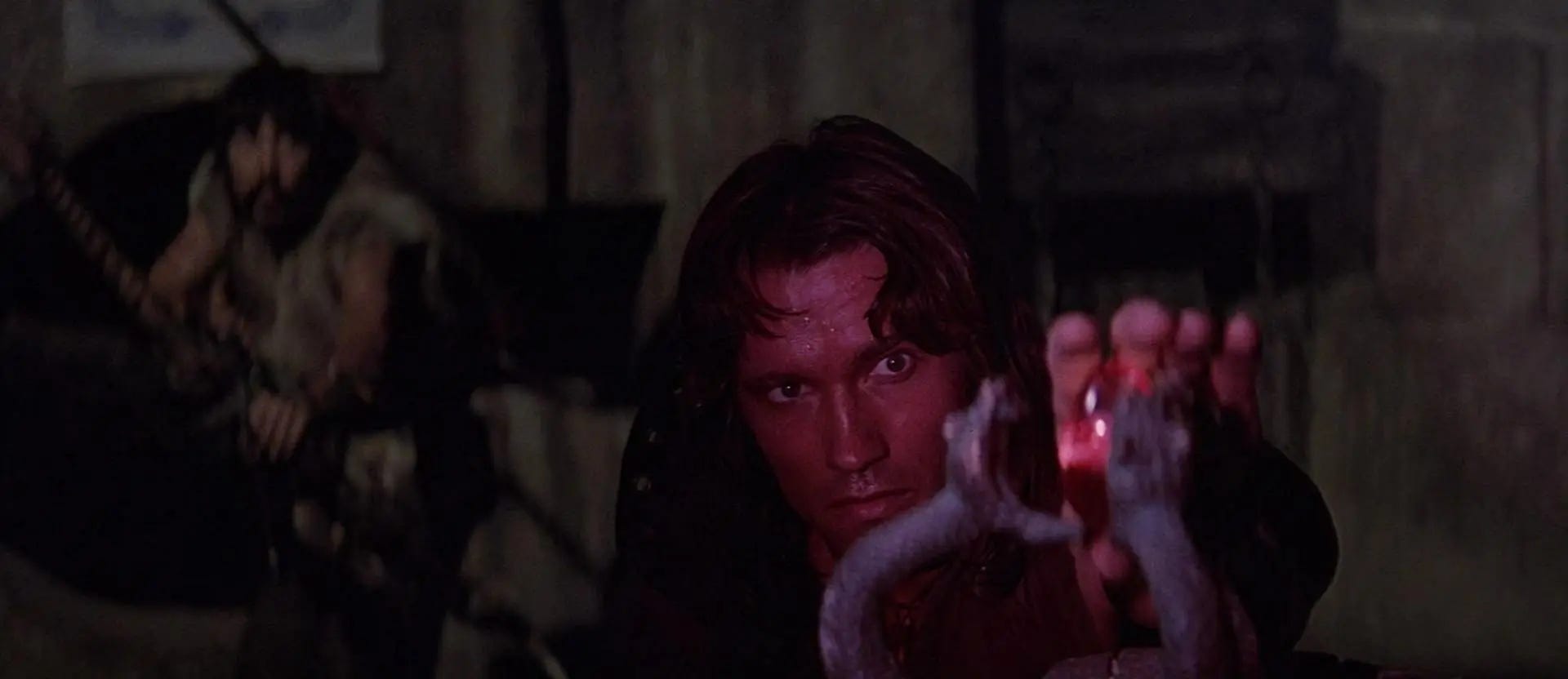
Cartoonist, conceptual artist and production designer Ron Cobb, who’d created practically everything industrial in Alien (1979) from spacecraft to astronaut helmets to company insignia, had been added to the payroll of Conan the Barbarian, sitting in on pre-production meetings and contributing tentative artwork for the weapons, wardrobe and buildings of the Hyborian Age. Cobb was available because he was actually waiting on director John Milius to return from Europe and start working with him on Half the Sky, but as Milius began to incorporate elements of his mountain man script into Conan, agreed with executive produce Dino De Laurentiis to tackle Robert E. Howard’s pulp hero next. Cobb came aboard as production designer. In the 2000 making-of documentary, he stated, “I loved the idea of inventing an architectural style you couldn’t quite identify. That was one of the things I wanted to do. You know, kind of design the snake cult so all the artifacts looked like they fit together, sort of like corporate logos and things like that.” (Cobb also appears as the Black Lotus Street Peddler who only ends up feeding Conan and Sabotai information).
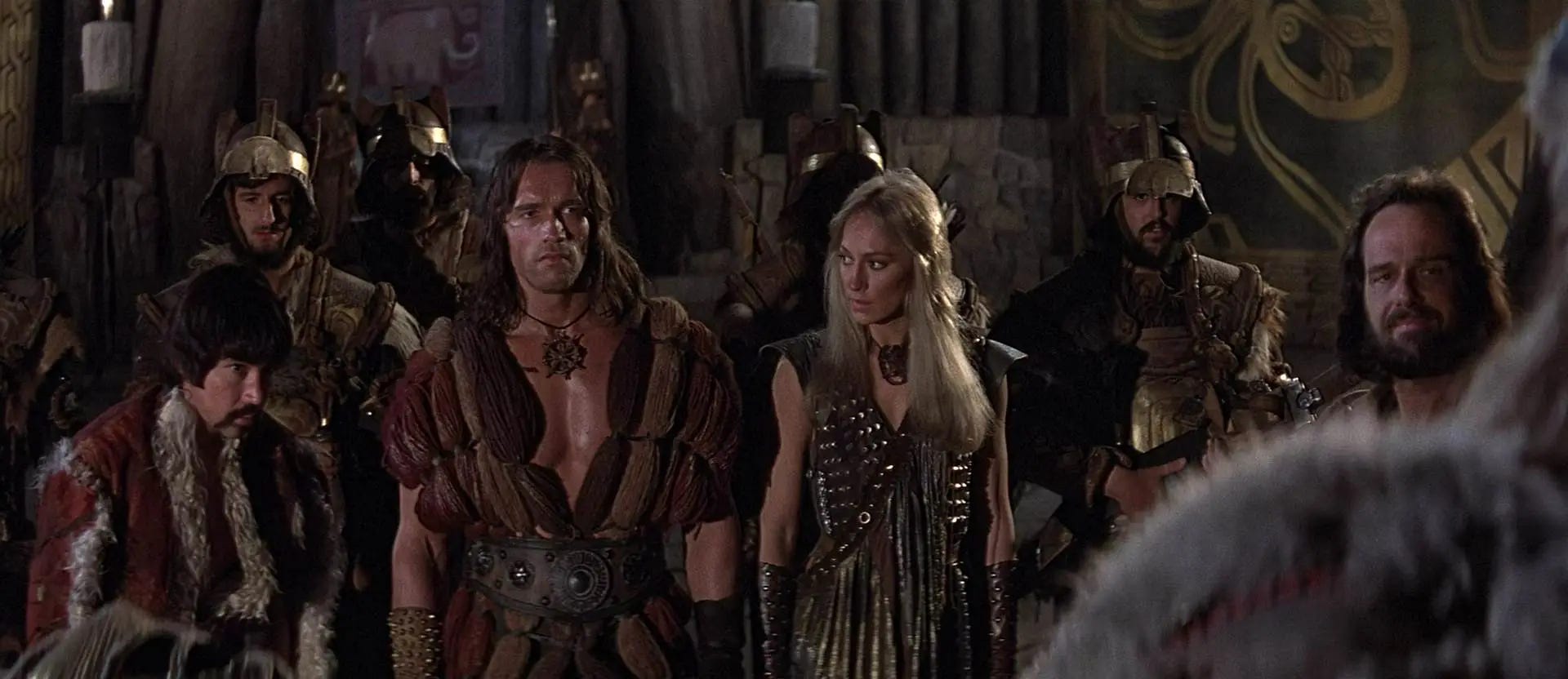
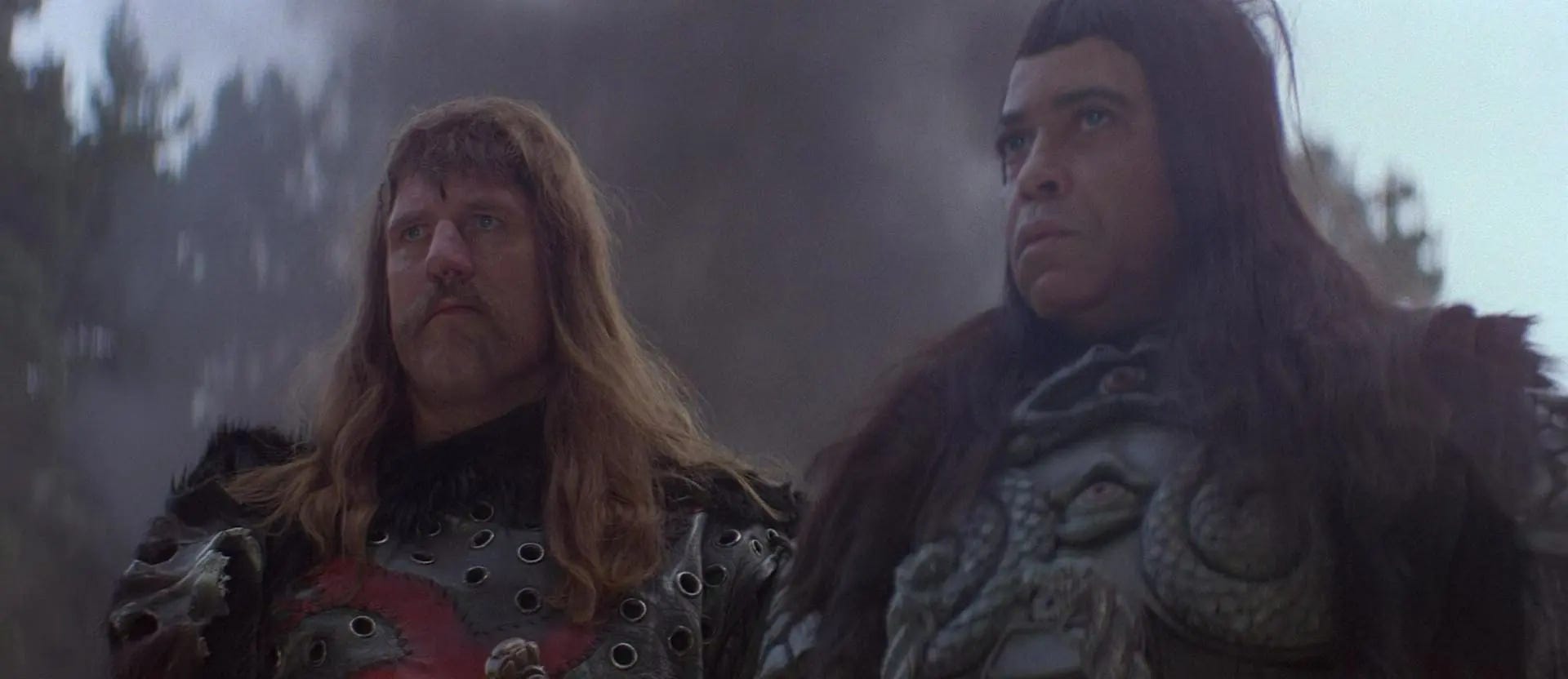
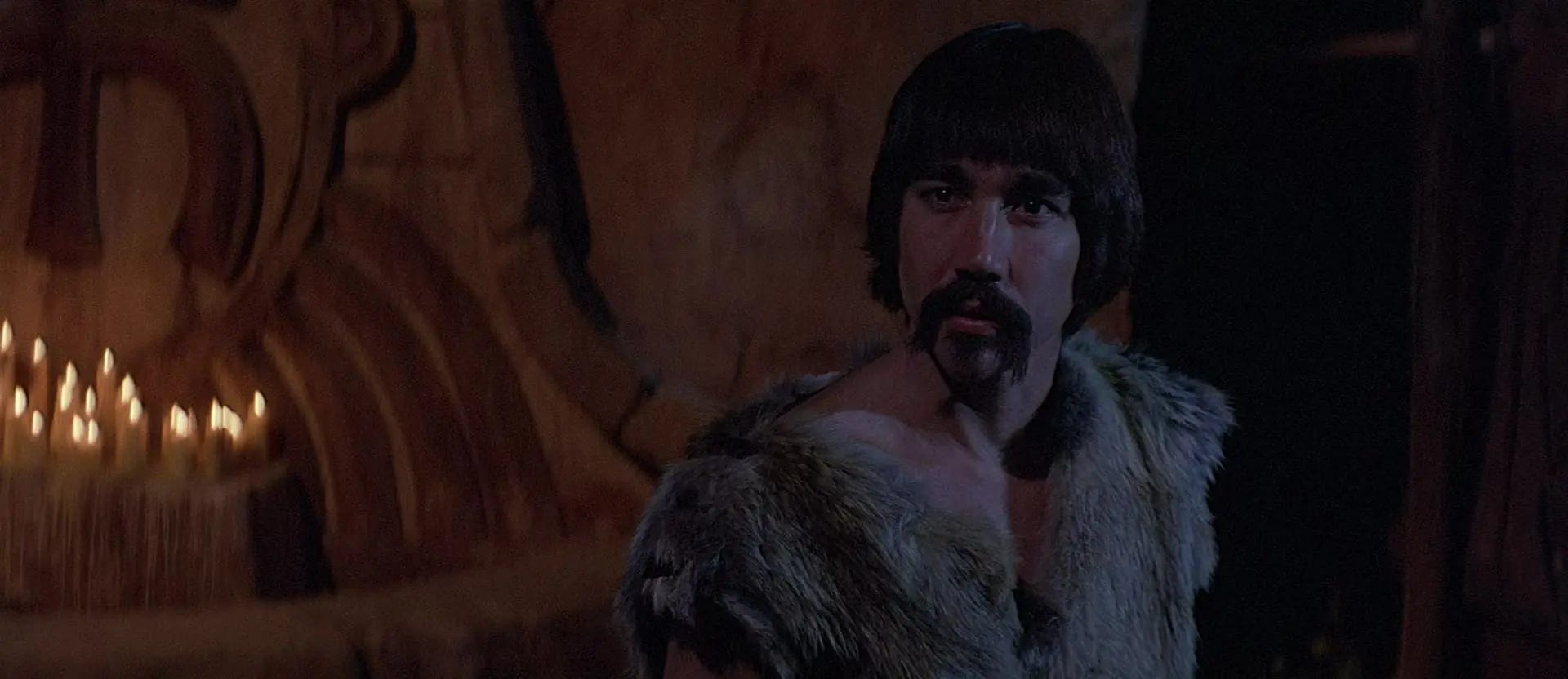
To complement Arnold Schwarzenegger, Milius cast several athletes the filmmaker felt he could coach decent performances out of, as opposed to actors who might struggle with the physical acting requirements. Milius was awestruck by a dancer named Sandahl Bergman in Bob Fosse’s musical All That Jazz (1979), exclaiming that she was a real Valkyrie. He cast her as Valeria. After handicapping most of the actors being considered for Subotai against his friend, surfing legend Gerry Lopez, Milius simply cast Lopez as the archer (Lopez would ultimately be dubbed by Japanese actor Sab Shimono). To play Thulsa Doom’s henchmen, Rexor and Thorgrim, Ben Davidson, a 6’8” retired NFL defensive end, and Sven Ole Thorsen, 6’5”, a Danish bodybuilder Schwarzenegger had trained with, were cast. The voice of Darth Vader, James Earl Jones, was cast as Thulsa Doom, and Mako as the Wizard. To mitigate Schwarzenegger’s thick accent, the decision was made for Mako to narrate Conan’s tale rather than the Austrian Oak himself. Sterling Hayden had agreed to take the small role of King Osric, who dispatches Conan, Valeria and Sabotai on their quest to rescue his daughter from Thulsa Doom, but the actor’s health led De Laurentiis to engage Max Van Sydow, who’d played Ming the Merciless for the producer in Flash Gordon (1980).
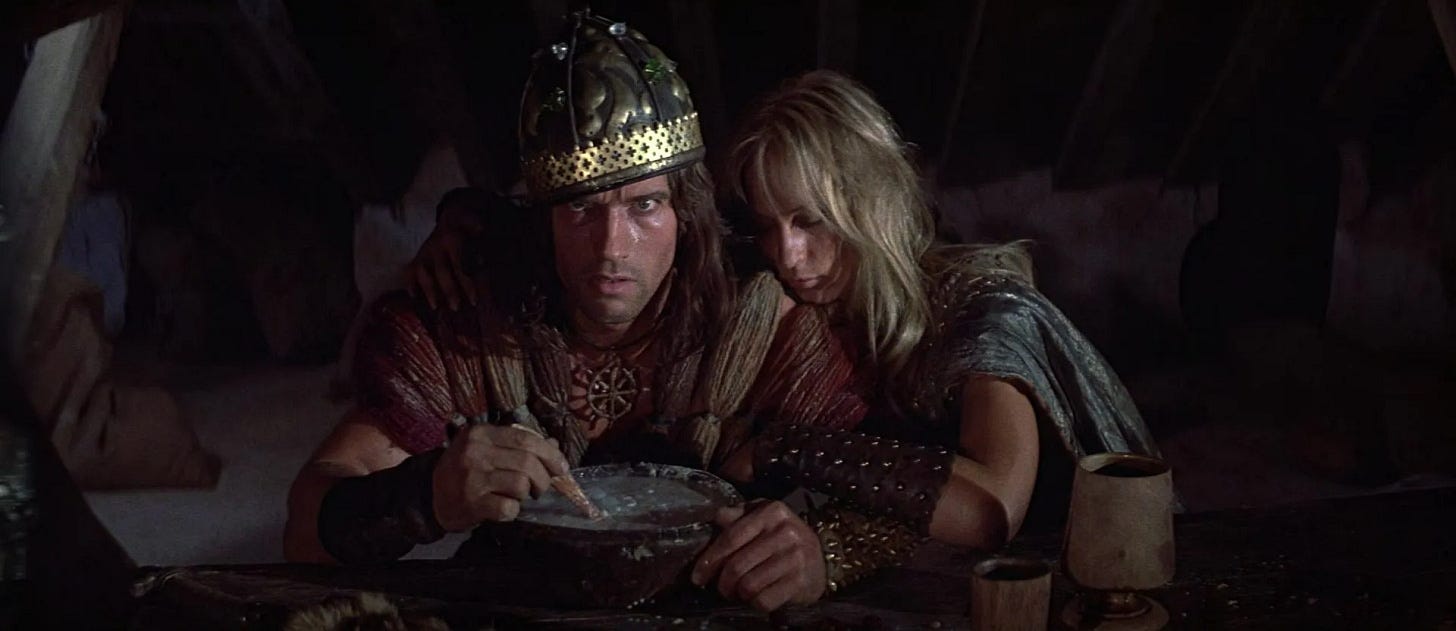
In Los Angeles, Arnold Schwarzenegger and Sandahl Bergman underwent months of training. They often spent mornings working with stunt coordinator Terry Leonard, Harrison Ford’s second double in Raiders of the Lost Ark (1981) who’d been dragged under a moving chassis for the film’s truck chase. After horseback riding and martial arts training with Leonard, the actors hit the gym by noon, including sessions with Kiyoshi Yamazaki, who instructed them in swordplay (Yamazaki also appears as the Sword Master in the film). In contrast to Sam J. Jones in Flash Gordon or Klinton Spilsbury in The Legend of the Lone Ranger (1981), who came to work so ill-prepared to carry a major motion picture that their voices were dubbed in post-production, Schwarzenegger trained with a vocal coach throughout production. Prior to filming the climactic Battle of the Mounds, Milius presented the actor with a half-page of dialogue he’d just written between Conan and Subotai. Confiding to Milius that he was struggling with his delivery, it was suggested he visit James Earl Jones in his trailer. Agreeing to help, the stage veteran asked Schwarzenegger to recite his lines. He then recommended two alternate copies be typed up for him and studied: one copy with the lines spaced in staccato fashion all the way down the length of the page, another with the lines spread sideways along the width. Learning his dialogue with unconventional line breaks had helped Jones ease into a less programmed rhythm and it worked for Schwarzenegger.
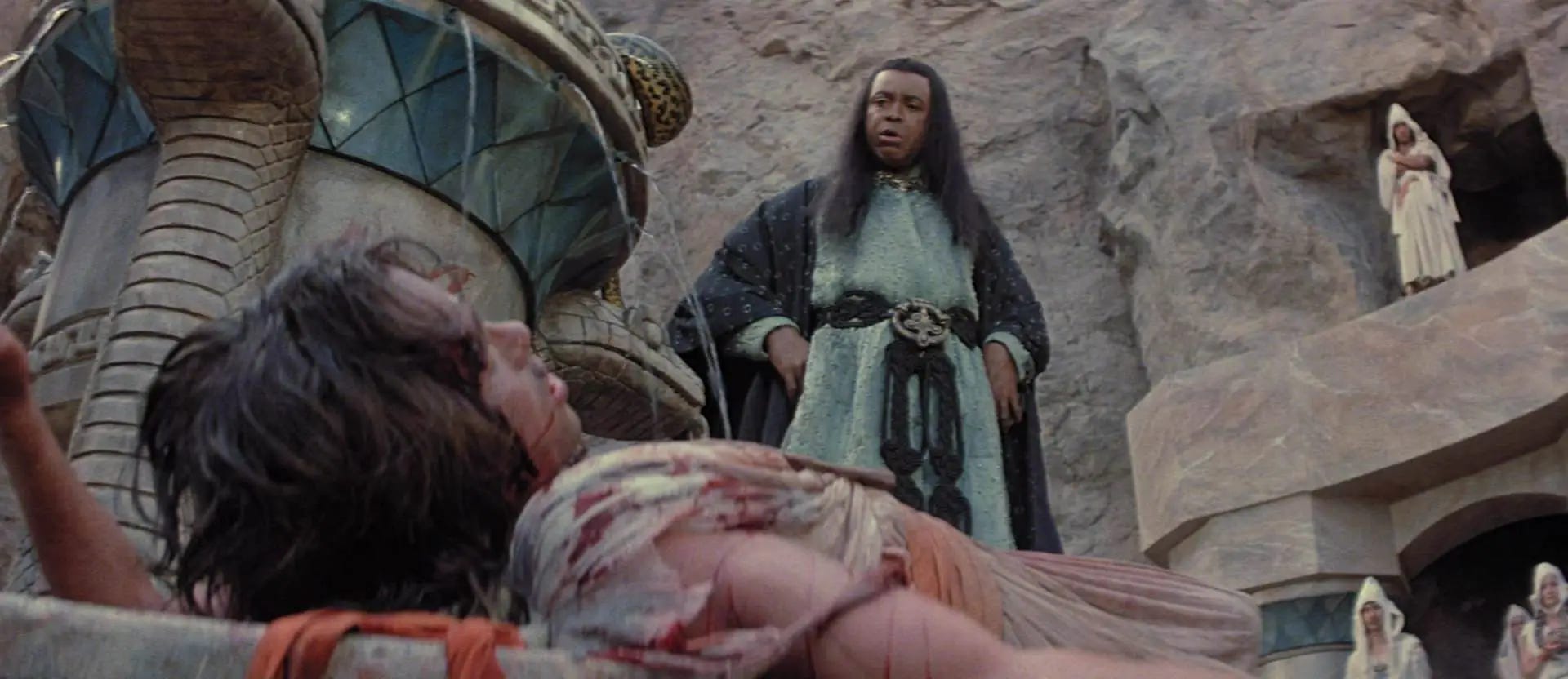
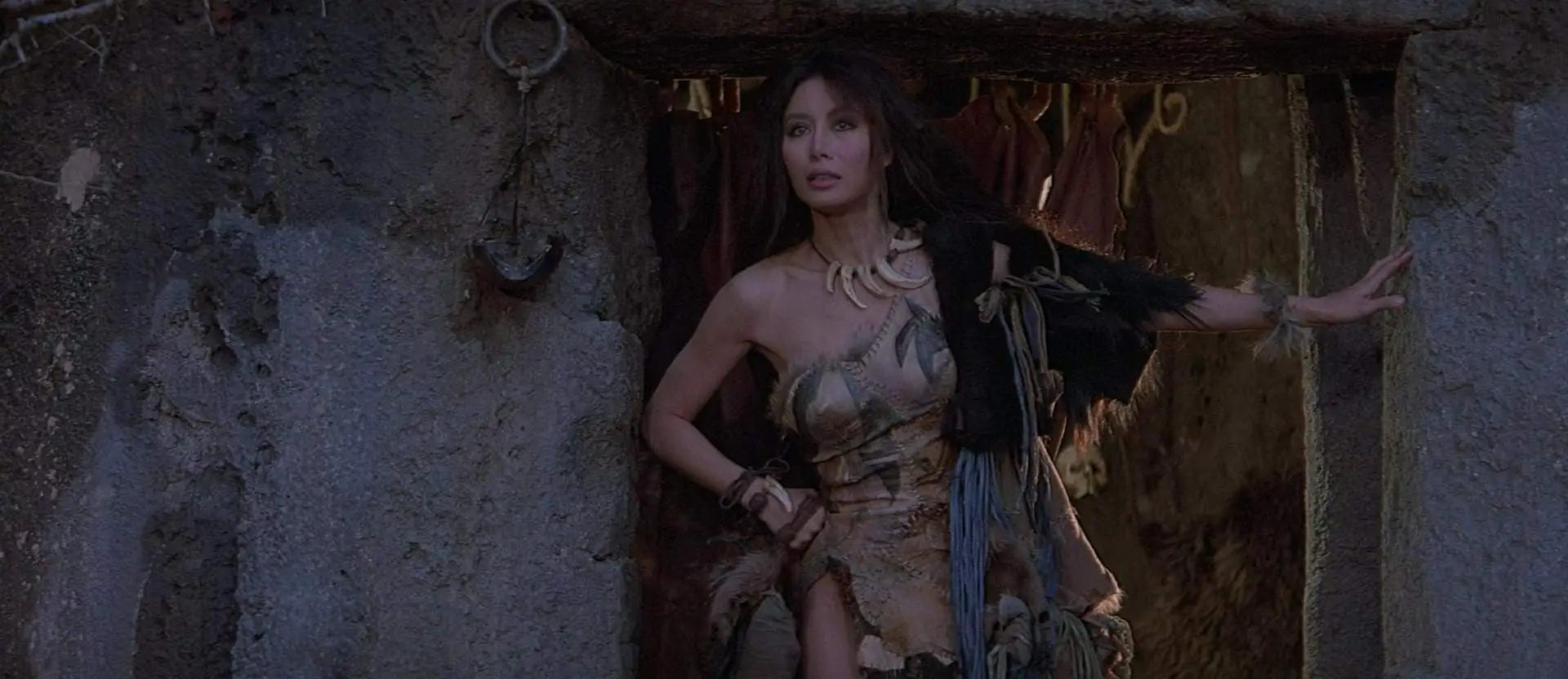
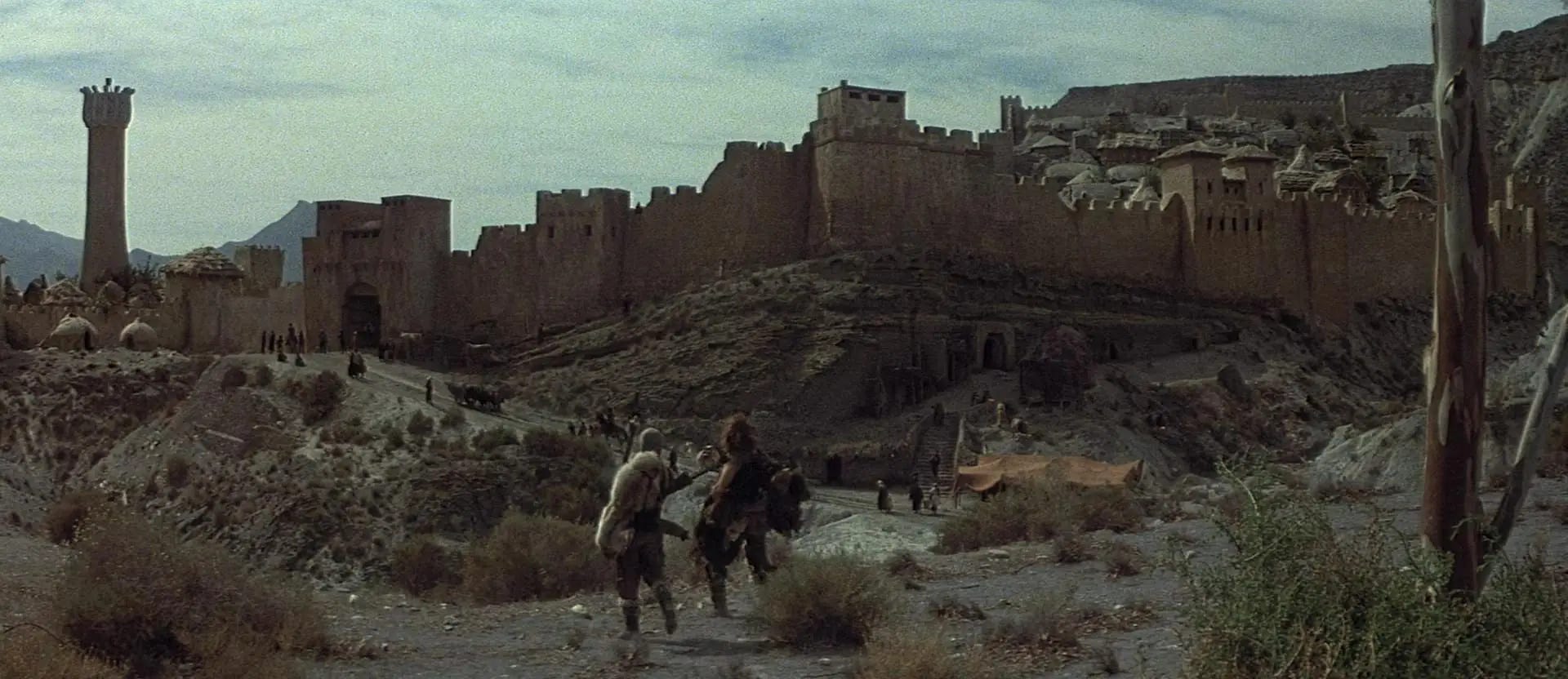
Raffaella De Laurentiis and Buzz Feitshans spent three to four months preparing to make Conan in Yugoslavia, setting summer 1981 as their release window. The political instability that swept through Belgrade following the death of strongman Josip Tito in May 1980 forced the producers to find an alternative. According to Arnold Schwarzenegger in his autobiography Total Recall, filming the picture in Italy would’ve cost $32 million, the rocky desert outside Las Vegas even more and a soundstage in Hollywood even more. Production relocated to Spain, where De Laurentiis had produced several pictures dating back to Solomon and Sheba (1959), and John Milius had used the province of Almería to stage the desert sequences for The Wind and the Lion (1975). In October 1980, it was announced that Conan the Barbarian would begin shooting in the Kingdom of Spain in January 1981 with a production budget of $22 million. The release was pushed back to December 1981. Cast and crew were housed in a hotel in central Madrid, which also served as a production hub. In temperatures of 0°F, the attack on Conan’s village was shot in the mountains near the town of Valsaín, in the province of Segovia (where Milius enthused was where the bridge in Ernest Hemingway’s For Whom the Bell Tolls was dynamited). The lair of the Witch (Cassandra Gaviola) was shot in the natural rock formations outside La Ciudad Encantada. The ancient city of “Zamora” was filmed at Fuerte El Condor (or El Condor), a large Western-style film set erected in the 1960s in the Tabernas Desert, where Schwarzenegger and Lopez were also filmed running. Thulsa Doom’s “Mountain of Power” was built in the desert terrain of El Peñon de Bernal, in the Tabernas Desert near Vicar. Many of the interiors were filmed on sets constructed at Madrid 70 Studios, a film facility in Fuenlabrada.
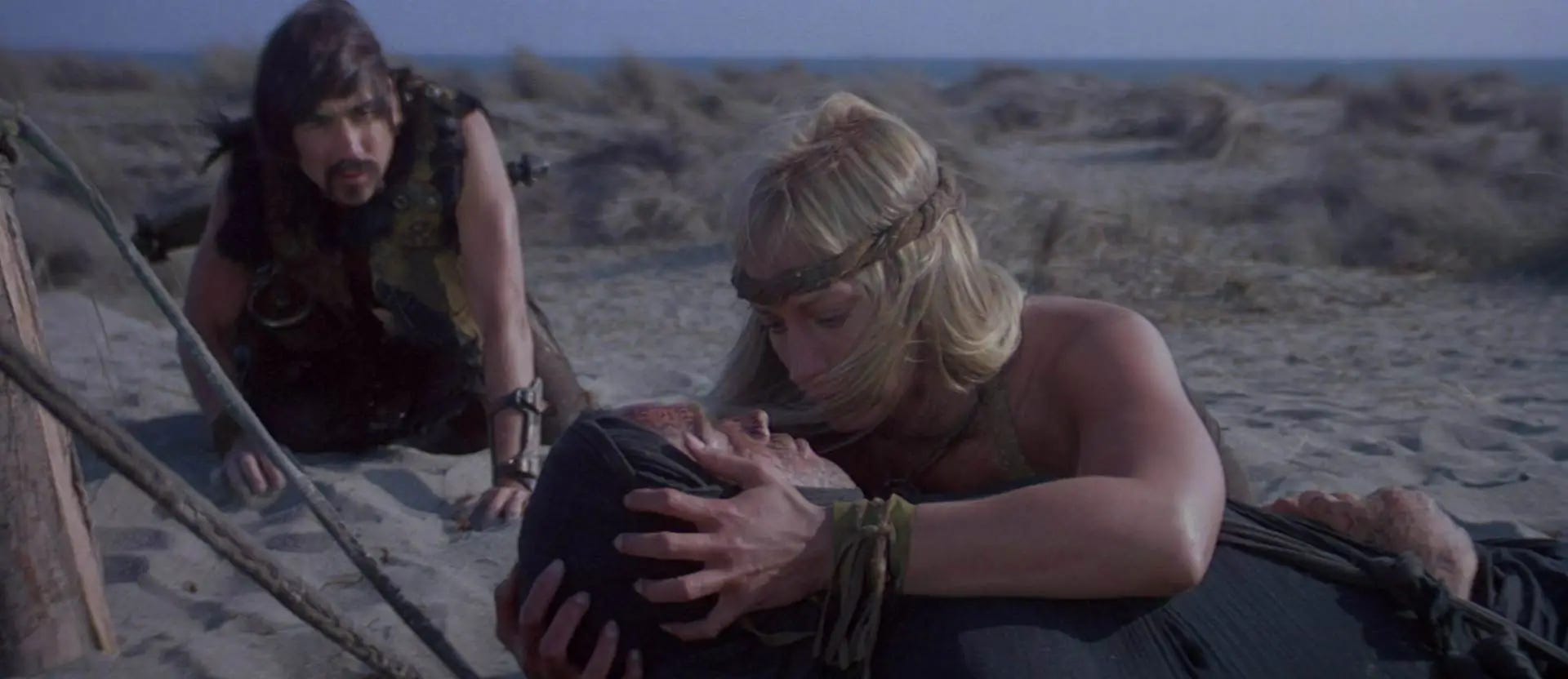
Universal Pictures chose cost and quality and appeared willing to sacrifice speed, granting John Milius more time to work on the film and moving the release of Conan the Barbarian back to summer 1982. This allowed an independently financed sword and sorcery film on nobody’s radar starring Lee Horsley, Simon MacCorkindale and Richard Lynch titled The Sword and the Sorcerer to sneak into theaters first, on April 23, 1982. Working with cost and speed and sacrificing quality, with much dialogue exchanged on cheap sets, the Group 1 release held a spot among the top ten grossing films in the U.S. for nine weekends, a hit. According to Schwarzenegger, the first test screening of Conan took place in Houston just after Valentine’s Day. On a scale of 1 to 100, the audience scored it an extraordinary 93. Universal wanted to know immediately if this was a fluke or they had a hit on their hands, arranging another screening the following night in Las Vegas and inviting Arnold to attend. His autobiography recounted, “Driving past the cineplex the next afternoon, we could see this was no ordinary screening. A line stretched around the block, and besides the comic book fans that Universal had expected, there were bodybuilders with tight shirts and bulging muscles, gays, freaks with weird hair and glasses, people wearing Conan outfits. There were some women but the crowd seemed to be mostly men, including a major contingent of bikers in full leather. Some of these guys looked ready to riot if they didn’t get in. Universal simply kept opening auditoriums, until everybody was seated–it took three to accommodate them all.” The Las Vegas test audience scored the movie the same as Houston had: 93.
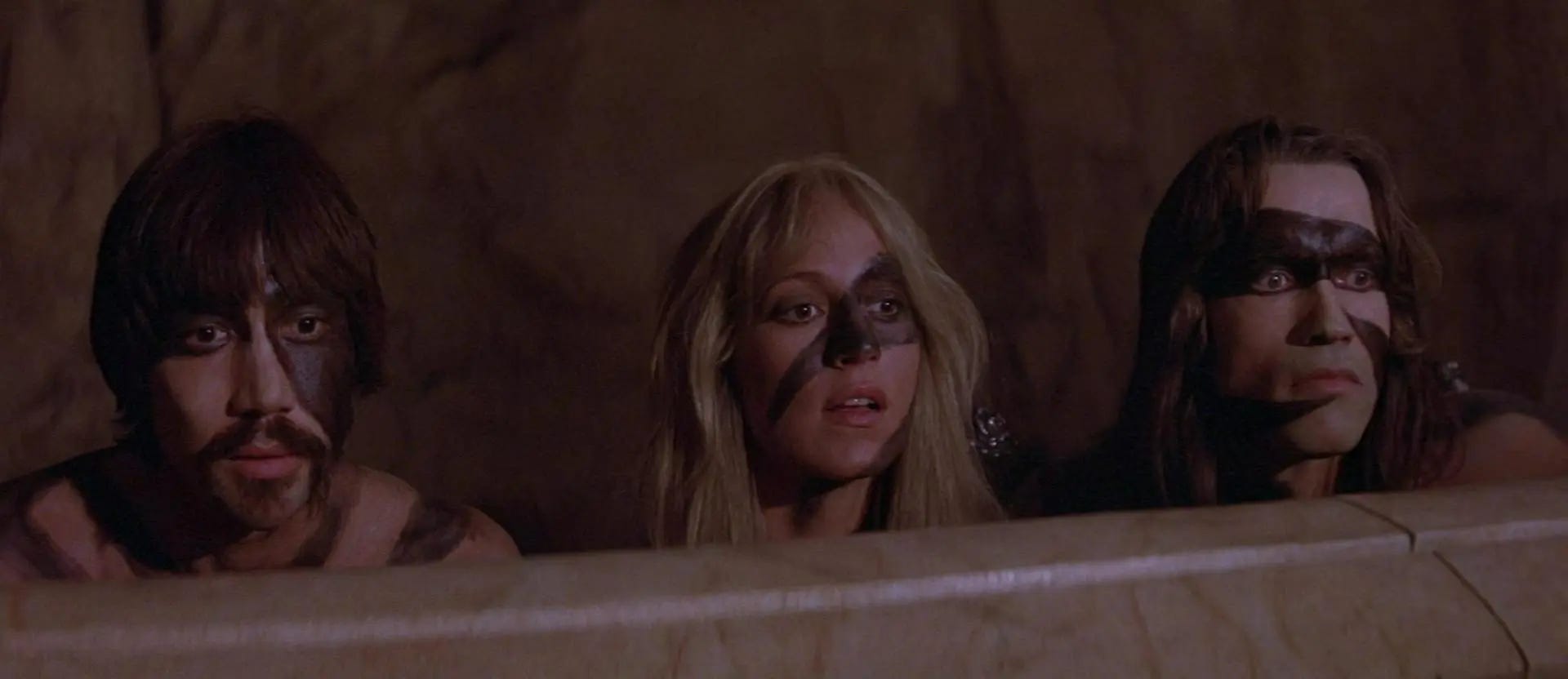
Conan the Barbarian opened May 14, 1982 in 1,395 theaters in the U.S. At that time, this was a huge release, and no other movie except E.T. The Extra Terrestrial (also from Universal) would reach more venues that year than Conan at its peak: 1,683. Perhaps as surprising as the test scores, newspaper critics leaned positive. Gene Siskel opened his review in the Chicago Tribune by mentioning George C. Scott and the actor’s commitment to the joy of acting. “ … there is the same joy in the performance of muscleman turned actor Arnold Schwarzenegger in his role as Conan the Barbarian, an avenging angel type who’s tall, swings a big sword and trusts no one. And it is Schwarzenegger’s good humor about his imposing looks and his Austrian accent that make his Conan characterization and the movie itself so much fun.” Siskel rated the film 3 stars out of 4. Writing in the Chicago Sun-Times, Roger Ebert added, “The movie’s casting is ideal. Arnold Schwarzenegger is inevitably cast as Conan, and Sandahl Bergman as Valeria. Physically, they look like artists’ conceptions of themselves. What’s nice is that they also create entertaining versions of their characters; they, and the movie, are not without humor and a certain quiet slyness that is never allowed to get out of hand. Schwarzenegger’s slight Teutonic accent is actually even an advantage, since Conan lived, of course, in the eons before American accents. The movie is a triumph of production design, set decoration, special effects and makeup. At a time when most of the big box-office winners display state-of-the-art technology, Conan ranks right up there with the best.” Ebert also graded the film 3 stars out of 4.
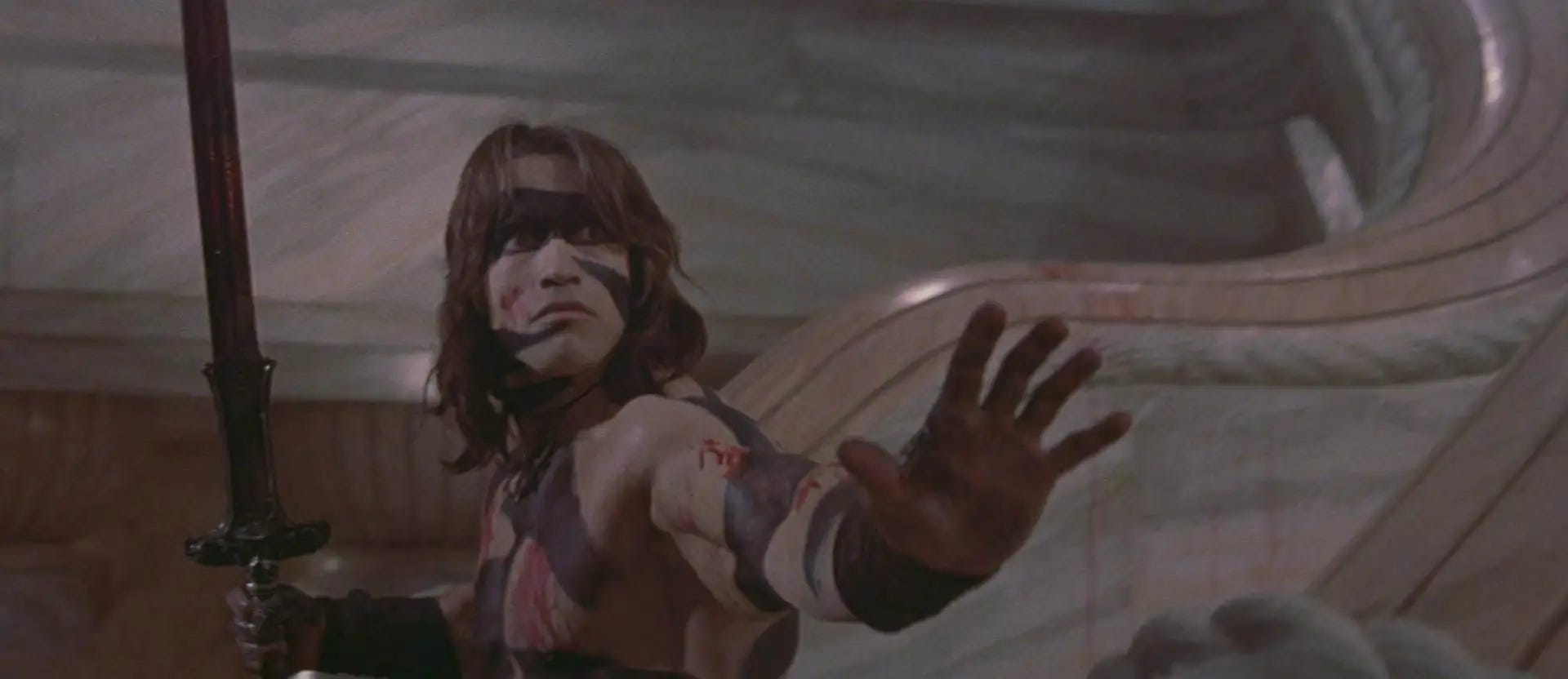
F.X. Feeney wrote in LA Weekly, “Great stuff, but also depressingly familiar stuff. Nevertheless Arnold Schwarzenegger proves himself a capable actor, combining his innate gentility with Conan’s brute directness to good effect. He gives credibility to the film’s humor. John Milius–especially in the film’s first, and best hour–directs with force and intelligence. Ron Cobb’s sets are wonderful throughout.” Conan the Barbarian opened #1 and held a spot among the top ten grossing films in the U.S. for five weekends, audiences pouring into theaters for the first of several contests between Schwarzenegger and Sylvester Stallone at the box office, with Rocky III opening #1 over Memorial Day weekend. Oliver Stone–who since turning in his script for Conan had written and directed The Hand, Ed Pressman producing the critically panned psychological horror film starring Michael Caine–did not look back on the picture or its legacy fondly, perhaps still directing it in his head. “God, it breaks my heart that Dino ended the series. He was so stupid and so short-sighted! Making the first one with Milius was bad enough, but it got by and made a little bit of money: you know, it wasn’t derided. It was silly, I thought, the way he made James Earl Jones look–it was terrible. I didn’t buy it–and there was a lot of hokey shit, especially the snake thing. And the second movie was so bad! [Conan the Destroyer, screenplay by Stanley Mann, story by Roy Thomas & Gerry Conway, produced by Raffaella De Laurentiis, directed by Richard Fleischer]. That ended the series, right there! Of course, the whole thing went into turnaround, and the other movies never got made. It was all lost due to Dino De Laurentiis. No question about it. It could’ve survived anything but him, and I’m sorry we lost it.”
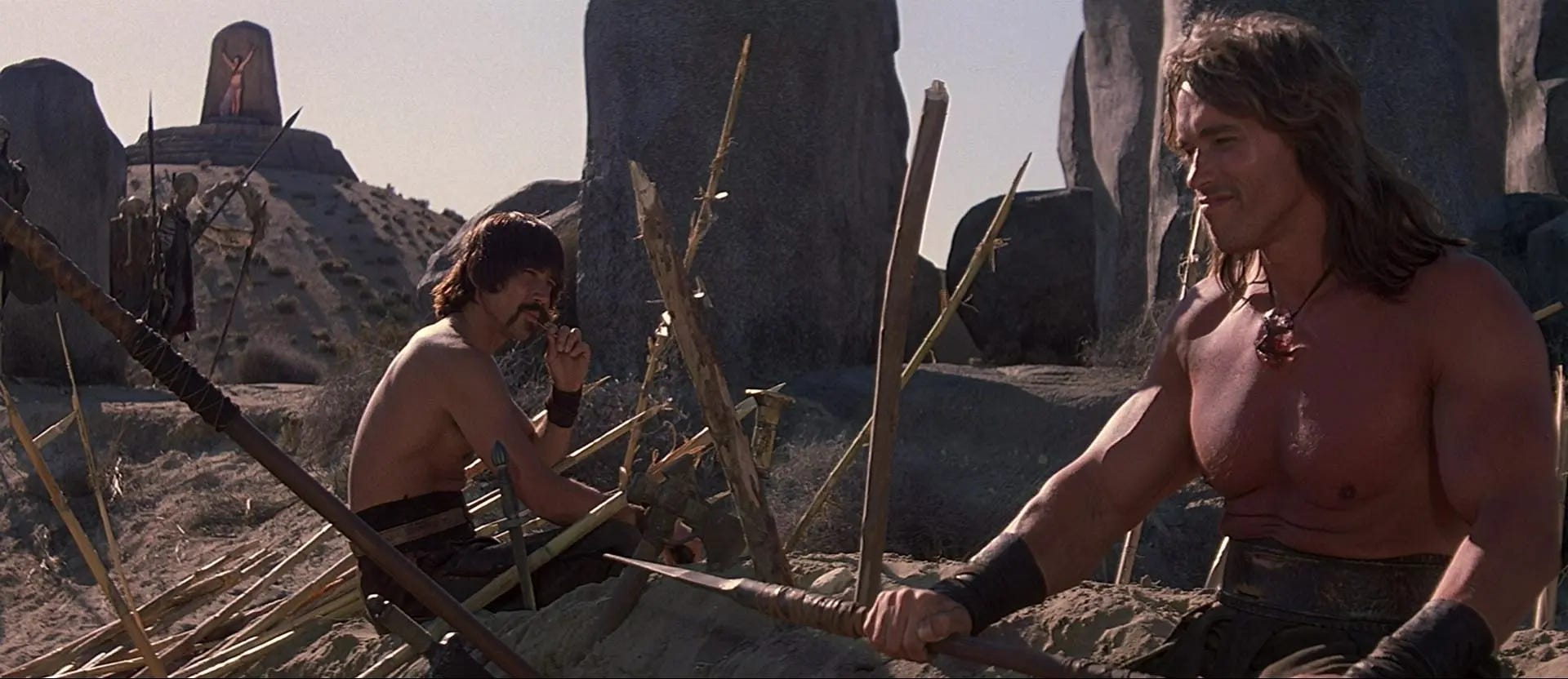
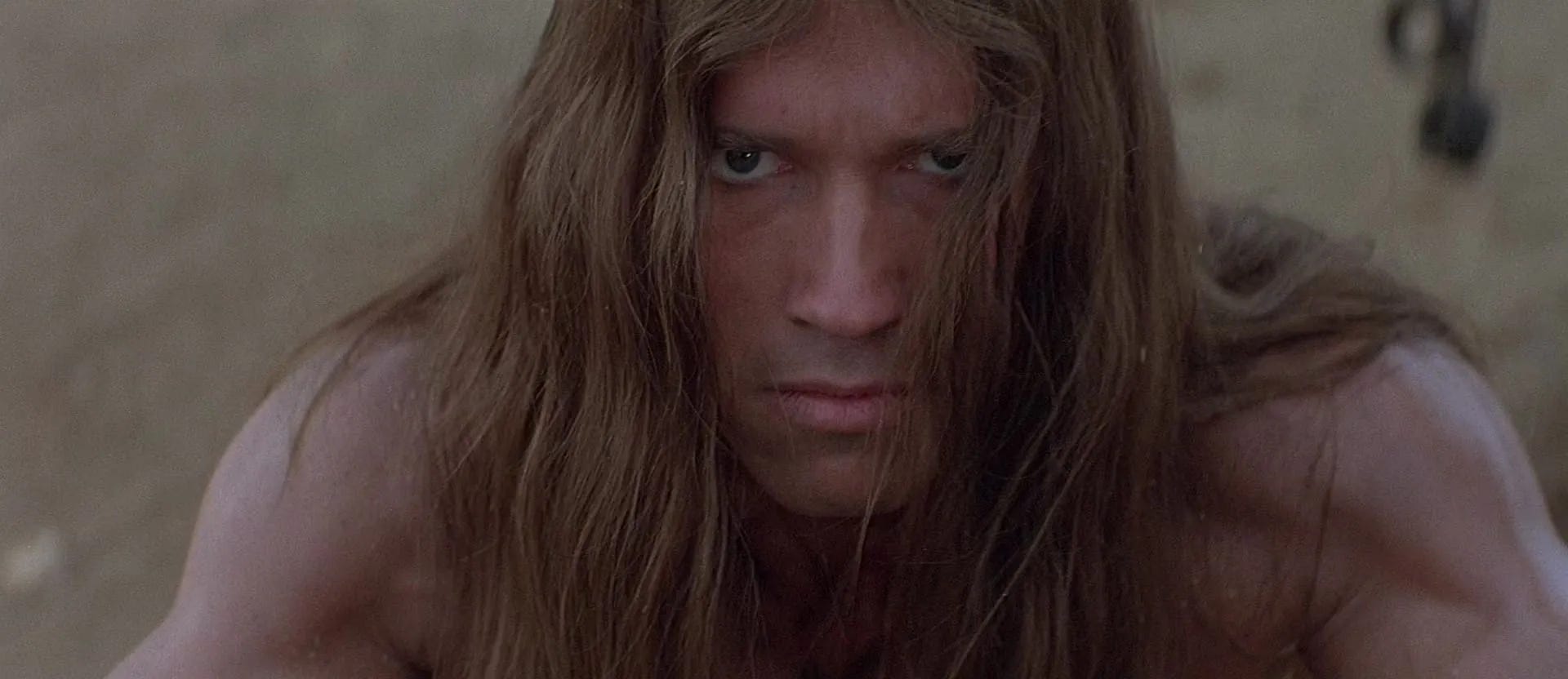
It’s difficult to put into words how much fun it was to discover Arnold Schwarzenegger on the big screen in the summer of 1982, or in the months following on videocassette. Arnold was like a star built in a lab, a world class athlete whose performing arts background set him apart from other sportsmen who’d gone into movies, from Johnny Weissmuller as Tarzan to Joe Namath as C.C. Ryder and everyone in between. Instead of being hindered by his physique or his accent, Schwarzenegger’s biceps and his voicebox, and his good humor about them, were key in making him a superstar. Edward R. Pressman–credited as an executive producer–deserves most of the credit for not only appraising this Mr. Olympia’s unique mix of dedication and playfulness, but remaining dedicated to seeing those star qualities were served by the right material, rather than exploiting the bodybuilder for a quick buck. When the Witch flings her magic powder into the hearth, or Conan contemplates the horrors Valeria suggests lie inside the Tower of Serpents, Schwarzenegger’s wonder is what sells his portrayal of a medieval warrior and makes the movie around him so enjoyable, not muscles. Before Valeria in Conan the Barbarian, there hadn’t been a dynamic female character in a sword and sorcery film, and there haven’t been many since. Sandahl Bergman’s physicality and spirit are so aligned with Schwarzenegger’s that given the choice between avenging his parents or going on sensual adventures with Valeria, it’s unconvincing Conan would choose the former except that the plot requires it.
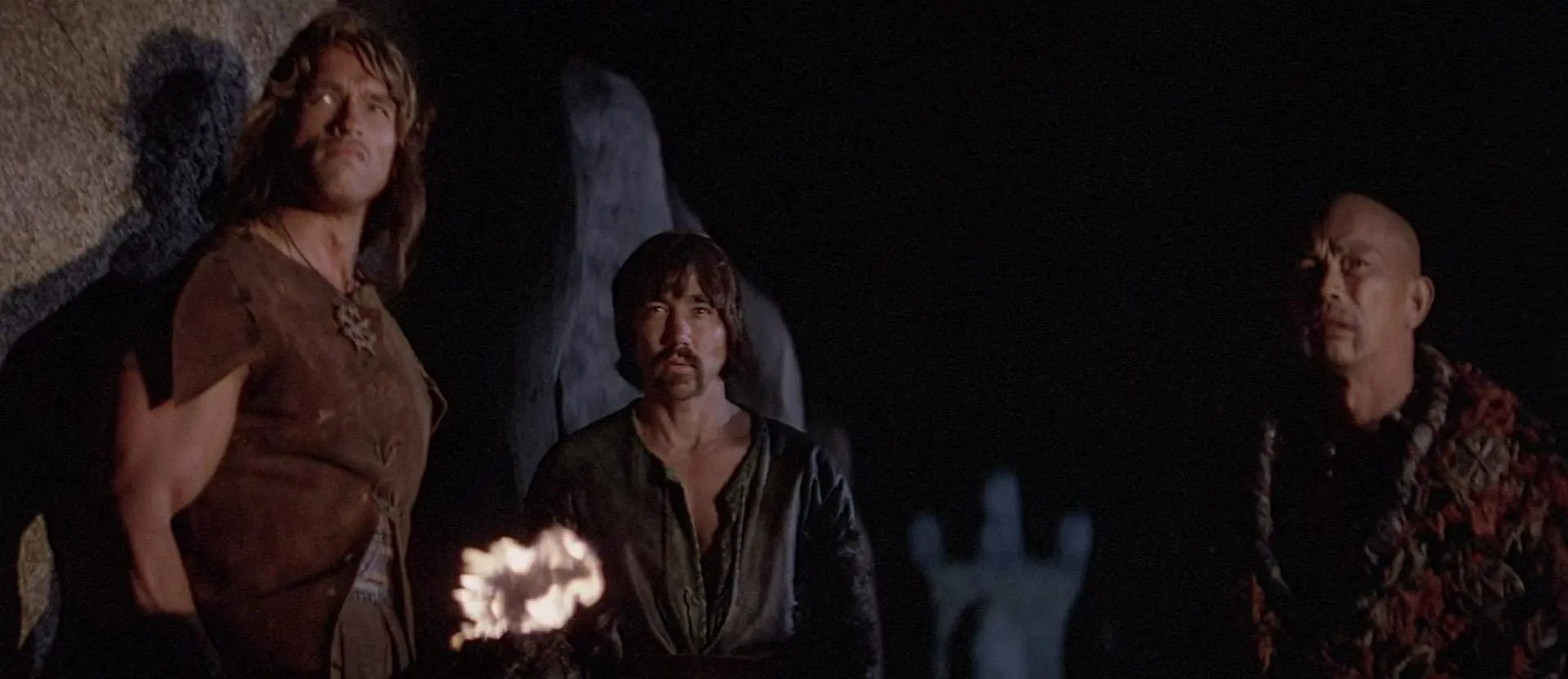
John Milius, who had a choice between serving comic book fans or trusting his sensibilities were in step with a wider audience, chose the latter, the same as Tim Burton did when he accepted the job of directing Batman (1989). Conan the Barbarian is a more exciting film. It builds a fantasy world from scratch, an alternate Eurasian antiquity, somewhere between the lost civilization of Atlantis and the steppes of Mongolia. Filmed entirely in Spain, the production utilizes the country’s diverse ecosystem of mountains, grassland, desert and coast superbly. Like Schwarzenegger, Ron Cobb would’ve had to be invented if he wasn’t available, an immensely talented designer capable of drawing up practical appliances to do unbelievable things, like the Wheel of Pain young Conan is sentenced to like a prehistoric factory job. The non-union Spanish crew and exchange rates in Spain seem to have saved Universal enough nickels to realize the best possible version of a Robert E. Howard story. Thulsa Doom’s Mountain of Power draws more followers than a Grateful Dead concert, while his palace orgy looks like a palace orgy. What Conan is missing here is his Joker. For a sorcerer, Thulsa Doom doesn’t strike fear into our hearts. Milius tries to empower him as a cult leader, but there’s little doubt once Conan hacks his way through Doom’s men the magician will hold his own. The Witch, memorably played by Filipino-American actor Cassandra Gaviola, makes a stronger impact in her two scenes. The ancient world aspects Milius is drawn to are well balanced with the fantasy elements leaking from Oliver Stone’s draft, namely the demons who come for Conan while he’s near death, sparingly depicted and cleverly animated. Along with Schwarzenegger, the film’s biggest star is composer Basil Poledouris, who provided an eccentric musical score both thunderous and forlorn when elevating the emotional content of the piece.
Video rental category: Fantasy
Special interest: Sword and Sorcery