

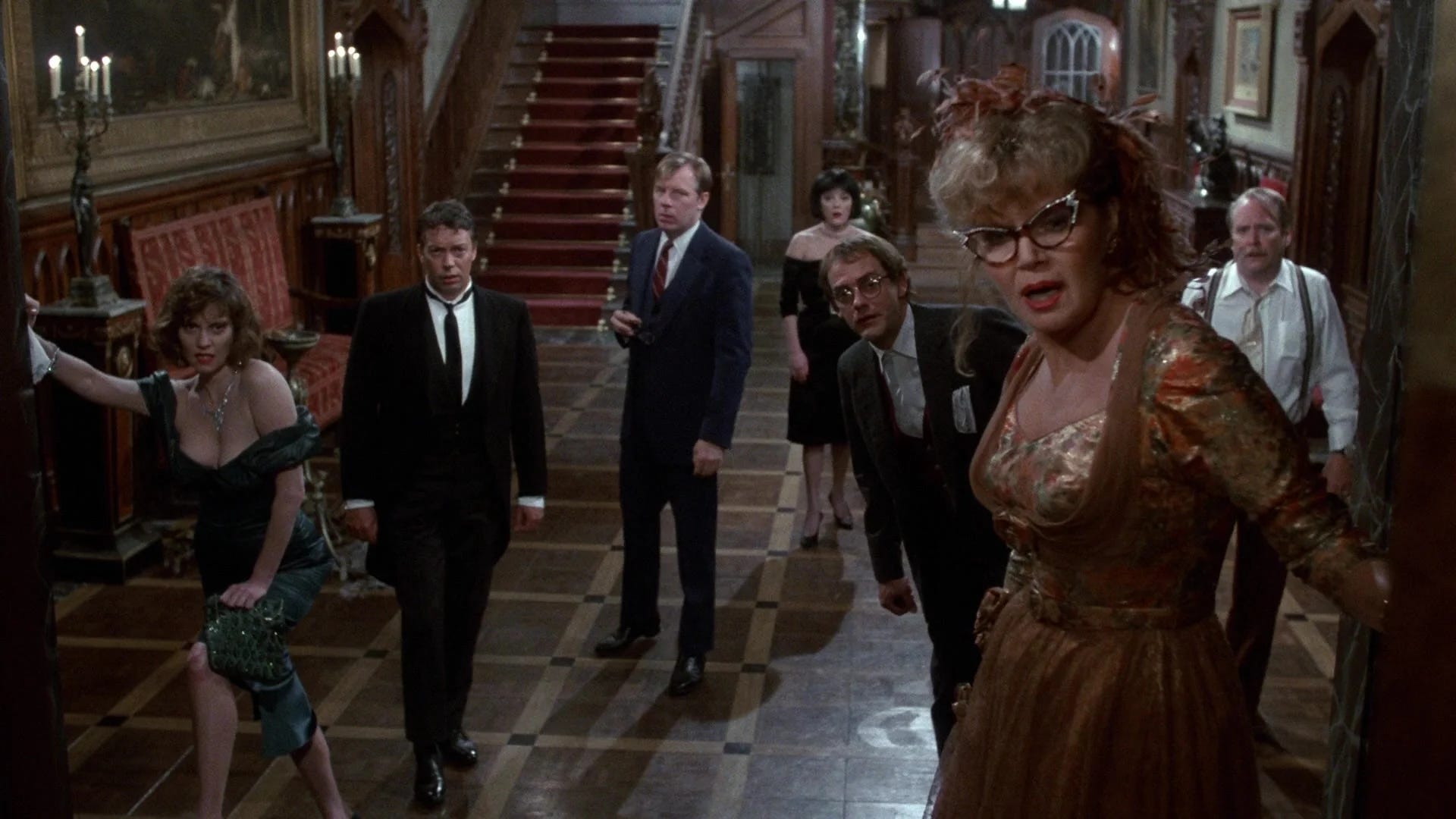
CLUE (1985) wasn’t the first movie to employ sensory gimmicks to lure audiences to theaters. Depending on which box office sold them a ticket, viewers saw one of three different endings. Where Clue differs from movies with labels like 3-D, Sensurround or Odorama is that the filmmakers weren’t just experimenting with new delivery systems for the sake of promotion. They poisoned their narrative without bothering to manufacture an antidote. This intricately written whodunit works so that all three endings actually make sense, daring viewers to rewatch the movie and rewarding them for their attention.
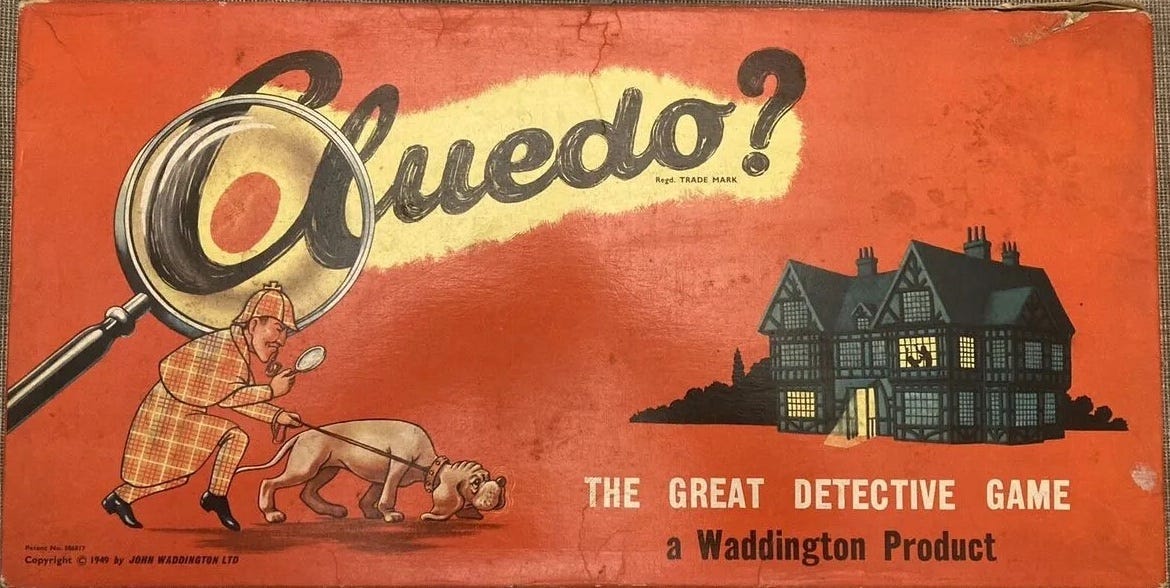
Anthony Pratt was born in 1903, in the Balsall Heath neighborhood of Birmingham. He left school in his teens, earning a living playing piano in hotels or aboard ocean liners. According to his daughter Marcia Lewis, her father worked as a pianist at the Worcestershire Brine Baths Hotel in the early twenties. There, Sir Horace Avory, the so-called “hanging judge,” often recounted notorious cases to rapt listeners. In an article by Nicola Upson published in The Times on October 17, 2025, Lewis recalled, “I grew up mainly in Bournemouth, and there were a couple of famous murders there, so he’d point out where Neville Heath left the body. It was the criminal psychology and detection that interested him, the trial process and the wars between the barristers.” The social set Pratt moved in had a habit of turning up at each other's houses on weekends for parties. One popular game went by a blunt name: Murder. A secretly selected murderer would “kill” players in a dim room by winking at them, victims dramatically going to their “deaths” while the other players had to catch the perpetrator (there were variations on the game, but “murder” was a recurring theme). Beginning in 1939, most social gatherings in England were restricted, with Birmingham bombed more heavily than any city in England after London and Liverpool by late 1940. Poor eyesight kept Pratt out of military conscription. He went to work at a munitions factory by day and did his patriotic duty as a firewatcher by night. Like most, Pratt began to miss his social life. A neighbor over his garden fence, Geoffrey Bull, had patented a board game titled Buccaneer, achieving modest success by selling the publishing rights to Waddington’s, a playing card manufacturer in Leeds. Following suit, Pratt and his wife Elva Rosalie Pratt invented a board game they called Murder. The object was to not only determine who among ten characters—Col. Yellow, Miss Scarlet, Rev. Green, Prof. Plum, Nurse White, Mrs. Silver, Dr. Black, Mr. Brown, Mr. Gold, Miss Grey—was a murderer, but where and with what as a weapon. On a board which Elva Pratt designed, players moved tokens around a mansion with eleven rooms.
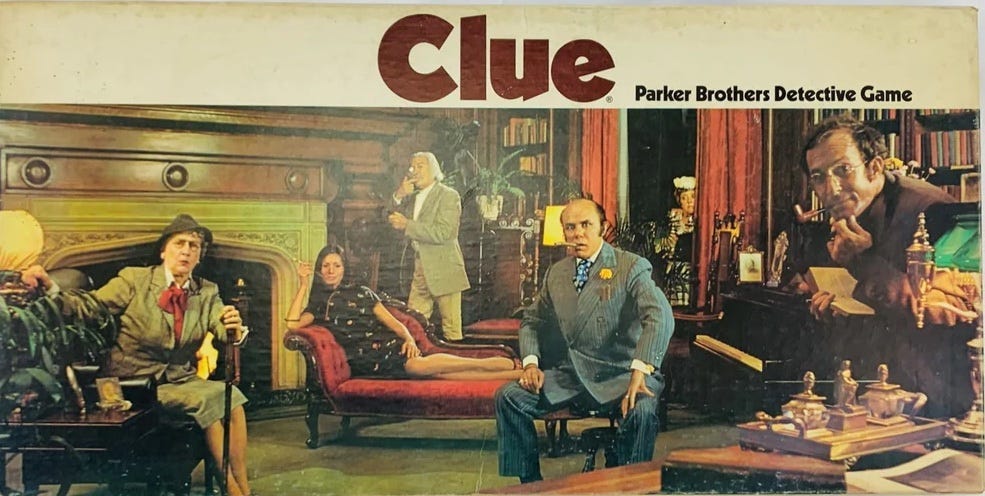
There were nine weapons in Murder: revolver, rope, dagger, cudgel, axe, poker, hypodermic needle, bottle of poison, bomb. Anthony Pratt’s correspondence with Norman Watson, managing director of Waddington’s, caught Watson’s interest. Watson made suggestions — changing the name of Col. Yellow to Col. Mustard to avoid the perception he might be a coward, substituting a lead pipe for a syringe and a candlestick for a bomb — and struck a deal to publish the game. 1945 was one of the worst years of the 20th century to manufacture a board game, but what was now titled Cluedo reached shelves in 1949, “Cluedo” a play on the Latin word “Ludo” for “play.” The U.S. publisher, Parker Brothers, simplified this to Clue. According to Lewis, Waddington’s told her father in 1953 that “they were rather disappointed in sales” and offered him £5,000, with a royalty of 5% to continue for each game sold in the U.K. through 1967. At that time, £5,000 could buy two houses and a car. She continued, “I think it was a very tempting proposition, I’d just been born and I’m sure my dad thought it was the responsible thing to do.” Pratt cashed in his winnings and got out of the casino at what must have felt like the right moment. He tried his luck twice more, pitching a treasure-hunt game and a gold-mine game to his publisher. Neither sold. When his patent on Cluedo expired, so did the money. Pratt spent his later working years as a clerk in a solicitor’s office. By 1985, Clue was a household fixture, the fourth best-selling board game in the U.S. Anthony and Elva Pratt’s invention was selling 750,000 copies a year, few gaming shelves without it. Lewis summed up her family’s legacy in 2025 by stating, “At the end of the day, what do you get remembered for? Making a shed load of money or creating something that brings genuine pleasure, happiness and escapism to people.”
It was Debra Hill, co-writer and producer of Halloween (1978), who first pursued the idea of turning Clue into a movie. Hill was born in Philadelphia, Pennsylvania, in 1950. Frank Hill, a salesman, entertained his daughter with tales of his days in Hollywood, where he claimed to have worked as an art director on the Hope-Crosby Road pictures (if true, Frank went uncredited). The Hills hopped from New York to Detroit to Haddonfield, New Jersey, where Hill started high school when she was fifteen. She attended college across the Delaware River in Philadelphia, where her love of movies prompted Hill to take all the film courses she could, establishing a base in screenwriting and editing. A bachelor’s degree in sociology led, unexpectedly, to training as a flight attendant. Tiring of the airlines, she tended bar in Jamaica, hooking up with a jazz musician and writing liner notes for his album.
In 1974, Hill returned to the States to start on the lowest rung of the show business ladder, as a production assistant on the TV series The Streets of San Francisco. She found work as a script supervisor on non-union productions, many of which never got released. As a script supervisor, Hill’s job was to track continuity on set, catching what the director or editor might miss. The position was so routinely filled by women it was dismissed as “script girl.” Working with a young director named John Carpenter on his first real feature film, an urban siege picture titled Assault on Precinct 13 (1976), Hill not only earned his professional respect, but the two began dating. When Carpenter received $300,000 in financing to make a horror movie about babysitters being stalked by a killer, Carpenter & Hill co-wrote Halloween. They named the Illinois town where the murder spree takes place for Hill’s hometown of Haddonfield. Carpenter directed and Hill produced. Initially panned by critics as it made its way from town to town, Halloween became a phenomenon, the most profitable independent film of its time. Credited as its sole producer, Hill had just turned twenty-eight. Though she reteamed with Carpenter as his co-writer and producer on The Fog (1980), Hill had ambitions beyond horror. She had the novel idea that a board game she’d played as a child might make a successful movie too. Speaking to Bob Thomas of the Associated Press in July 1985, Hill stated, “When I was growing up, I always liked Clue better than Monopoly, which seemed to be just buying and selling. I liked the thinking part of Clue, and I knew that a lot of people had played it—and still play it. When I approached the Parker Brothers people about making a movie of the game, they said nobody had ever asked them.”
Hill started pitching a film version of Clue in 1979, but even with Halloween breaking house records, her pitch didn’t land with a major studio. Speaking to Neal Zoren of Philadelphia and South Jersey’s Courier-Post in February 1980, Hill stated, “A picture is like a jigsaw puzzle. It has a lot of different pieces, and they all have to fit. It’s depressing when something I’ve written doesn’t translate to the screen.” To show buyers what a board-game movie could look like, Hill wrote a treatment. Dated August 1980, her concept featured a bumbling rookie detective named Parker who arrives at a country mansion, where a victim named Mr. Boddy lies murdered and six suspects await interrogation. Col. Mustard collects candlesticks. Miss Scarlet is a woman of ill-repute. Professor Plum is a criminologist obsessed with creating the perfect crime. Mrs. Peacock is a socialite. The maid is named Mrs. White and the butler, Mr. Green. In Hill’s treatment, Parker draws a floor plan of the mansion on a chalkboard, like the game. Virtually none of these details would make it into the film, but from the start, Hill saw Clue as a finely crafted whodunit in the spirit of Agatha Christie. Above all, she wanted it to be fun. Hill's plans for Clue didn't start with a movie. She proposed adapting the board game for the London stage, then bringing it to film.
It was a young development executive named Lynda Obst who championed Debra Hill’s vision for Clue on the big screen. Obst, who was the same age as Hill, got her start as a magazine and book editor in New York. Her first job in Hollywood was to find material that her boss could develop into movies. As the former president of Columbia Pictures, Peter Guber’s track record had won him the job of running PolyGram Pictures, the new film and television division of PolyGram Group. To serve as a co-owner and co-managing director, Guber had brought along his friend Jon Peters, a former hairdresser who’d produced A Star Is Born (1976) and The Main Event (1979) for Peters’ girlfriend Barbra Streisand. Universal Pictures, where Peters and Guber had a development deal, agreed to front them the money to develop a feature film based on Clue. Guber put Obst in charge of obtaining the film rights. Wanting to be a producer herself, she began mentoring under Hill. The duo came close to producing a sequel to Flashdance (1983), which fell apart after too many men wanted in on the action, including Guber and Peters, who’d packaged the original. Hill and Obst would partner in 1986 to form one of a handful of film production companies with women at the controls. They brought Adventures In Babysitting (1987) and The Fisher King (1991) to the screen as producers. Clue was the first project the two collaborated on, Obst going uncredited.
Hill and Obst traveled to England to meet with Waddington’s. Continuing to think differently, Hill proposed that just as each play of the game ended with a different murderer being exposed, screenings of Clue could climax with a different ending, with a total of four to be shot (one of these would later be cut, leaving three endings). Waddington’s granted Hill and Obst permission to move ahead with a movie without even charging them a licensing fee, accepting payment in lieu of profit participation if and when Clue went into production. Their only stipulations were that the title carry a registered trademark symbol (Clue®) and that the film be free of profanity, the game being a family one. On October 23, 1980, the Hollywood Reporter announced that Hill had purchased the screen rights to Clue, known in the U.S. as a Parker Brothers title, with plans to turn it into a feature film. The challenge for a screenwriter would be more than fleshing out the game pieces—in the U.S., the characters had been standardized to Col. Mustard, Miss Scarlet, Mr. Green, Prof. Plum, Mrs. White and Mrs. Peacock—but to write a mystery that would hold up no matter which of four different endings was plugged in.
Hill’s search for both a writer and director took her to London in early 1981. The first screenwriter she engaged was Alan Ayckbourn, often credited as the second most performed playwright in the English language at that time, William Shakespeare being number one. Hill also met with fellow American John Landis, director of National Lampoon’s Animal House (1978) and The Blues Brothers (1980), who was in production of An American Werewolf In London (1981) from his own script, with Peter Guber and Jon Peters arranging the financing at PolyGram. By the summer of 1981, Hill’s plan to produce a stage version of Clue from Ayckbourn’s script, with Landis adapting the play to film, seemed to be coming together. Negotiations with the playwright made it far enough for Ayckbourn’s name to be leaked as the screenwriter, but as a sign of how intricate the assignment would prove, a man who'd had at least one play running on the West End every year since 1970 wouldn't produce a single page of Clue.
John Landis had co-written The Blues Brothers, working with Dan Aykroyd to hone the actor’s epic musical comedy into a two-hour movie, and was confident enough of a writer to sketch out his own treatment of Clue. Speaking to Adam B. Vary with BuzzFeed in 2013, Landis recalled, “It was a classic murder-mystery with a bunch of characters. I just loved the idea of playing it as farce.” He grasped early on that audiences had to follow who was who and what was going on whether they were familiar with the board game or not. Landis's treatment established the blueprint of the movie that would reach theaters four and a half years later. It began with the game’s six colorful characters arriving at a mansion for a dinner party. Rather than Mrs. White and Mr. Green being maid and butler as Hill had proposed, Landis added two characters: a sexy French maid named Yvette and a butler he referred to as “Cleese,” penciling in actor John Cleese for the part. Their host Mr. Boddy is alive and well at this stage in the story. Landis proposed a town like Palm Beach, Florida as the site of the mansion and a tropical storm which traps the characters overnight. 1954, too, was the director’s idea. It’s hard to ignore this was the year Alfred Hitchcock’s Dial M For Murder (in 3-D) was released, its costuming and set decor perhaps making an impression on Landis. He also wanted the movie to take place in real time, as Hitchcock had done with Rope (1948). Cleese was central to Landis's treatment, which concludes with the butler revealing he knows who the murderer is, reenacting the events of the film to include what the viewer didn’t see.
The first screenwriter Hill commissioned was Warren Manzi, a twenty-six-year-old actor serving as Tim Curry’s understudy as Mozart in the Broadway production of Amadeus. As a playwright, Manzi had just optioned a mystery/thriller to Broadway titled Perfect Crime that, remarkably, would go on to be the longest running play in the history of New York theater after it opened in 1987. Manzi titled his first draft Clue: A Mystery, Based on the Parker Brothers Board Game, but it neither followed Landis's blueprint nor took the game seriously, qualifying as an original screenplay. Dated March 29, 1982, Manzi’s draft ran 152 pages. Rather than take place in the world of Clue, it concerned a serial killer sending cards from the game to a mystery writer named Charlie, who publishes as “H. Lawrence Grithstyle.” Manzi gave his amateur sleuth a nine-year-old daughter, a prodigy named Agatha. The playwright took well over a year to turn in a second draft. Dated August 1983 and running 138 pages, it conformed to Landis's characters and setting. The action takes place in a mansion where Cleese serves as butler, but concludes with only one ending. Manzi also ignored the stipulation by Waddington’s that Clue be a family film, making liberal use of sex, violence and profanity.
While Landis and Hill waited for Manzi to finish his second draft, the director dialed up a ringer in October 1982. One of England’s most respected working playwrights, Tom Stoppard had written a one-act play titled The Real Inspector Hound that skewered the manor house mystery, much the way he’d turned Hamlet inside-out with his play Rosencrantz and Guildenstern Are Dead. Stoppard agreed to be flown to Los Angeles to hear Landis out in February 1983. The director’s pitch, the challenge, the money or all three might have compelled Stoppard to take the job (it’s not known whether anyone told him that Warren Manzi was also adapting Clue for the screen). Stoppard agreed to turn in his first draft in twelve weeks, but halfway through his assignment, in April 1983, he mailed Landis a series of letters in which he begged off and finally withdrew from the project. Unaccustomed to leaving a job unfinished, Stoppard attached a check reimbursing Landis for the fee he'd accepted. (Contacted by Vary for the BuzzFeed article, the 76-year-old playwright had no recollection of working on Clue, as if the whole assignment had simply dissolved into the London fog.)
After making a statement with Midnight Express (1978), which was nominated for six Academy Awards including Best Picture, Peter Guber and Jon Peters had struggled to translate that prestige to PolyGram. An American Werewolf in London was well-received, as was Missing (1982). These were far outnumbered by pictures that no one took seriously, whether they flopped, like King of the Mountain (1981), or were modest successes, like the breathlessly marketed Endless Love (1981). By 1983, Guber and Peters cut ties with their former company. In their exit, they walked away with several PolyGram projects to develop as independent producers. One of these was Clue. In addition to losing their writer, Hill and Landis had lost a champion in Ned Tanen, president of Universal Pictures, when he resigned from office in December 1982. With the studio's new regime focused on making their own pictures, Universal put Clue in turnaround. Landis followed through on his early instinct, pitching John Cleese the film and the role of the butler. Cleese would opt to work with director Charles Crichton on a farce they started writing in June 1983 and titled A Fish Called Wanda (1988). Cleese did give Landis the name of a British writer he thought might be able to solve Clue.
Jonathan Lynn arrived at Pembroke College at Cambridge in 1961 with the intention to study law. Bitten by a desire to be an actor, he joined Footlights, the student sketch comedy club at Cambridge, overcoming some initial stage fright to begin performing for an audience. At Footlights, Lynn met classmates Graham Chapman, John Cleese and Eric Idle, cast members of a revue called the Cambridge Circus which preceded Monty Python. The show moved to London’s West End in July 1963, and was so well-received that it traveled to New York, closing after only twenty-three performances. Lynn never practiced law for a day. Committed to becoming a thespian in the vein of Sir Alec Guinness, Lynn reached his acting pinnacle in 1967, playing Motel the tailor in the original West End production of Fiddler on the Roof, with Jerome Robbins directing. Lynn shifted from appearing on television sitcoms to writing episodes of On the Buses and several spinoffs of Doctor In the House. In 1976, he was named artistic director of the Cambridge Theatre Company. Back in TV land, a writer/producer named Anthony Jay approached Lynn with an idea he had about civil servants and their role in keeping an otherwise inept government functioning. This became Yes, Minister, which Jay & Lynn wrote, debuting in 1980. Between writing for television and directing theater, Lynn had more work than he knew what to do with when another gig landed in his lap. Speaking to the Hollywood Reporter’s Seth Abramovitch in 2026, he recalled, “My agent in London said, ‘There’s a man from Hollywood in town called Peter Guber, and you would be interested to meet him. He’s different.’ And so we met. And after about three minutes, which I really didn’t say anything, he said, ‘I’ve got the perfect project for you.’ And it was to write the screenplay based on the board game Clue, which I thought was the silliest idea I’d ever heard.” Lynn wasn’t interested, but did have an open week in his schedule. He’d never visited California or traveled first class, which the man from Hollywood was offering him. Lynn agreed to take a meeting with director John Landis. He continued, “And so John pitched his idea for a story, which was very entertaining. He ran around his office and jumped on the furniture and yelled and it was wonderful. Went on for about ten minutes. I’d never seen a pitch like that. In England, everything is much more simple. And then he said, ‘And then the butler says, “I can tell you who did it!”’ So I said, ‘Who did?’ He said, ‘I don’t know. That’s why I need a writer.’”
Lynn returned to his hotel, the Chateau Marmont, which had lost its Jazz Age luster and was better known as the place where John Belushi had spent his final hours, dying of an accidental drug overdose in one of the bungalows in 1982. The hotel had no restaurant or much within walking distance. Lynn phoned his agent asking if he could come home. His agent suggested that since he’d already made the trip, he might as well go through with a follow-up meeting. Lynn recalled, “So the next day, I went in and suggested a couple of ideas to John, which we liked. And he said, ‘Would you write the script?’ And I said, ‘Sure.’ So I went back to London with a commission to write this screenplay with no idea really what I was going to write. There was no story yet. It was just a series of events.”
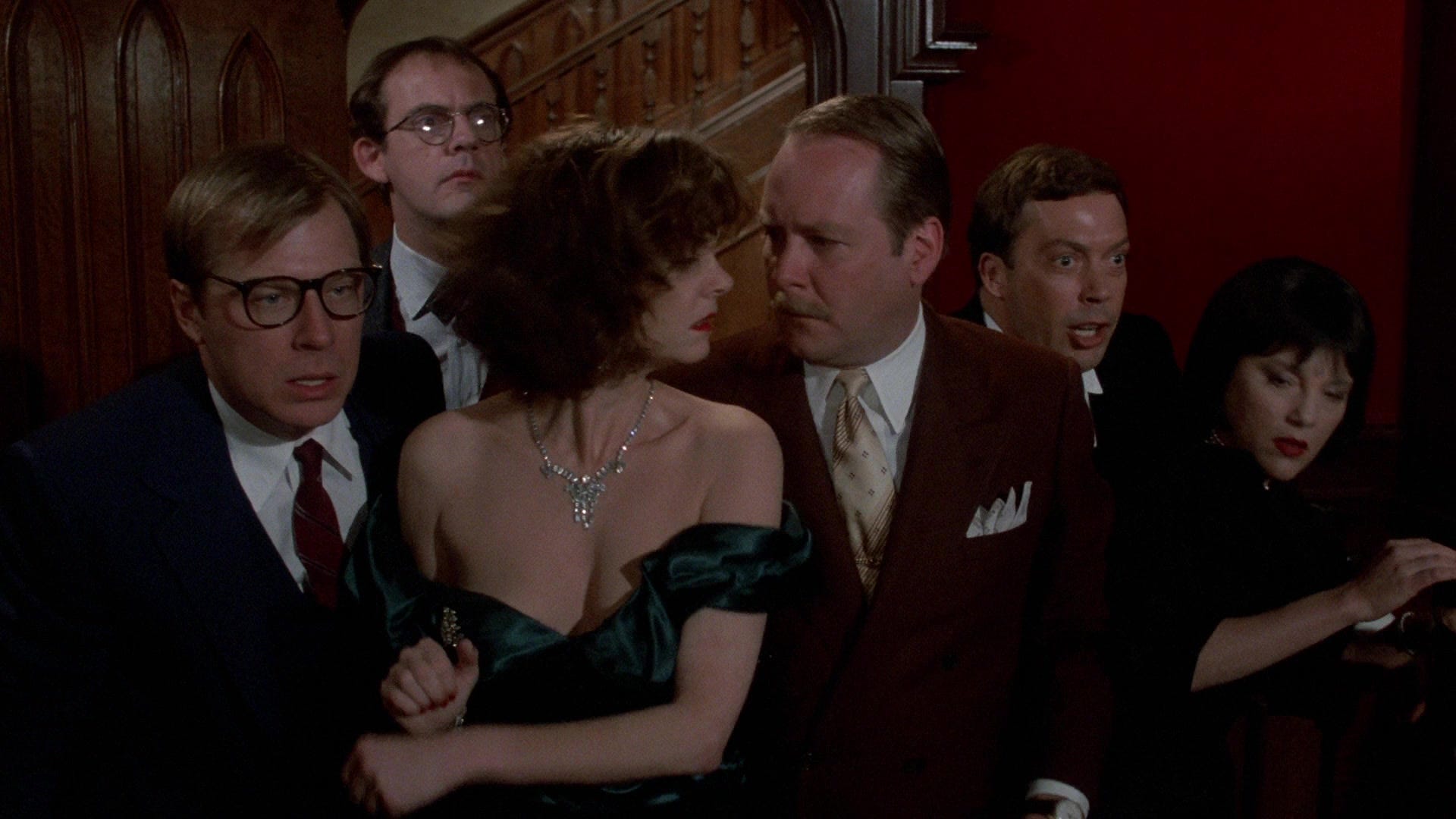
In December 1983, Lynn got to work. Fortuitously, the decade of American history he was most familiar with was the fifties, namely, how it was shaped by the Red Scare. His knowledge came from friendships with men like Donald Ogden Stewart, screenwriter of The Philadelphia Story (1940) and a suspected Communist who’d refused to name names to the House Un-American Activities Committee. Blacklisted from work in the States, Stewart had emigrated to London with his wife. Reinvention provided a solution to one of Lynn’s larger concerns with adapting Clue: the absurdity of six murder suspects named after colors. It stood to reason that dinner guests with dark secrets would be assigned aliases upon their arrival at the mansion. Lynn decided they were all being blackmailed by their host, Mr. Boddy, giving each guest a motive to murder him, along with anyone else who threatened them. Lynn rocketed through the first act in a week. The next six months went less smoothly. By his own estimate, Lynn spent about three weeks actually writing, the rest figuring out what to write. This included two rough attempts to arrive at a draft he was confident enough to call his first. At one point, Lynn was flown back to Los Angeles without yet knowing how all four endings would land. Dated May 4, 1984, Lynn's official first draft of Clue ran 200 pages, the length necessary for four endings, each requiring its own scenario for the butler to act out. He named the character Wadsworth, writing the part with Leonard Rossiter in mind. At the time, Lynn was directing the actor in a production of Joe Orton's farce Loot. In October 1984, Rossiter was waiting to go on stage when he suffered heart failure and died before Lynn ever got to offer him the role. A second draft dated June 4, 1984 contained superficial edits, such as replacing English spellings with American ones. Lynn’s third draft, which he finished in January 1985, had more noticeable changes. Lynn had shifted the action from Florida to New England, and lightened the tone of his previous drafts with fewer references to the Red Scare.
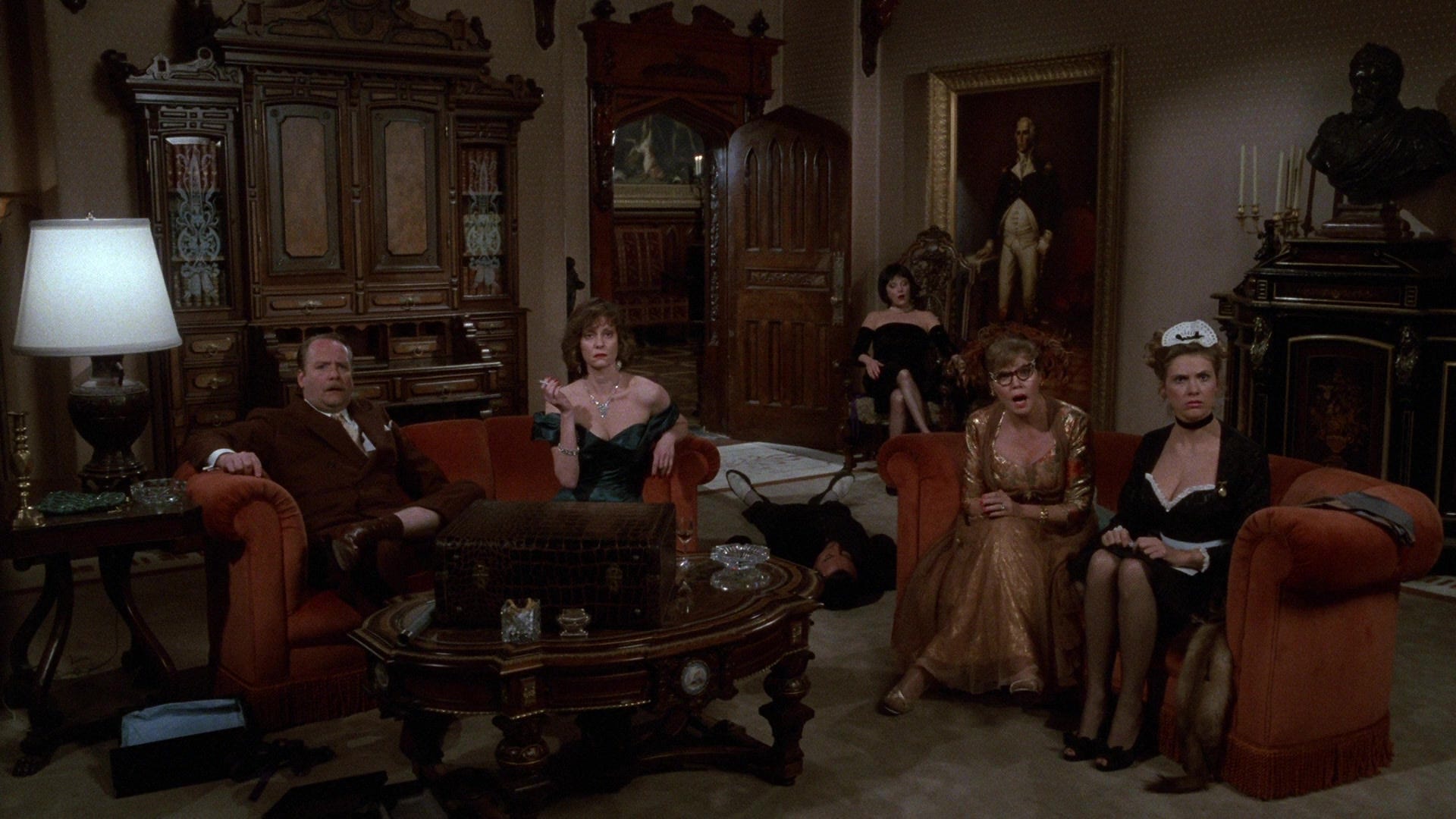
Clue had spent four and a half years waiting for a greenlight, and it would take two job openings, arriving almost on top of each other, to finally deliver one. In October 1984, Ned Tanen assumed office as president of motion pictures at Paramount. With the new regime needing projects they could put into production immediately, Tanen lobbied studio chairman Frank Mancuso that Clue should be one of them. Almost as soon as the board game adaptation had a home, it lost its director. John Landis announced that he’d decided to direct the lavish action/comedy Spies Like Us (1985) for Warner Bros., from a screenplay by Dan Aykroyd & Dave Thomas. Paramount’s president of production Dawn Steel would have to start from scratch searching for an available director who shared Landis’s ardor for farce. But on his way out the door, Landis sold her on Lynn being the right director for Clue. He’d dialed in every page of the script (the Writers Guild of America would award sole screenplay credit to Jonathan Lynn, from a story by Lynn and John Landis) and nearly all of it could be shot on soundstages at Paramount. Lynn recalled, “I’d been directing in the theater for fifteen years, so I wasn’t worried about the prospect of directing actors. I was concerned about the camera, which I knew nothing about. But I’d done some big hits in London, farcical shows mostly, Feydeau and Joe Orton. So I said, ‘Yes, I’d like to direct it.’” With Debra Hill as producer, Landis and his producing partner George Folsey Jr. retained executive producer credits, as did Peter Guber and Jon Peters.
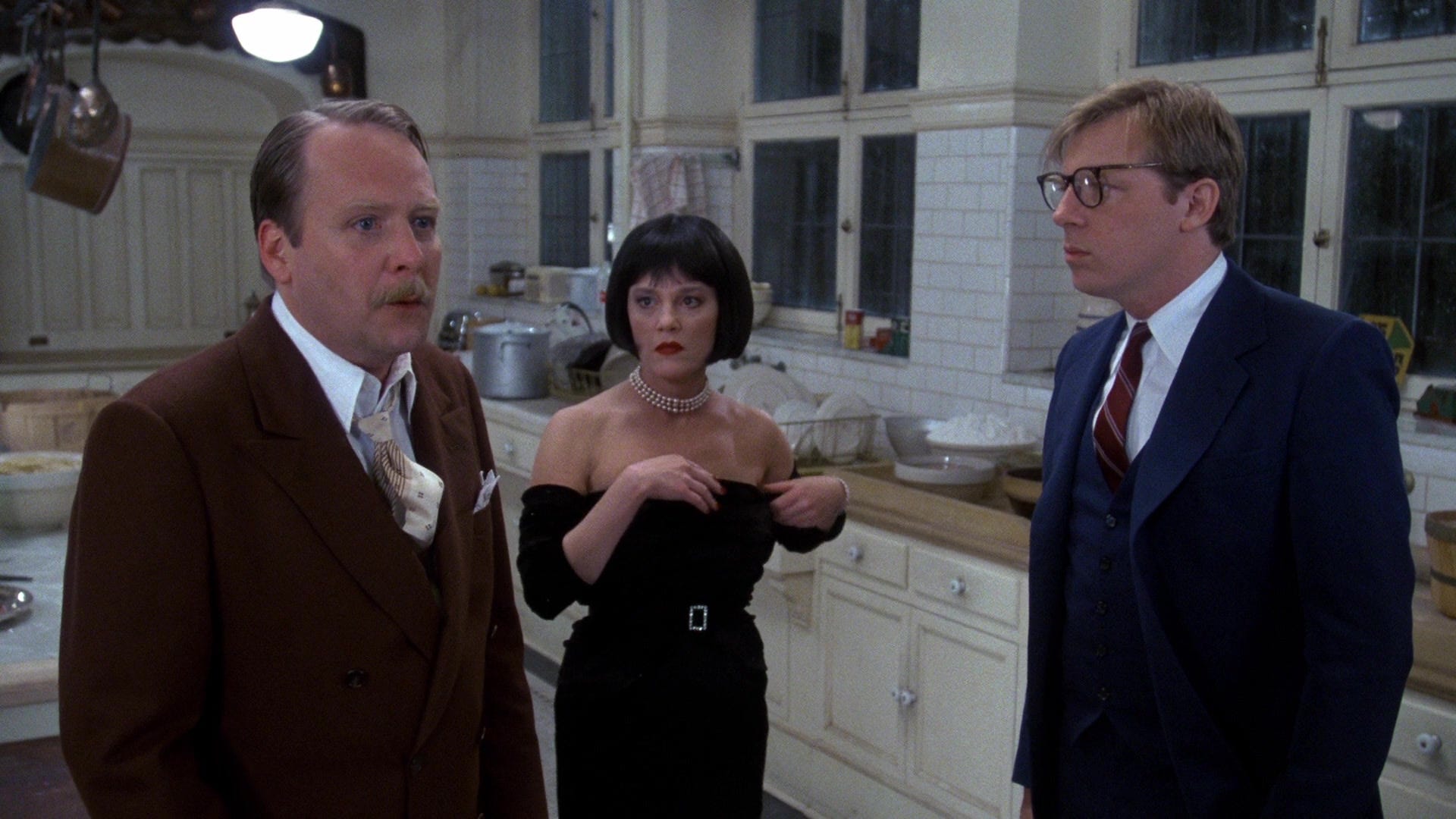
On January 23, 1985, casting directors Janet Hirshenson [Hursh-En-Son] and Jane Jenkins submitted their first list of actors to Hill, Guber and Lynn. Hirshenson and Jenkins had cast The Dead Zone (1983) and were preparing to make a remarkable quarter-century run casting films that would define moviegoing for a generation. Their initial list for Clue wasn’t afraid to shoot high on Wadsworth, floating names like Bill Cosby or Bill Murray for the butler. Dabney Coleman, Carrie Fisher, Harry Anderson and Christopher Lloyd quickly emerged as favorites for Col. Mustard, Miss Scarlet, Mr. Green and Prof. Plum respectively. Michael McKean, who’d played David St. Hubbins in This Is Spinal Tap (1984), was considered a plug-in for any of the male roles. Narrowing the list with the casting directors on February 5, Hill and Lynn had added three candidates for Wadsworth: Rowan Atkinson, Tom Conti and John Lithgow. In Who Done It: The Clue Documentary (2023), Lynn recalled, “Rowan Atkinson I was very keen on. He was a big star in London at that time. And I contacted him and said, ‘Would you be interested?’ And he said, ‘Yes.’ And I said, ‘Unfortunately, Paramount has never heard of you. Can you send a reel of some sort?’ So he did, but I don’t think they ever watched it. They certainly said, ‘No, we don’t know who he is, we’re not interested.’” Lesley Ann Warren was a serious candidate for Mrs. White. Anthony Perkins was at the top of the list to play Mr. Boddy. In addition to playing Norman Bates in Psycho (1960) and its 1983 sequel, Perkins had co-authored the screenplay for the star-studded whodunit The Last of Sheila (1973) with composer/lyricist Stephen Sondheim. The duo had actually joined Landis for lunch to discuss co-writing Clue, but Paramount took Perkins & Sondheim no more seriously than they would Rowan Atkinson.
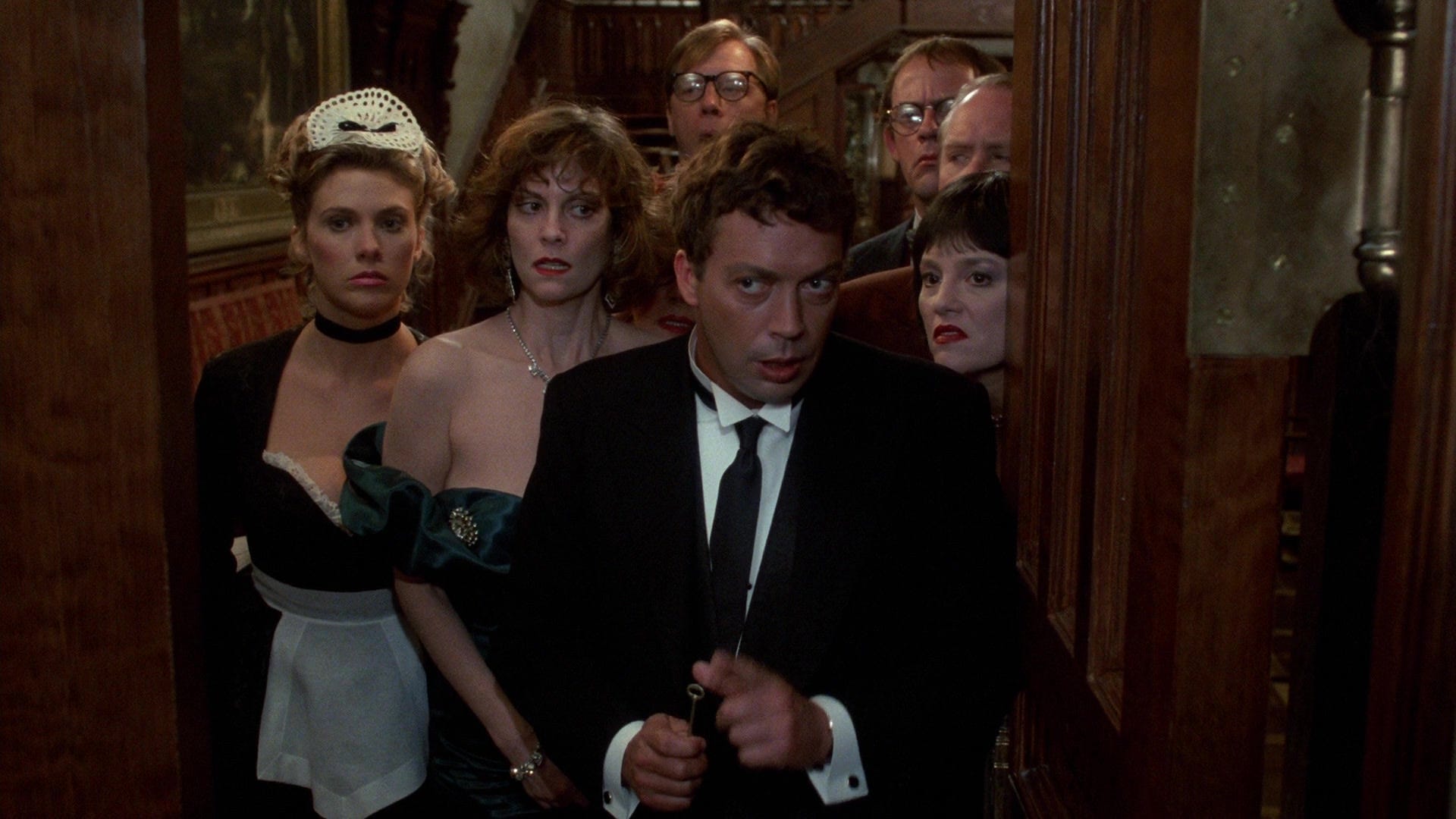
With the list whittled down to actors who were affordable and available, Hill, Guber and Lynn began meetings on February 6. First up was Michael McKean, with whom they discussed the role of Mr. Green. Shelley Duvall came in to discuss playing Mrs. White. Dabney Coleman, David Ogden Stiers and Martin Mull met to talk about Col. Mustard. Carrie Fisher and Lesley Ann Warren had meetings to discuss playing Miss Scarlet and Mrs. White, respectively. On February 10, Hill and Lynn flew to New York to meet several actors. These included Billy Crystal for the role of Mr. Green, Charles Grodin as a potential Col. Mustard, Jane Curtin and Madeline Kahn for Mrs. Peacock, and Phoebe Cates for Yvette. By February 12, Coleman and Grodin had passed, clearing the way for Mull to play Col. Mustard. Mull had played a comic heel opposite Michael Keaton in Mr. Mom (1983), but first came to living rooms as a droll sketch comedian and star of Fernwood 2 Night, the first mock TV talk show. Elsewhere in casting sessions, Hill and Lynn agreed that Harry Anderson, Judge Harry Stone on the sitcom Night Court, wasn’t what they were looking for in Mr. Green. Michael McKean was offered the part. Christopher Lloyd was a lock for Professor Plum, with Carrie Fisher expected to play Miss Scarlet. The filmmakers flirted with the possibility of casting a fifties matinee idol like Doris Day, Ava Gardner or Elizabeth Taylor as Mrs. White, but that idea only got as far as Taylor replying that she would play Miss Scarlet but not the less glamorous widow. Lesley Ann Warren was moving from backup to most likely to be offered the role of Mrs. White. Anthony Perkins passed on playing Mr. Boddy, a smaller part he was nonetheless perfect for. Pamela Stephenson, who’d joined the cast of Saturday Night Live for its 1984–85 season, had taken her name out of the running to play Yvette. On February 27, Hill and Lynn met with Olivia Newton-John, Nicolette Sheridan and Pia Zadora, none of whom seemed right to play the French maid.
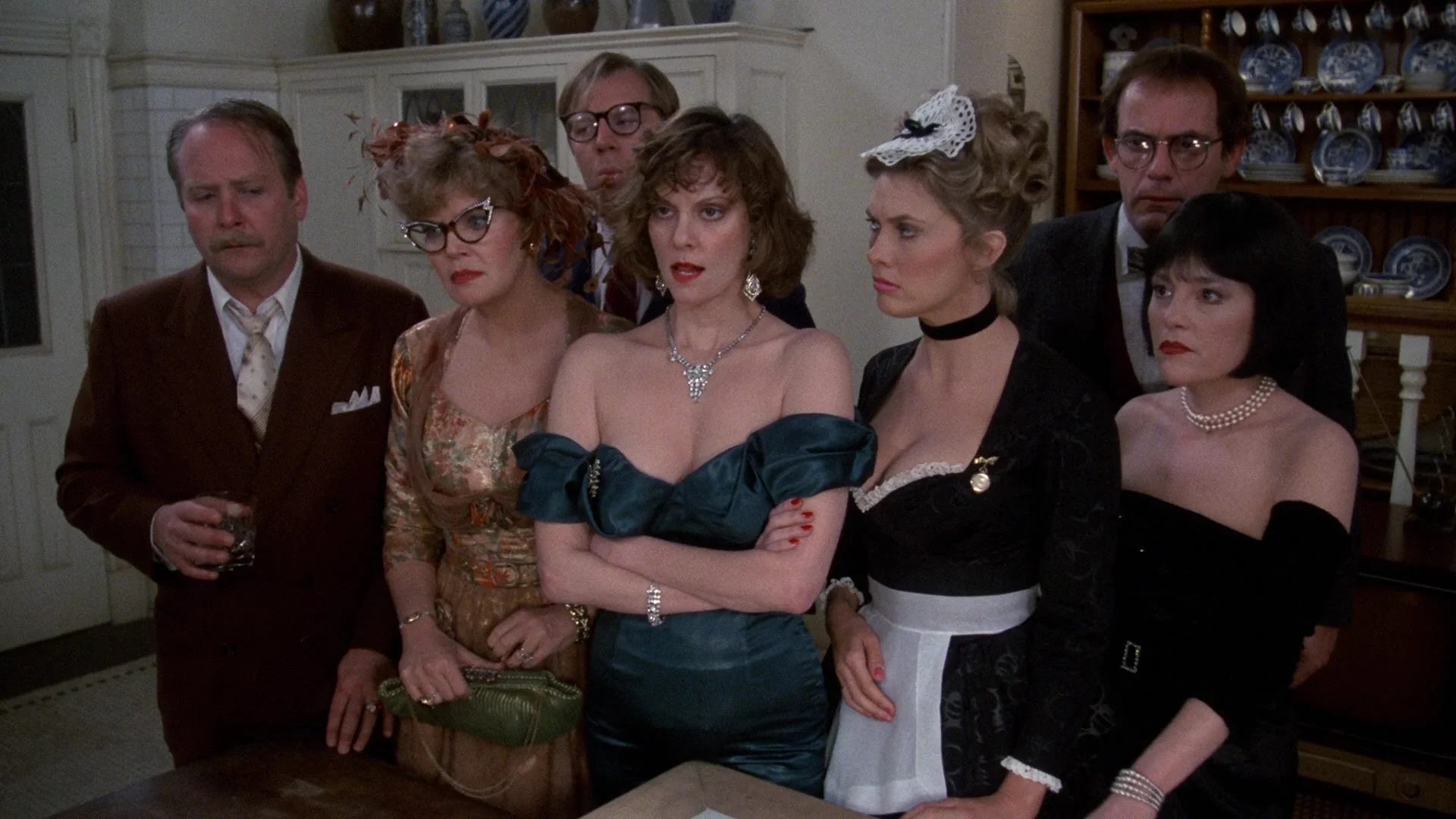
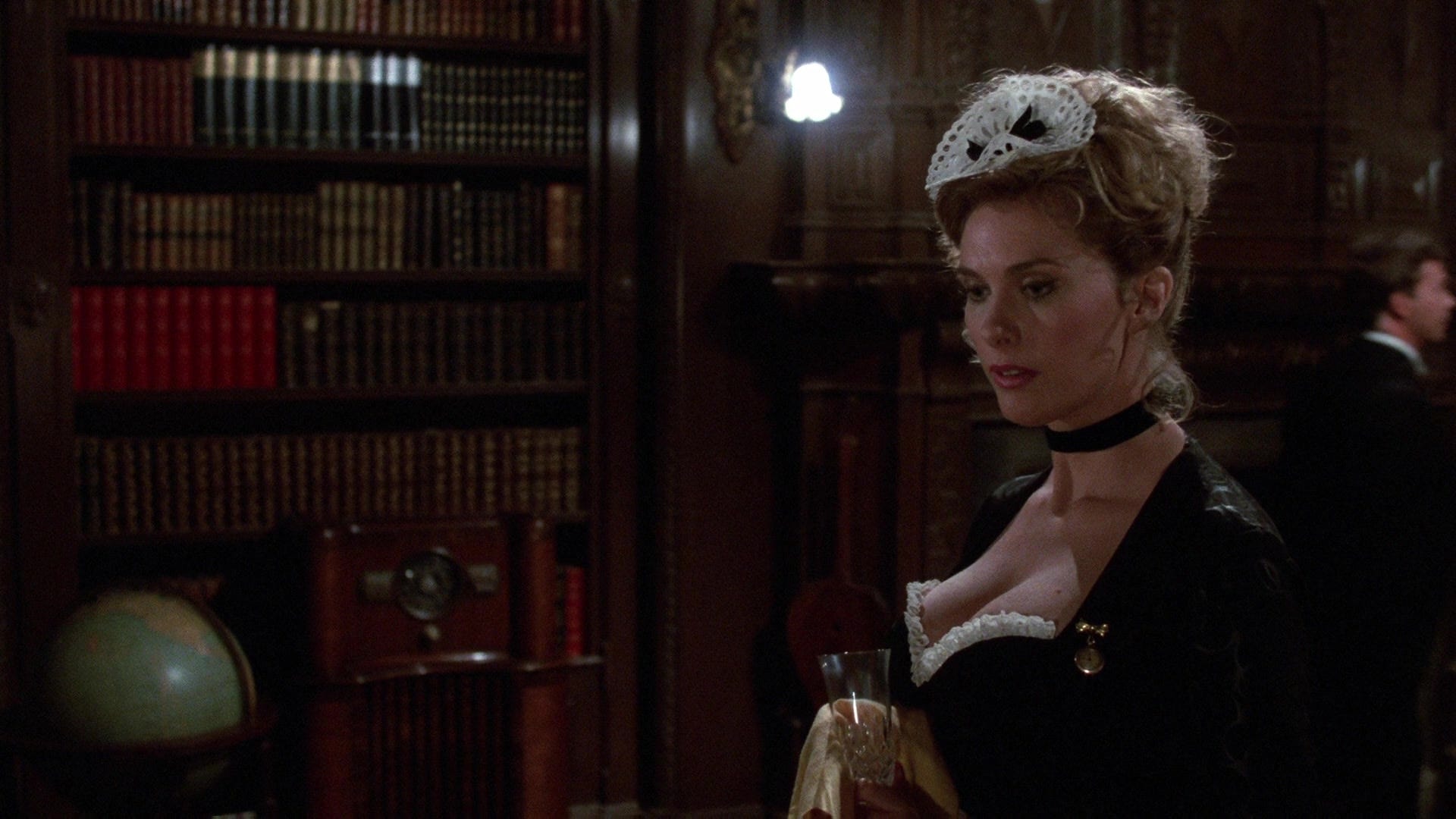
The most crucial role in Clue was still open. To cast Wadsworth, the filmmakers finally embraced a suggestion Hirshenson and Jenkins had submitted weeks earlier: Tim Curry. The actor and recording artist originated the role of Frank-N-Furter in The Rocky Horror Picture Show on the London stage in 1973, its Los Angeles tour the following year and in a cult classic when it was adapted to film in 1975. Curry and Lynn had actually attended Methodist prep school together, in Bath, when Curry was 12 and Lynn was 14, not friends but not unfamiliar to each other either. Curry was offered the role and accepted. On March 26, Hill and Lynn read Pam Dawber, Heather Locklear and Kelly Preston for Yvette, but Colleen Camp—who presented at her audition in black stockings, short black dress with white apron, and a plunging bodice—leapt in front of the other candidates. Camp was a chameleon, rarely playing the same role—bombshell, best friend, mother—twice, hopping from appearances in Apocalypse Now (1979) to The Seduction (1982) to Valley Girl (1983). She offered something the others did not: versatility. The casting of Mr. Boddy took an odd turn. Lee Ving, frontman of the punk band Fear who'd appeared as hoodlums in Flashdance (1983) and Streets of Fire (1984), auditioned for the role of the Motorist. Lynn believes his reading led Dawn Steel to propose Ving for Mr. Boddy. That left Mrs. Peacock to cast. Eileen Brennan was another name that Hirshenson and Jenkins proposed and had been skipped over. Brennan was an Academy Award nominee, for Best Supporting Actress in Private Benjamin (1980). On October 27, 1982, she was walking back to her car following dinner with her co-star Goldie Hawn at a Los Angeles restaurant. Crossing a street darkened by a power outage, Brennan was struck by a motorist traveling fifty miles an hour. She fractured both legs on impact, and in what may have saved her life, bounced off the hood. Landing on the pavement head first, Brennan broke her nose and suffered a slight concussion. She recovered from her injuries to seek treatment for a dependency to painkillers, admitting herself to the Betty Ford Center in September 1984. Clue would be Brennan's first film role since her accident. Rather than wait for the equivalent of a sparring contest, Brennan assured Hill and Lynn that she was up for a battle royal.
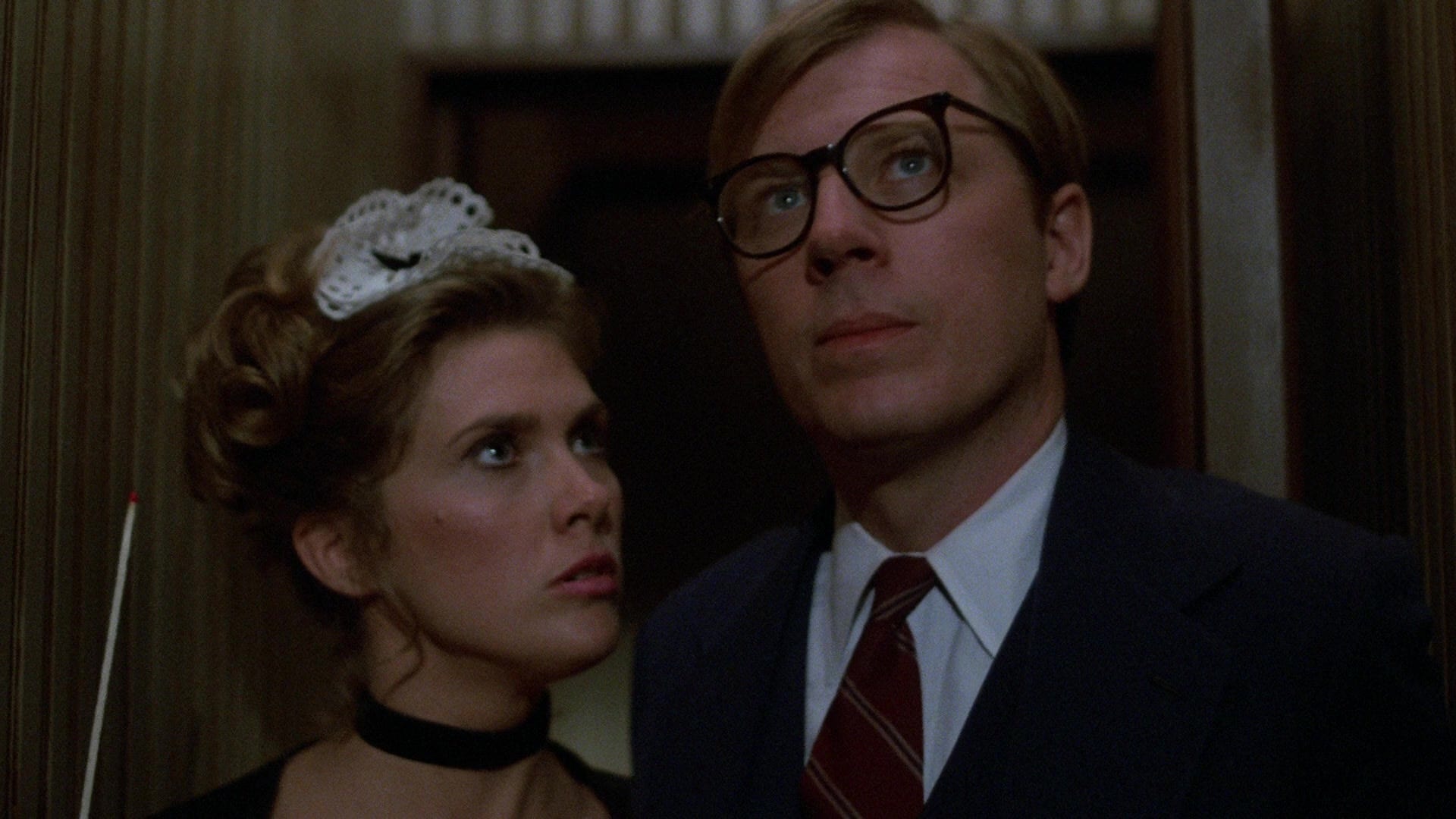
A ten-day rehearsal was scheduled to begin at Paramount in early May 1985. Lynn was so busy preparing to make his film directorial debut it’s unlikely he heard that Carrie Fisher had overdosed on tranquilizers. Two friends, one a doctor, rushed Fisher to Cedars-Sinai Medical Center in West Hollywood where her stomach was pumped. The actor was in stable condition, but her brush with John Belushi’s fate convinced her it was time for rehab. Fisher’s recovery would inform her memoir Postcards from the Edge and her screenplay adaptation, Meryl Streep playing Fisher’s surrogate in the 1990 comedy. Fisher put a call in to her director to update him on her condition. Lynn recalled, “Just before we started rehearsal—I’m glad I insisted on a week’s rehearsal—just before we started she phoned me and said, ‘Hi, it’s Carrie. I’m in rehab, at Century City Hospital, and I just wanted you to know that.’ And I said, ‘Well, how would you do the movie?’ She said, ‘Well, they’ll let me out every day. And I’ll come back here at night.’ And I thought, ‘I wonder if that’s true.’ So I phoned Debra Hill, who was the producer. And Debra seemed relaxed about it. So we told the studio and Dawn Steel didn’t seem to mind. So it stayed like that for a couple of days.” Fisher’s name was still on the cast list as of April 26, 1985 along with Lesley Ann Warren as Mrs. White. Lynn continued, “Then I got a message saying the insurance, we can’t get her insurance, she can’t be in the movie. So I had four or five days left to recast.” Within a week, Carrie Fisher was out, and Lesley Ann Warren had agreed to take over the role of Miss Scarlet. Warren, the second ex-wife of executive producer Jon Peters, had seen her career blossom since their divorce, with an Academy Award nomination for Best Supporting Actress in the musical comedy Victor/Victoria (1982). Madeline Kahn, who’d begun as a possible Mrs. Peacock, joined the cast as Mrs. White. Warren and Kahn were flown to Los Angeles days before rehearsals began.
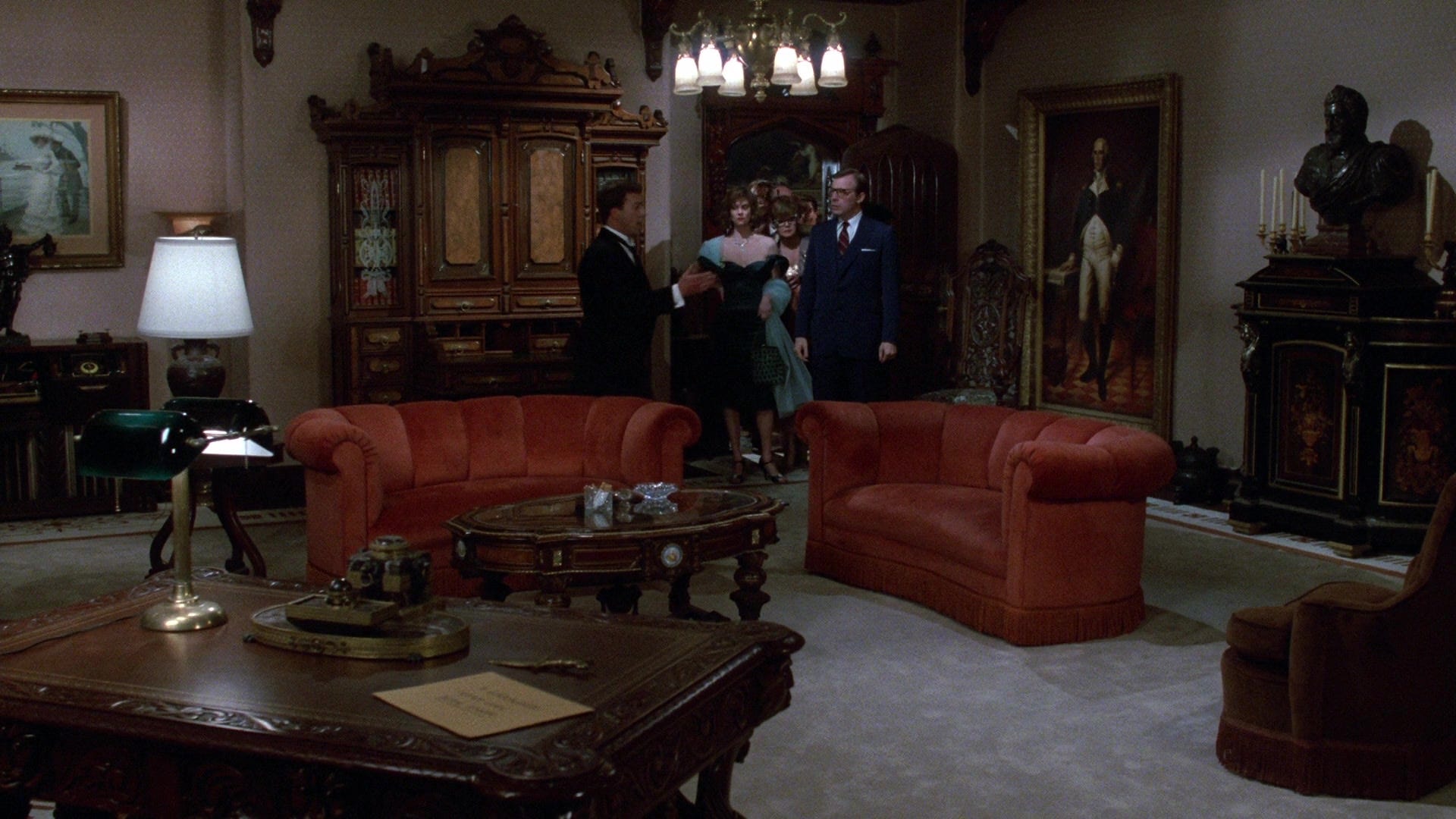
Clue commenced filming on May 20, 1985, with a production budget of $8 million. This was comparable to what Universal Pictures spent to produce Fletch (1985) and Weird Science (1985). Unlike those comedies, Clue would require barely any location work or visual effects. Audience familiarity with the game justified its relative expense. Lynn dubbed the film’s forbidding mansion “Hill House” as a tribute to both Shirley Jackson’s novel The Haunting of Hill House and to producer Debra Hill. Nearly all the interiors, the front facade and driveway were constructed and shot on Stage 18 at Paramount. This was the soundstage that housed the massive and intricate apartment courtyard for Alfred Hitchcock’s Rear Window (1954). Not everything in Clue could be faked on the stage. Cast and crew headed to nearby Pasadena to spend two days working at Max Busch House, a brick Tudor-style mansion built in 1929 and designed by Paul Revere Williams, the first Black member of the American Institute of Architects. The gate stood in for the entrance to Hill House, while its ballroom spared production designer John J. Lloyd the expense of building one for such a brief scene in the film. Illusion Arts, a company founded by visual effects cinematographer Bill Taylor and matte painter Syd Dutton, executed the exterior shots of Hill House through the art of matte paintings. Academy Award-winning matte artist and special effects pioneer Albert Whitlock, who’d worked with Hitchcock early in the director’s career with The 39 Steps (1935) and at his apex with The Birds (1963), came out of retirement to consult on Clue. (Hitchcock had only been dead for five years, but the producers of Clue, who’d grown up under his reign as the master of suspense in both film and television, were still whistling past his grave.)
Director of photography Victor J. Kemper had finished shooting Tim Burton's feature film directorial debut, Pee-wee's Big Adventure (1985), six weeks earlier, and Hill hired Kemper to steer another director through his first picture. Lynn recalled, “One of the problems is this business of crossing the line … If you shoot a close-up of me looking that way, then a close-up of the person replying, also looking that way, they have to appear to be talking to each other. You can’t tell who anyone’s talking to. So the problem is, if you shoot scenes with seven or eight people in them, you’ve got to work out with real precision where the line is at any given moment, where I can cut to from this character to that character and they appear to be speaking to each other, or whether you can’t. So, lengthy scenes with several people in them, you need to work all that out in advance.”
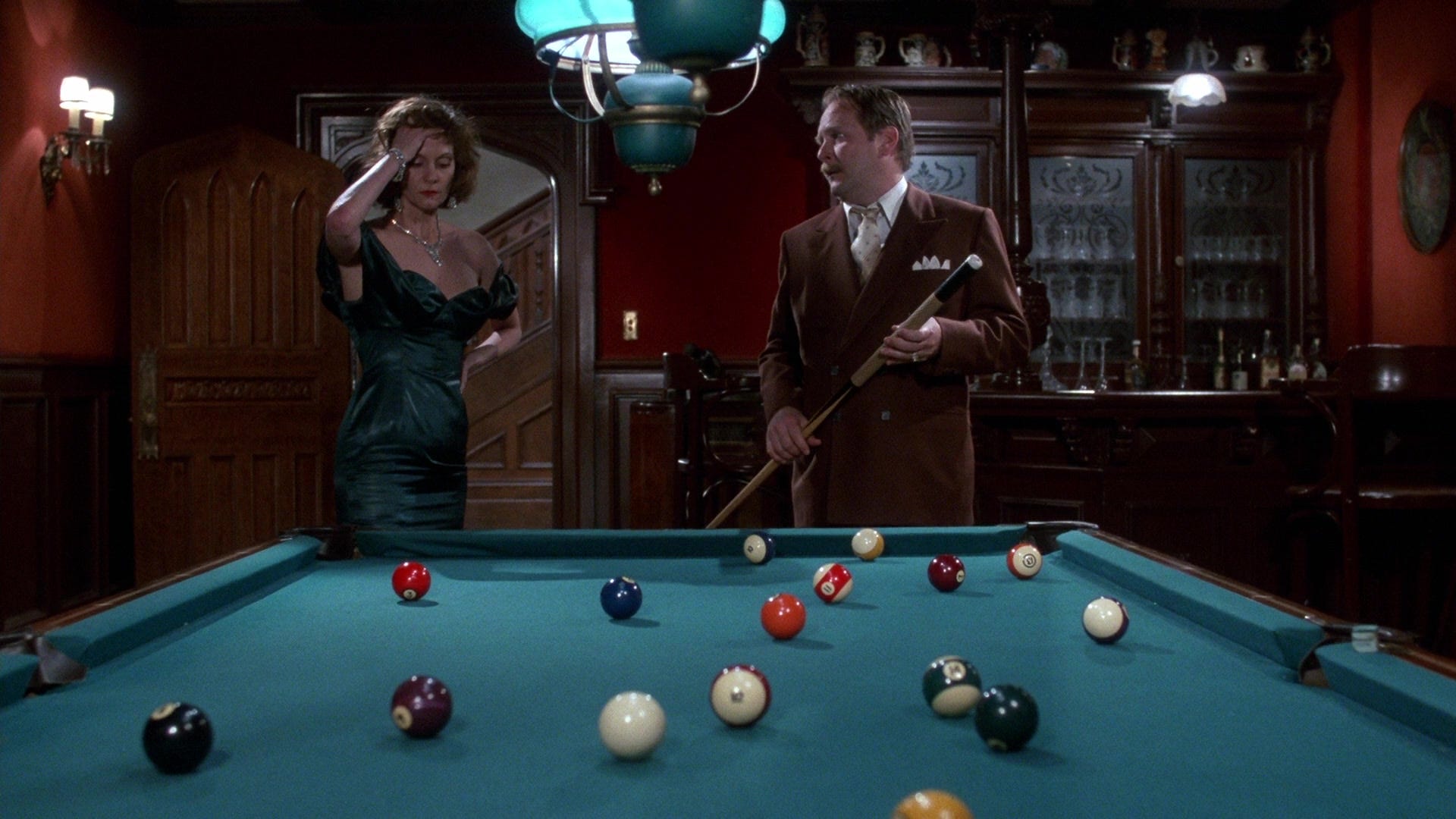
Lynn had lit and blocked plenty of plays without using storyboards, and didn't start on Clue. He choreographed the shots in advance with Kemper, a process that took time but, in the end, Lynn felt had worked out. Booking the primary cast on the same eight-week schedule in the same location also echoed his experience in the theater. The plan was to shoot in continuity, helping Lynn and the actors hold the madcap plot together. John J. Lloyd, an Emmy-winning production designer with one hundred episodes of Alfred Hitchcock Presents to his credit before designing The Blues Brothers and The Thing (1982), drew up the sets for Clue. These elaborate sets took longer to light than Kemper had anticipated. Production fell behind, and after roughly four weeks, the schedule was tweaked. Whether filming in order or shooting out of it, the intricacies of Lynn's script left very little room for the actors to improvise. Madeline Kahn became an exception. Lynn recalled, “There was a speech written for her. Madeline said, ‘You mind if I don’t do this speech? Can I improv something?’ And I said, ‘Sure, but if it doesn’t work, we’ll do the speech we wrote. The speech in the script.’ And she did that speech, flames speech, and it just made me laugh so much. And everybody else on the set. And I don’t think we ever shot what was in the script … Mrs. White was barking mad, which was something Madeline played very well.”
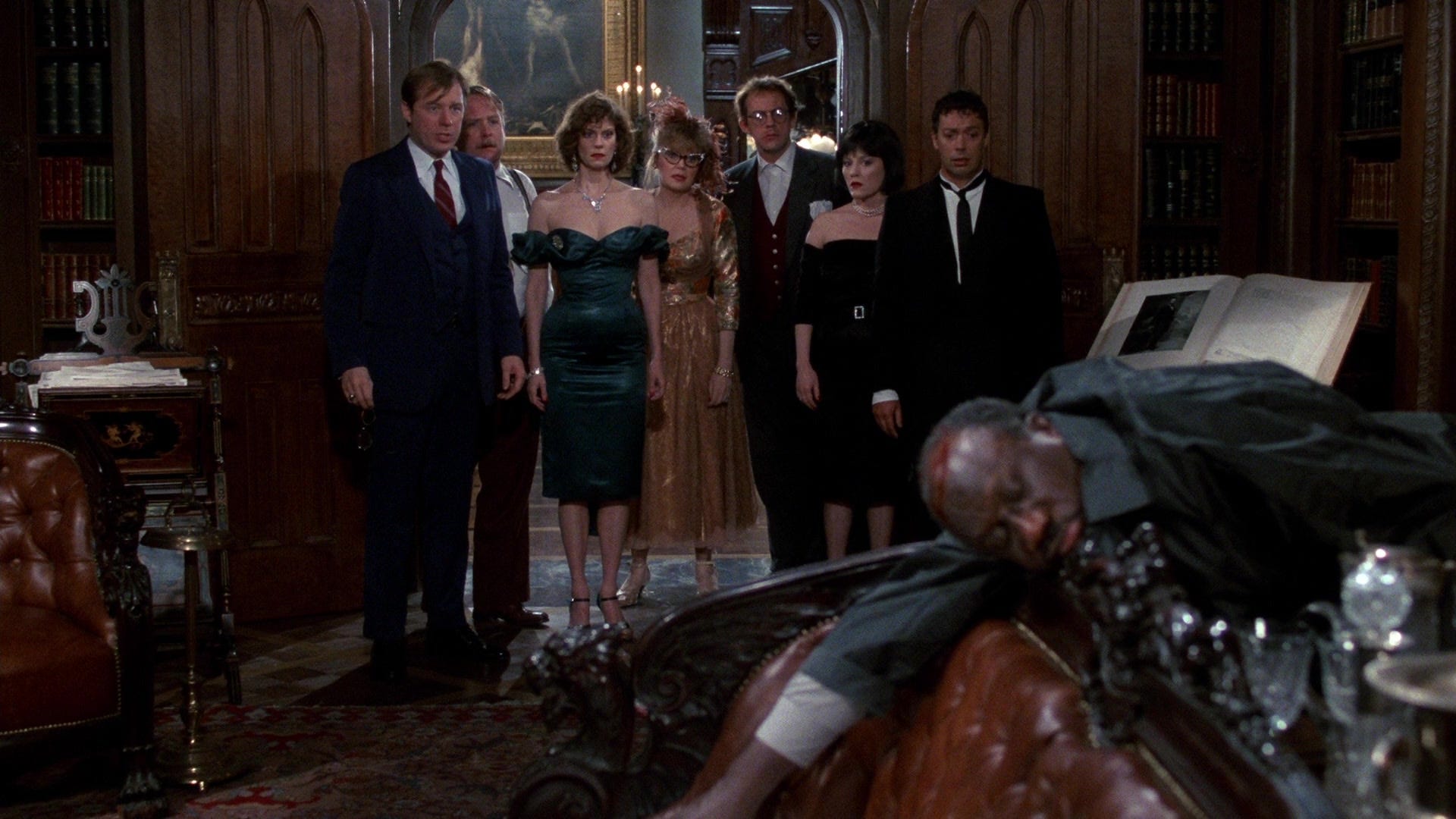
Jonathan Lynn has maintained he was dubious of the gimmick to ship Clue to theaters with one of four different endings attached. He’d shot all four as written, but when the film went before a test audience in September 1985, one of the endings tested so poorly it would be permanently cut. In this lost ending of Clue, Wadsworth reveals himself to be the murderer, having poisoned each of the guests. In the frantic search for the antidote, the action jumped through five different rooms, the driveway and the interior of a car. Despite being the most arduous ending to shoot, test audiences didn’t find it funny. This left Lynn with three endings: A (Miss Scarlet did it), B (Mrs. Peacock did it) and C (everyone did it). In her coverage of Lynn’s script, Paramount script reader Julie Lantz recommended that if the filmmakers dropped the multiple-ending scheme, A would be her preferred ending. Lynn stated his preference was to attach all three endings to every print of the film, but in the end, he trusted that his producers knew what they were doing. Paramount’s plan was to send each theater exhibiting Clue four reels plus a fifth labeled ending A, B or C. The theater box office would post which ending they were playing, and local newspapers were supposed to report that information as well. The studio was gambling that audiences would not only remember whether they’d seen A, B or C, but would pay to see Clue multiple times. When screened for the press, Paramount presented all three endings, which suggested this was the best way to see the film. According to Roger Ebert, a studio representative was either unable or unwilling to confirm for him whether the order in which the endings had been screened for critics followed the same A-B-C option moviegoers would be presented with.
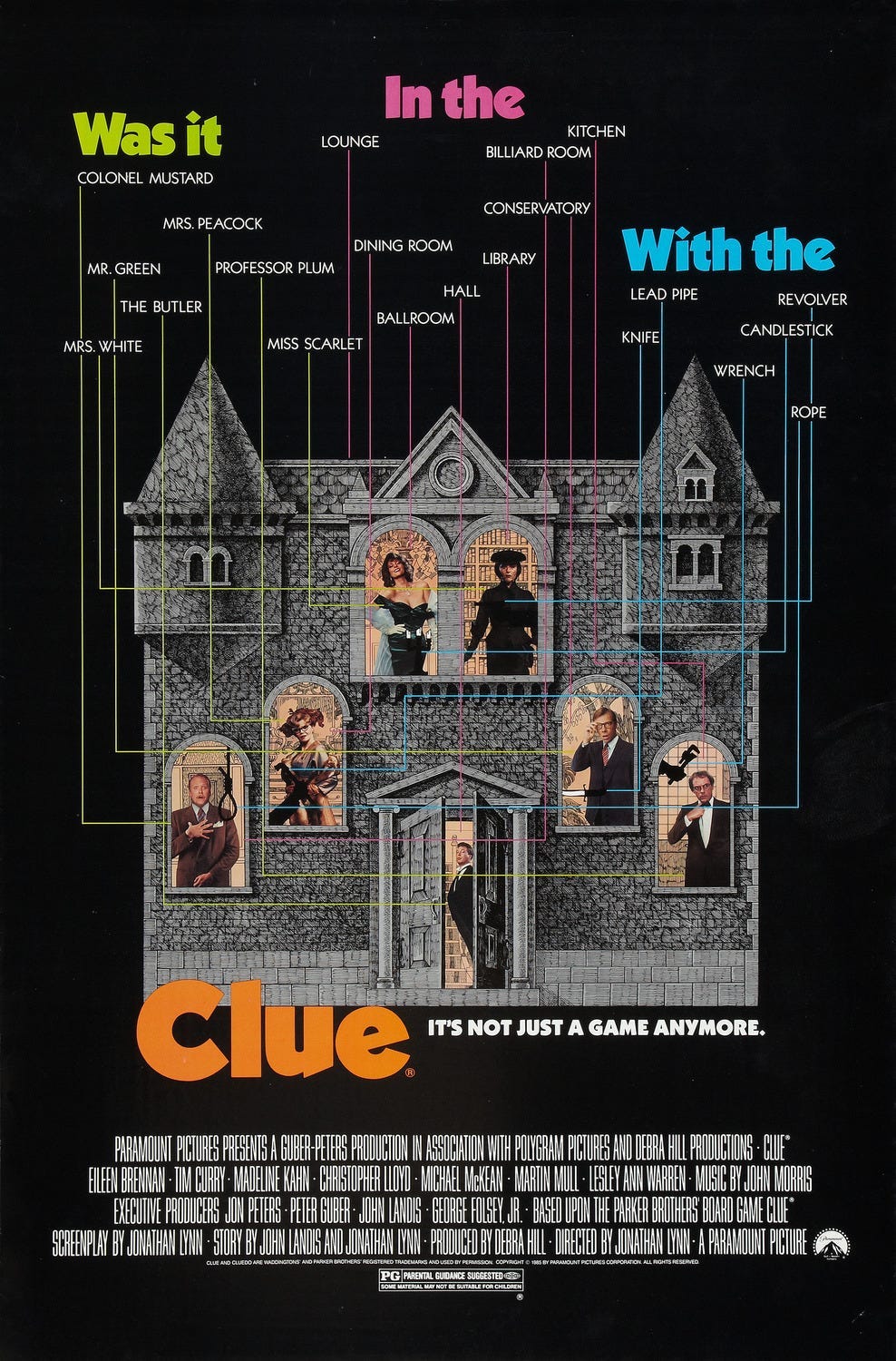
Clue debuted December 13, 1985 in 1,006 theaters in the U.S. Critics came out swinging. Writing in the Chicago Tribune, Gene Siskel declared, “When all of these characters are being introduced, Clue is very funny. Each has been given a cute secret and a couple of snappy retorts. But after they are all in the same room together, and the lights go out, so does the film’s inspiration. A murder has been attempted, and the rest of the movie turns the cast into a bunch of mice running on a treadmill.” Siskel gave the film 2½ stars out of 4. In the Chicago Sun-Times, Roger Ebert found less to like, “Since none of these events have the slightest significance, the filmmakers have attempted to make Clue into a screwball comedy, with lots of throwaway gags and one-liners. Some of these moments of comedy are funny. Most are not. The cast looks promising … but the screenplay is so very very thin that they spend most of their time looking frustrated, as if they’d just been cut off right before they were about to say something interesting.” Ebert gave the film 2 stars out of 4. On their syndicated television program, Siskel & Ebert agreed that ending A was the best, and urged moviegoers to avoid theaters showing B or C, roughly two-thirds of the houses exhibiting Clue. In LA Weekly, Mary Beth Crain wrote, “This movie is so bad that watching it along with all three of the endings—the film critic’s punishment for existence—was like listening to a terrible 90-minute long joke with three equally terrible punch lines. The waste of talent is lamentable: Eileen Brennan, Madeline Kahn, Martin Mull and Tim Curry are funny, funny people with better things to do than bring to lifelessness the playing card characters in a Parker Bros. mystery that causes high excitement to beat in the breasts of those six years old and under.” Virtually everyone who filed a review of Clue hammered on how baffling the multi-ending gimmick was.
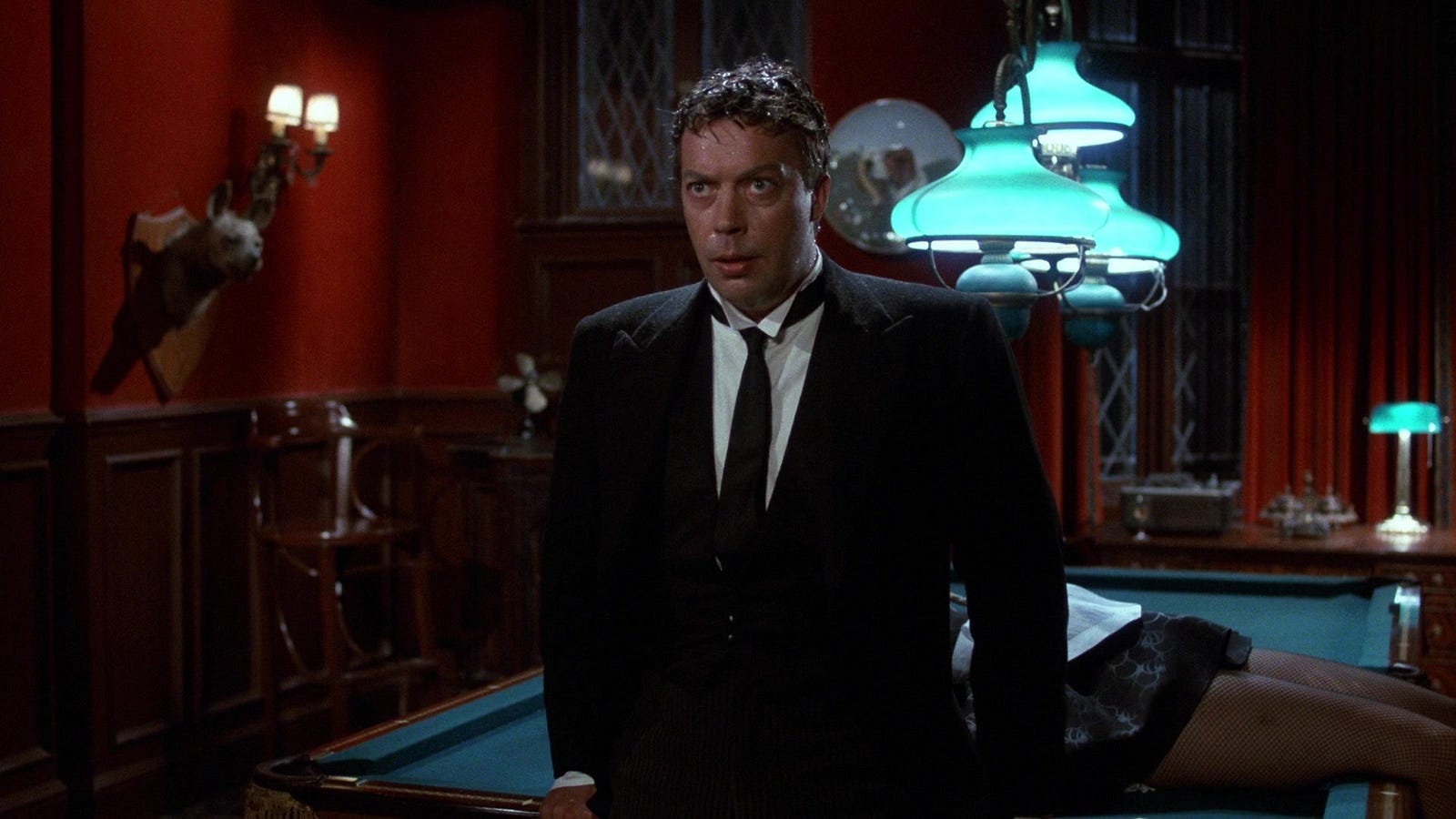
To avoid opening against the John Landis-directed Spies Like Us on December 6, or getting thrown against six other films opening in wide or limited release the weekend before Christmas, Clue opened December 13 against one new film. The Jewel of the Nile, a sequel to Romancing the Stone, coasted on the goodwill of an original that had been held over in theaters deep into the summer of 1984. Audiences bought it. The sequel reuniting Michael Douglas, Kathleen Turner and Danny DeVito sold three times as many tickets as Clue did in its opening weekend. In spite of support from Paramount, which would keep the picture playing in wide release for five weekends, Clue failed to build an audience, losing crowds to The Color Purple and Out of Africa as they opened in limited release, and Walt Disney Pictures when it re-issued One Hundred and One Dalmatians (1961) for Christmas. Addressing what many felt had alienated viewers, future prints of Clue — on VHS, basic and pay cable, DVD, streaming — included all three endings: “How It Might Have Happened” (A), “How About This?” (B) and “Here’s What Really Happened” (C) separated by title cards.
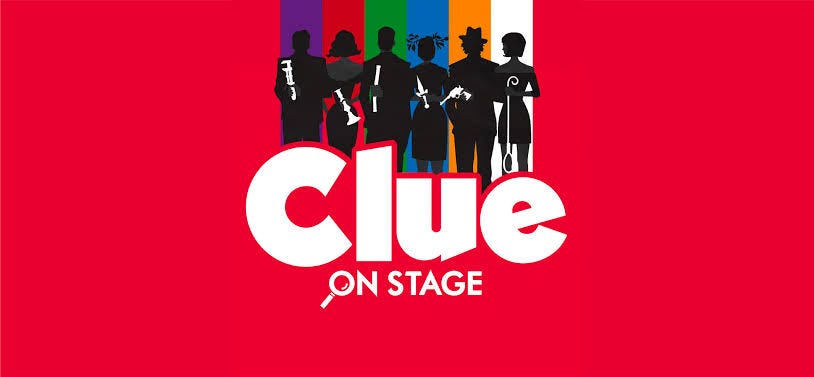
John Landis got his first hint that the board game adaptation hadn’t been a misfire when an eighth-grade theater arts program inquired about staging a live performance of Clue at their school. He recalled, “I advised them to do it and not ask Paramount for permission — just don’t charge money. It was somewhere in the Midwest. And then I got a very cute home video of the production.” A stage musical with professional actors titled Clue the Musical premiered in Baltimore, Maryland, in 1995 and reached Off-Broadway in December 1997, where it closed after twenty-nine performances. Far more popular would be a stage adaptation of Lynn’s screenplay by Sandy Rustin. Clue: On Stage opened in 2017 at the Bucks County Playhouse in New Hope, Pennsylvania. Regional theater from Oxford, Maine to La Mirada, California would perform the play, with many high schools getting in on the act. A new generation discovered the film and ate it up. In Who Done It: The Clue Documentary (2023), Lesley Ann Warren stated, “Wherever I go, twentysomethings always come up to me and are reciting every line in the movie, things that I don’t remember. It’s so popular with a whole new audience. And all the midnight shows they have all over where people dress up and become these characters. It’s become iconic.” Michael McKean added, “If you find an audience, or the audience finds you, that’s great. But to quote William Goldman, ‘Nobody knows anything.’ I had been on sets where everyone was convinced: smash-a-roo. And if it ain’t, we don’t hear from them so much. You really can’t know. It’s best to do your best.” Jonathan Lynn couldn’t get a job in the States until Twentieth Century Fox, which preferred a writer/director at the helm, offered him directing duties on My Cousin Vinny (1992). In 2013, he told BuzzFeed that Clue is the movie he gets the most mail about. “I saw Lesley Ann Warren a few months ago, and she said, ‘People love it now, you know.’ And I said, ‘Yeah.’ And then when I saw Michael McKean a few months ago, he said, ‘You know, people like it now.’ And I said, ‘Yeah.’ That’s the extent of the conversation. You move on.”
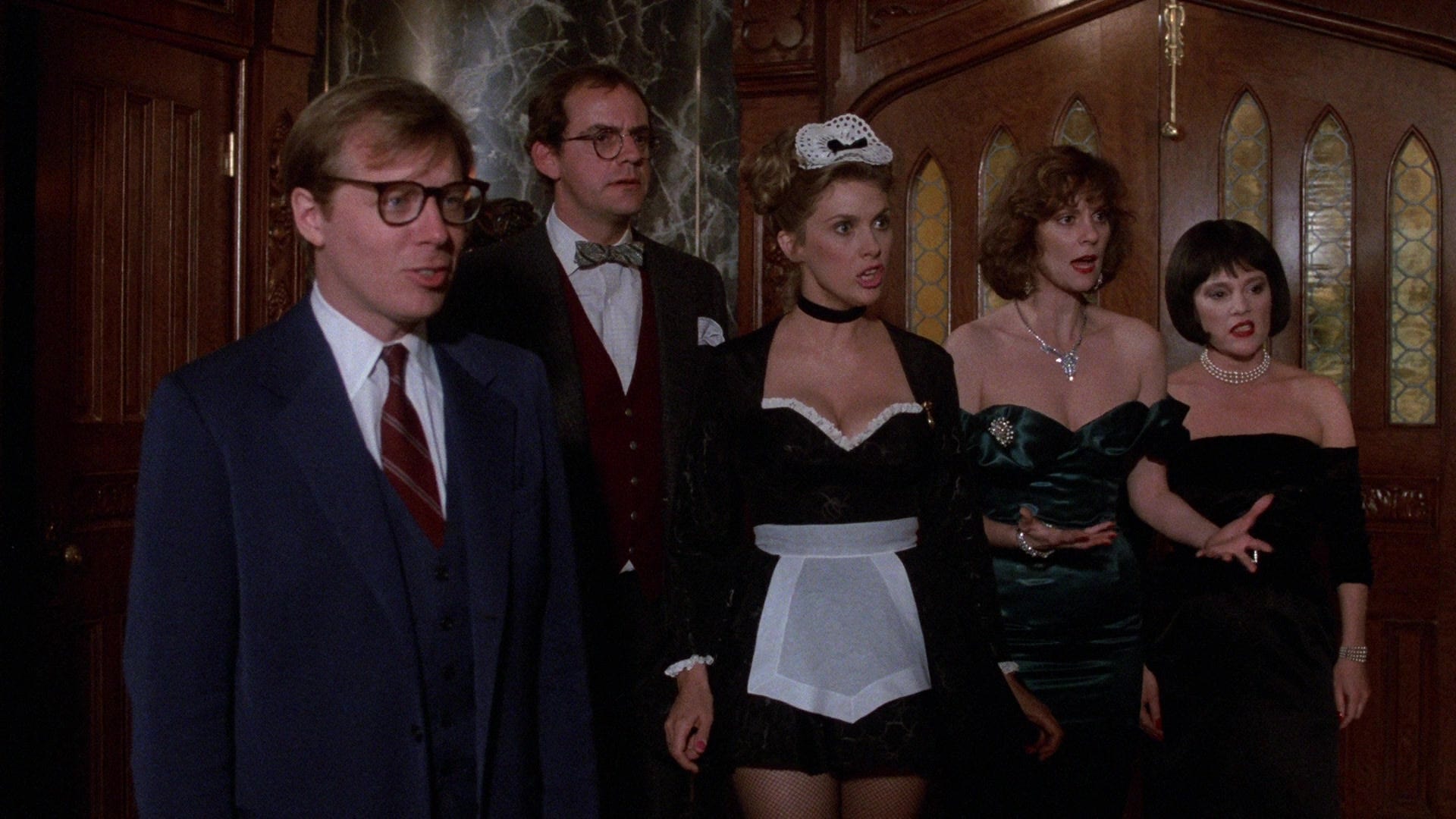
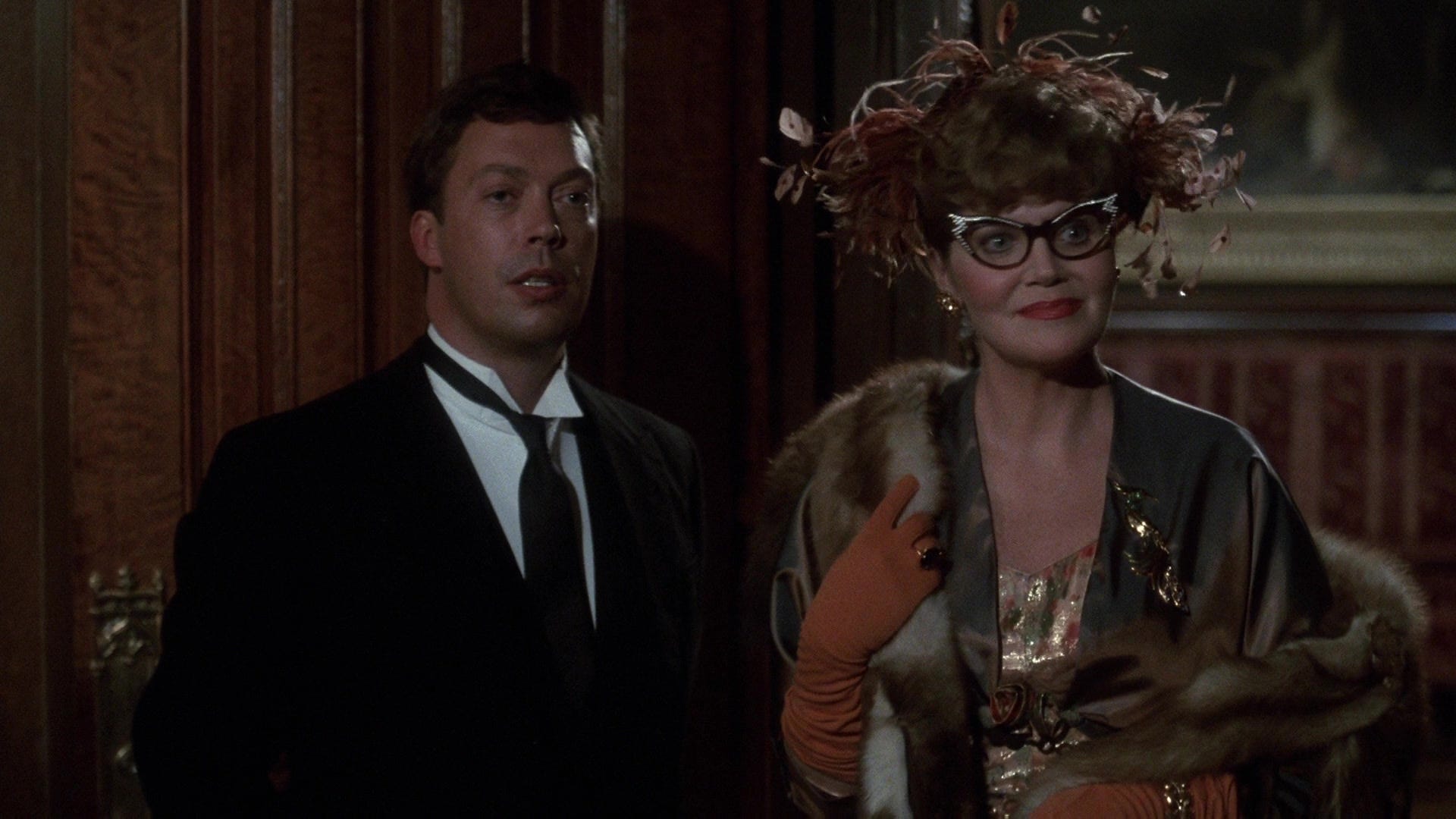
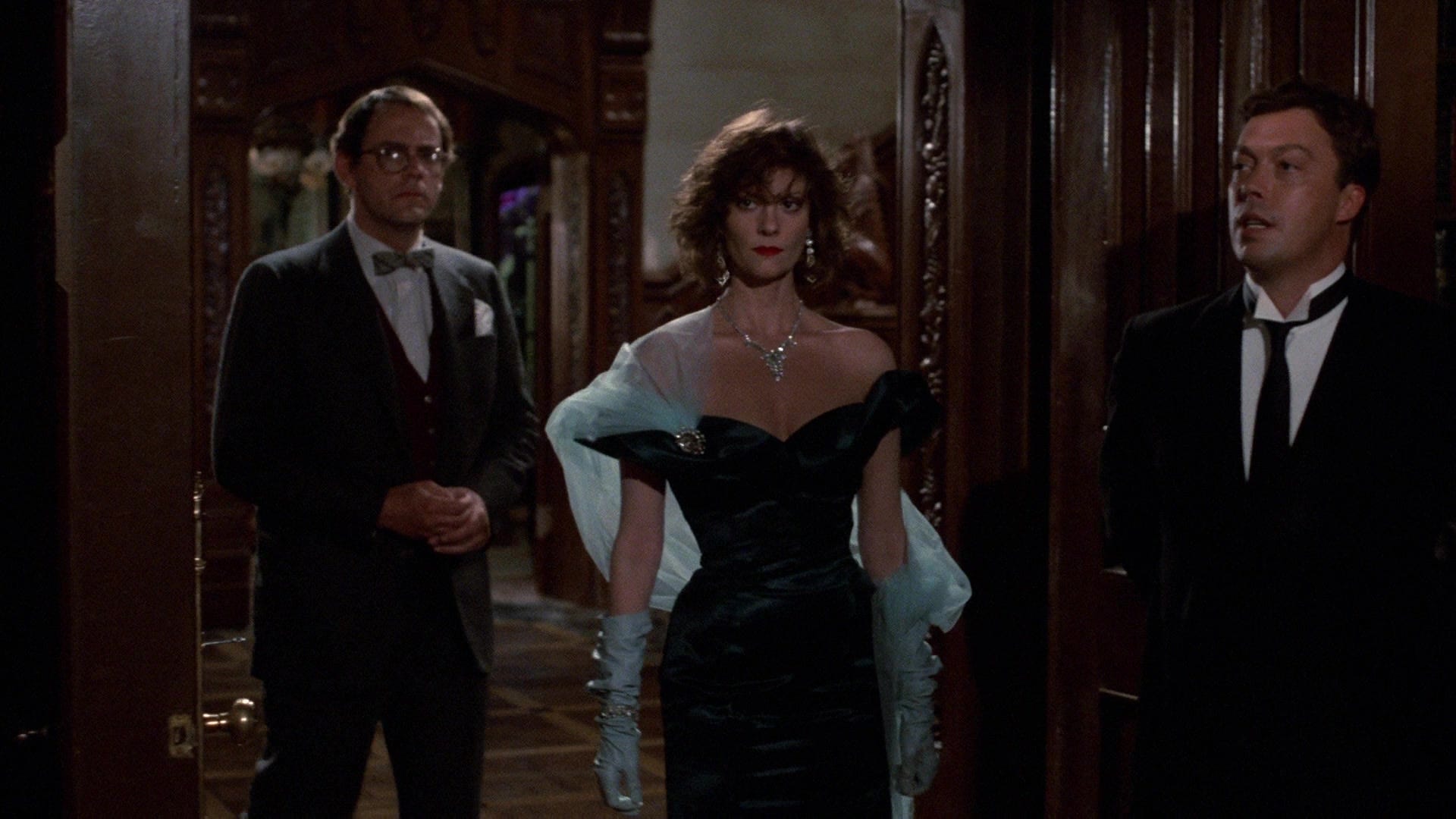
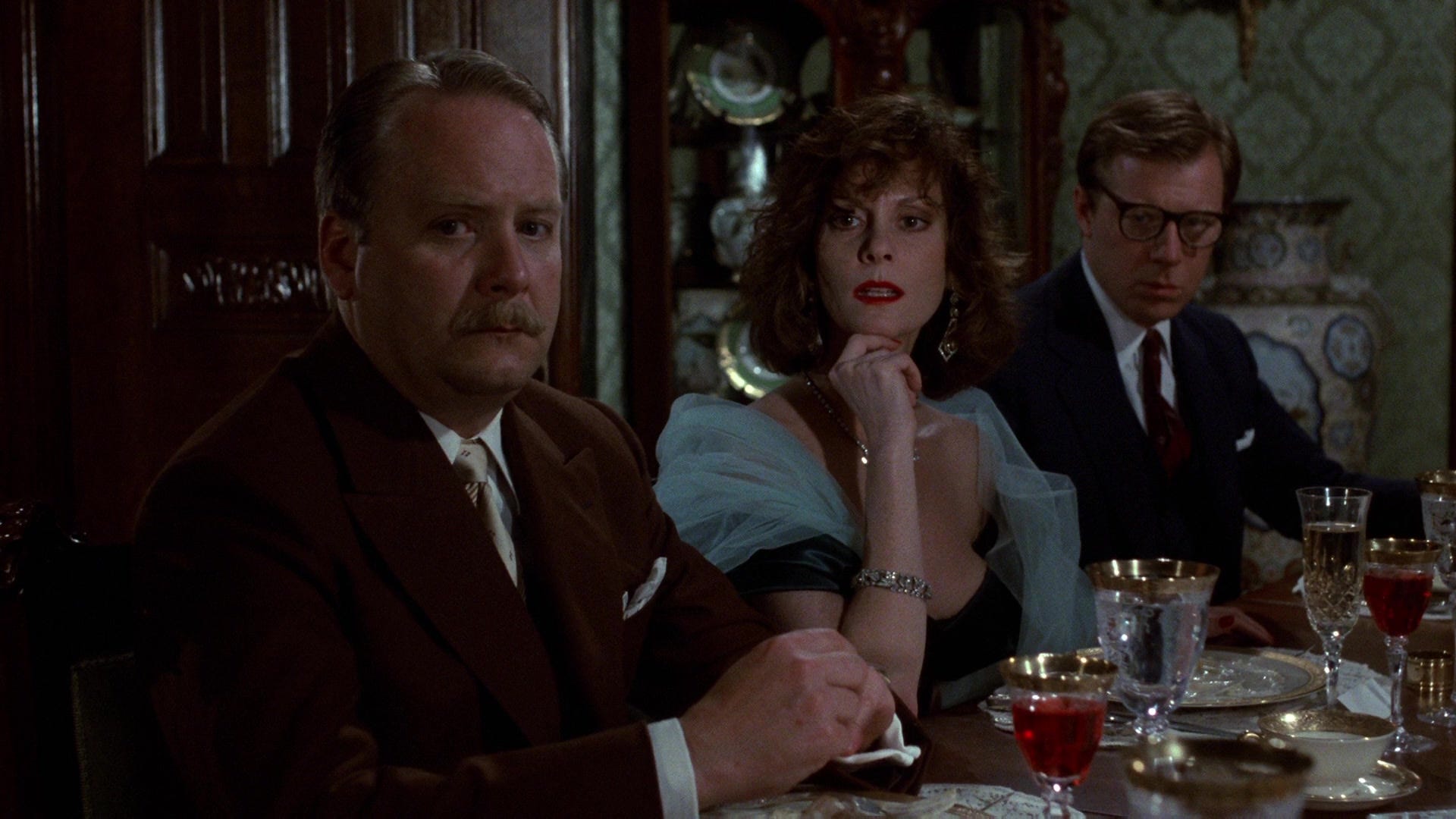
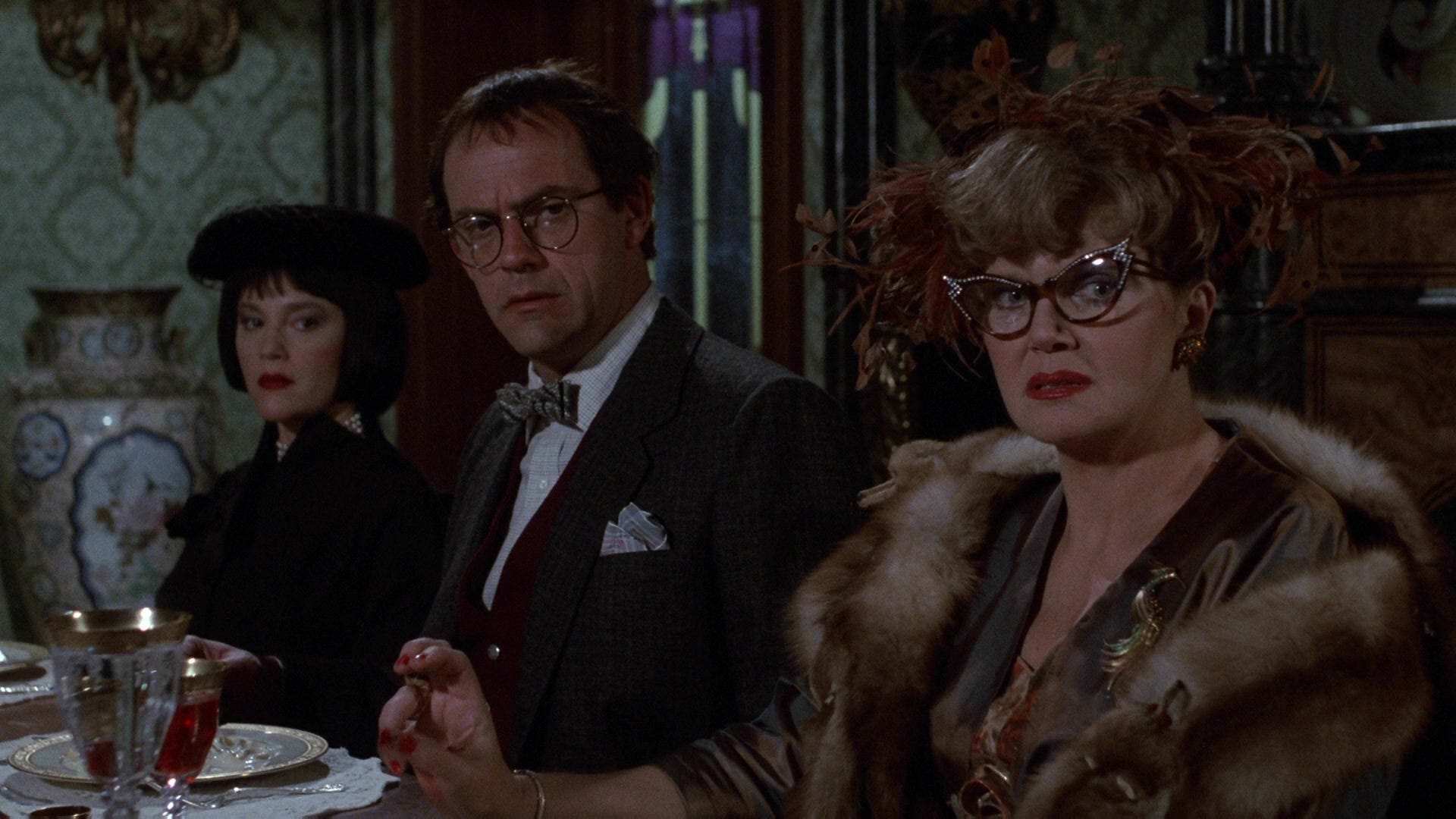
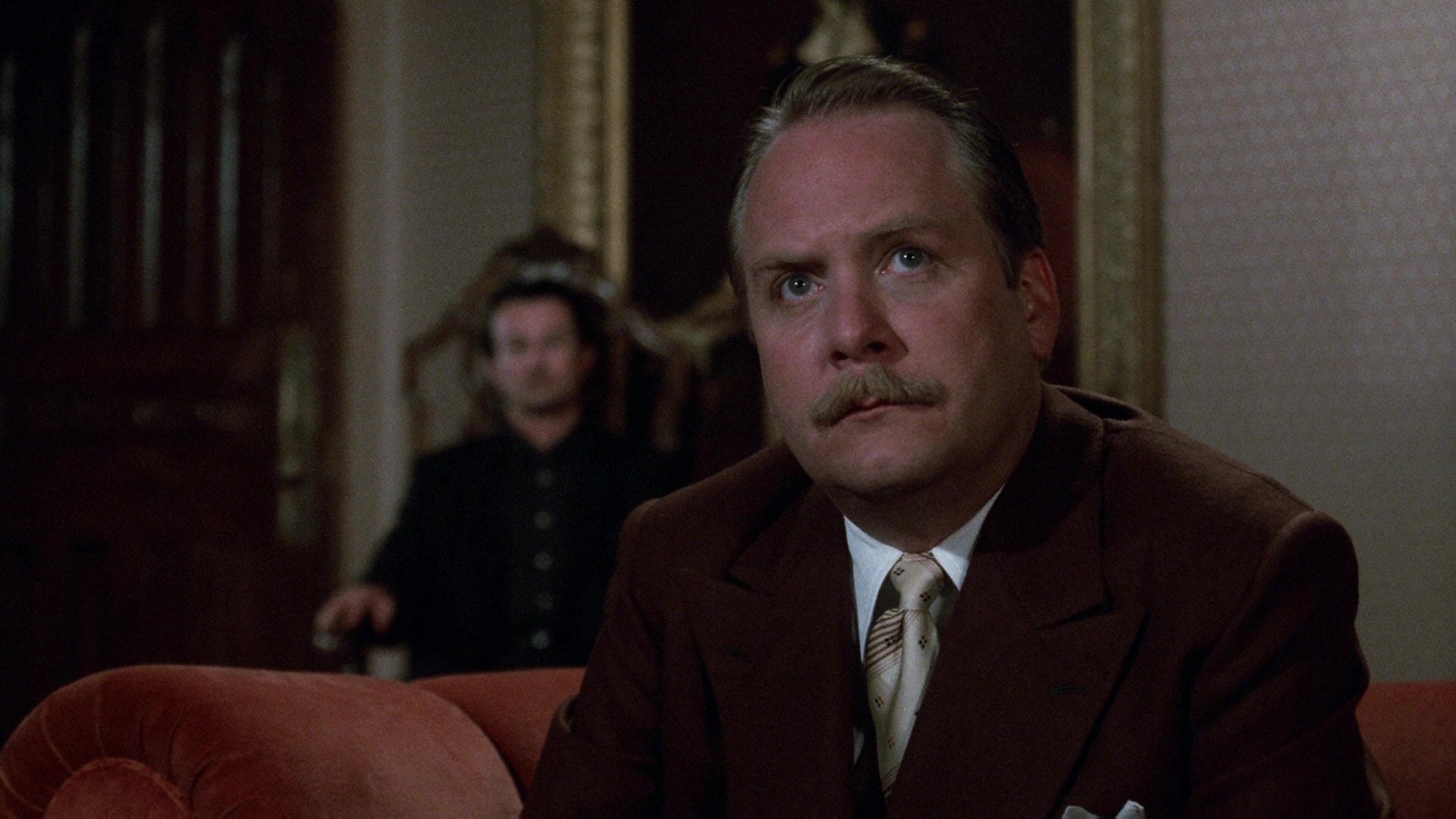
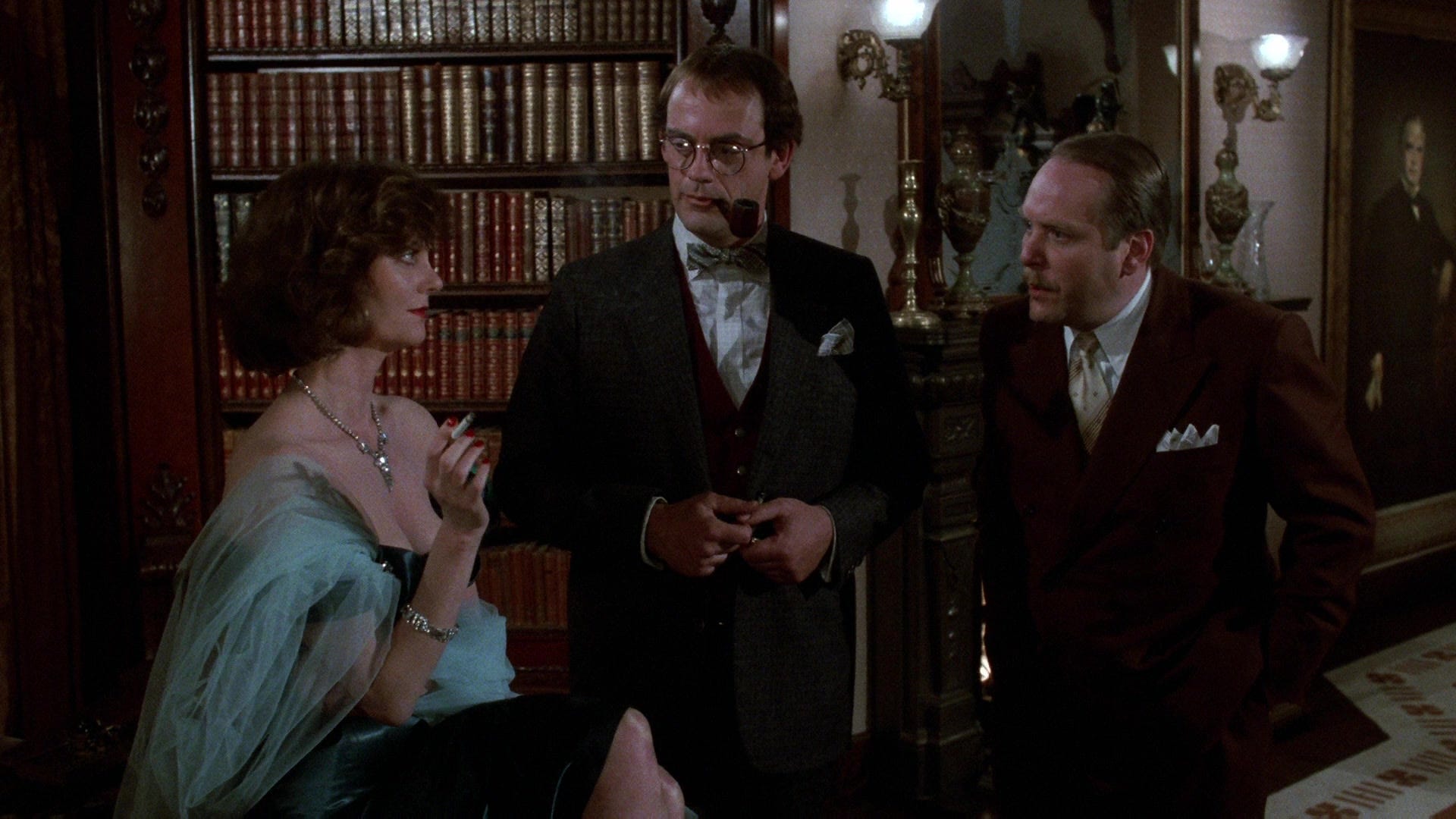
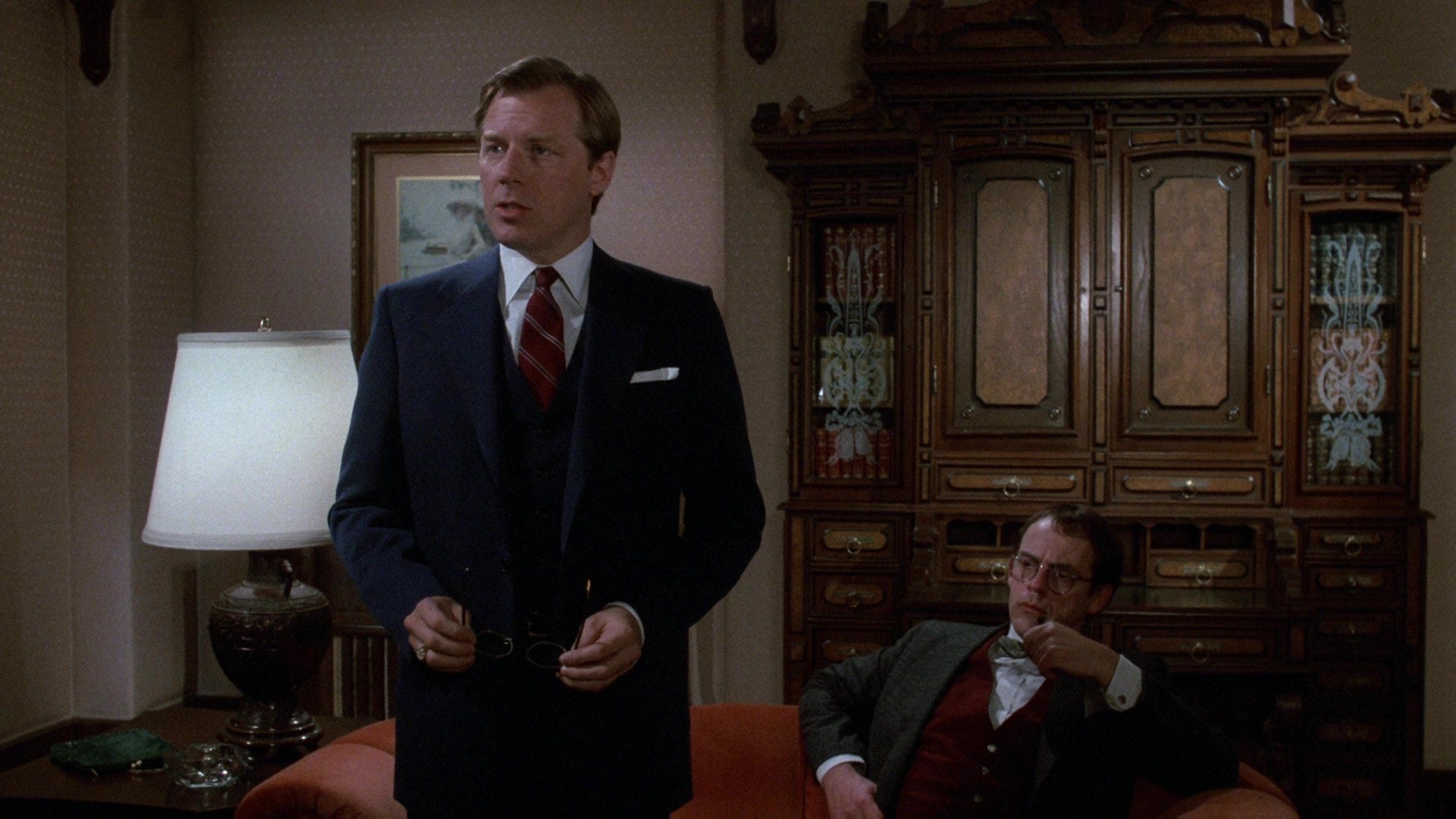
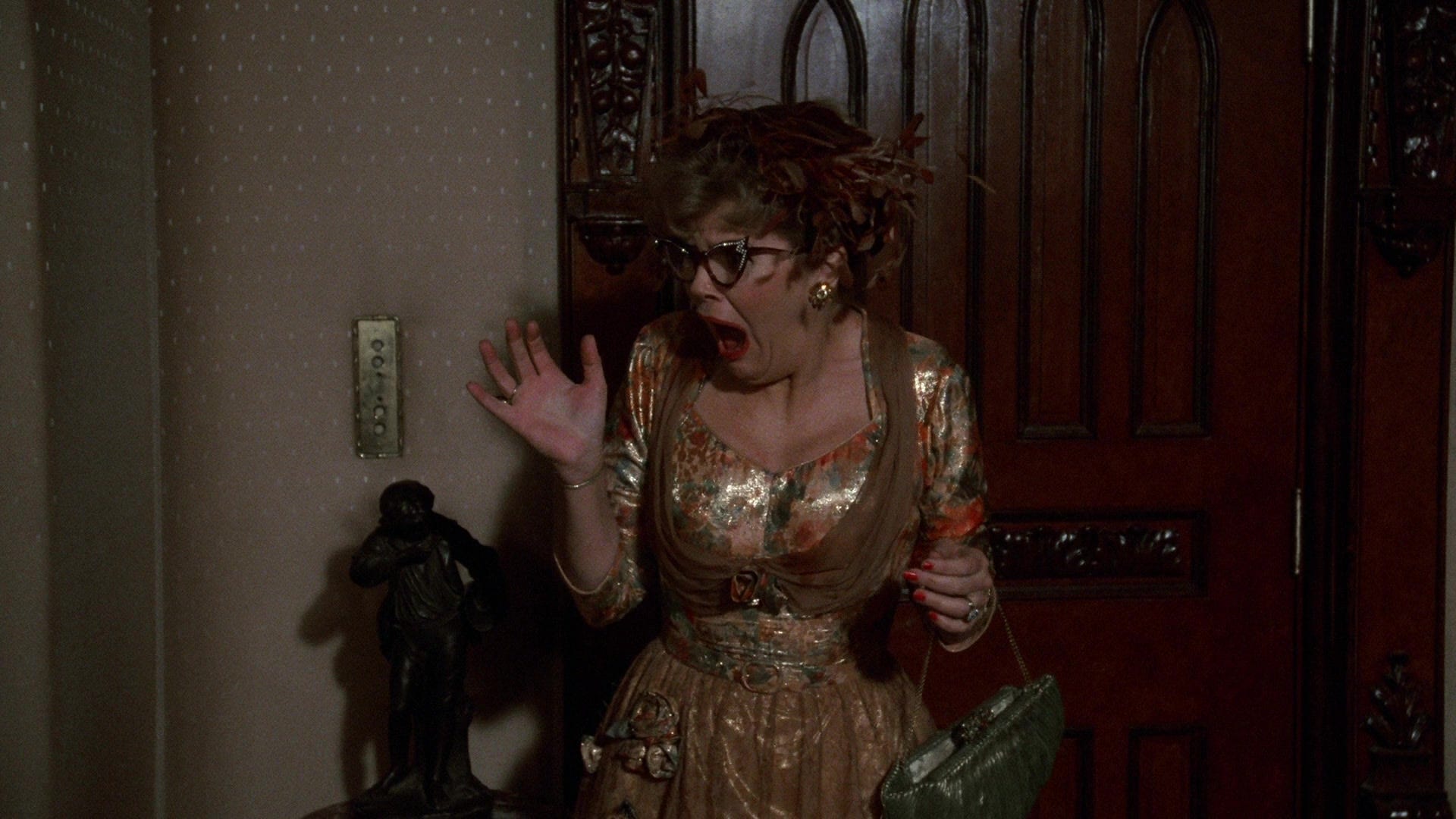
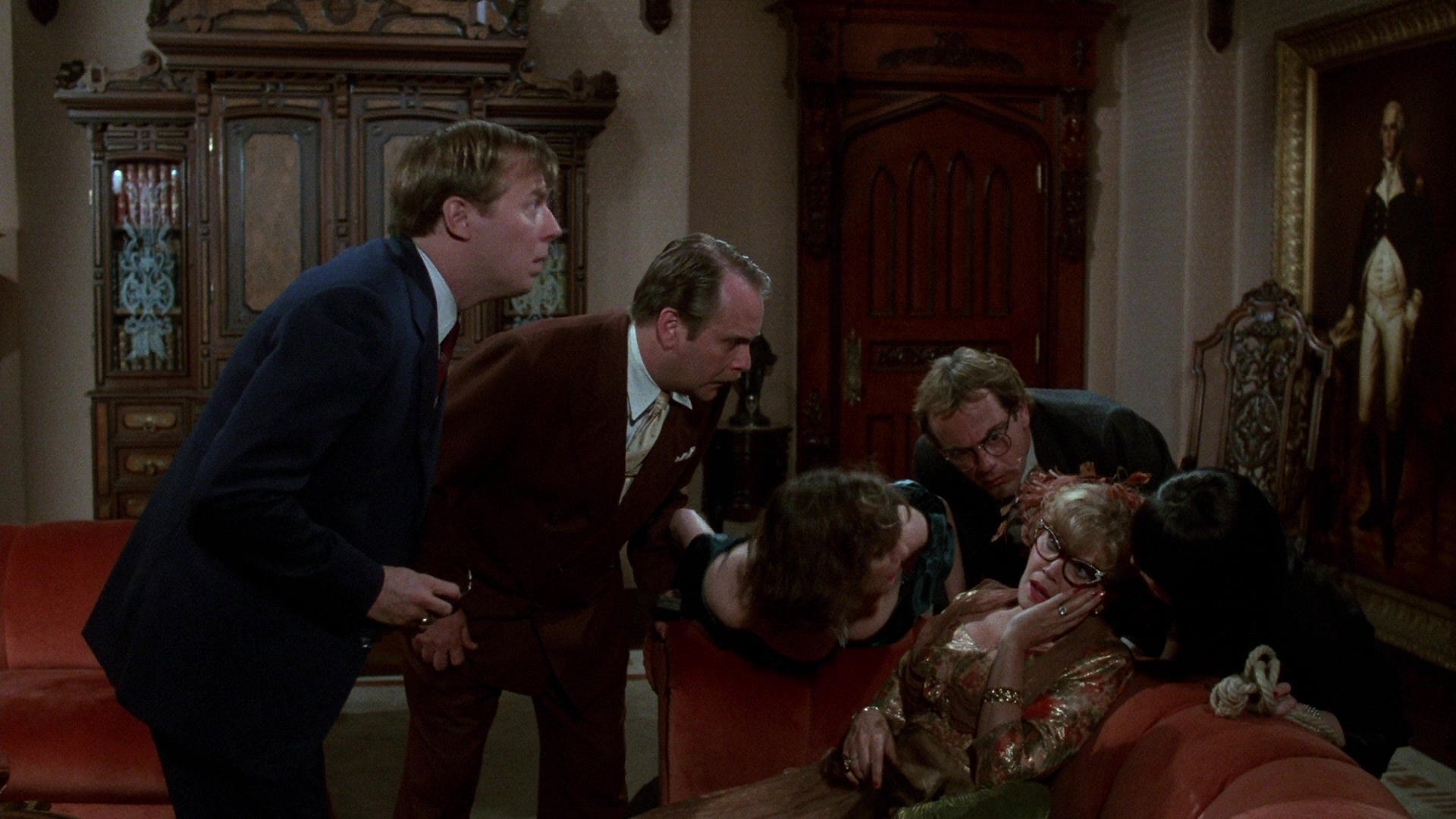
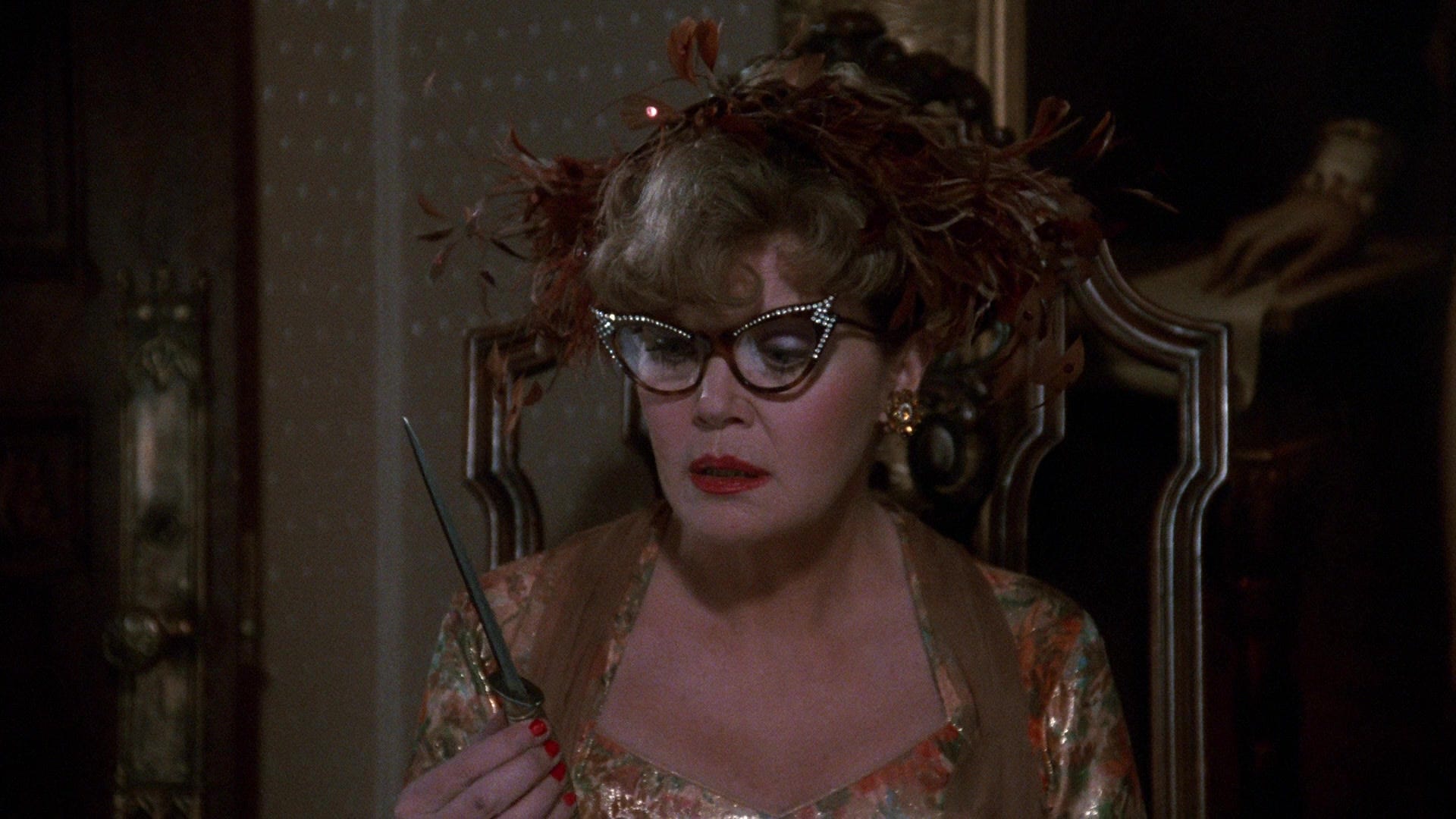
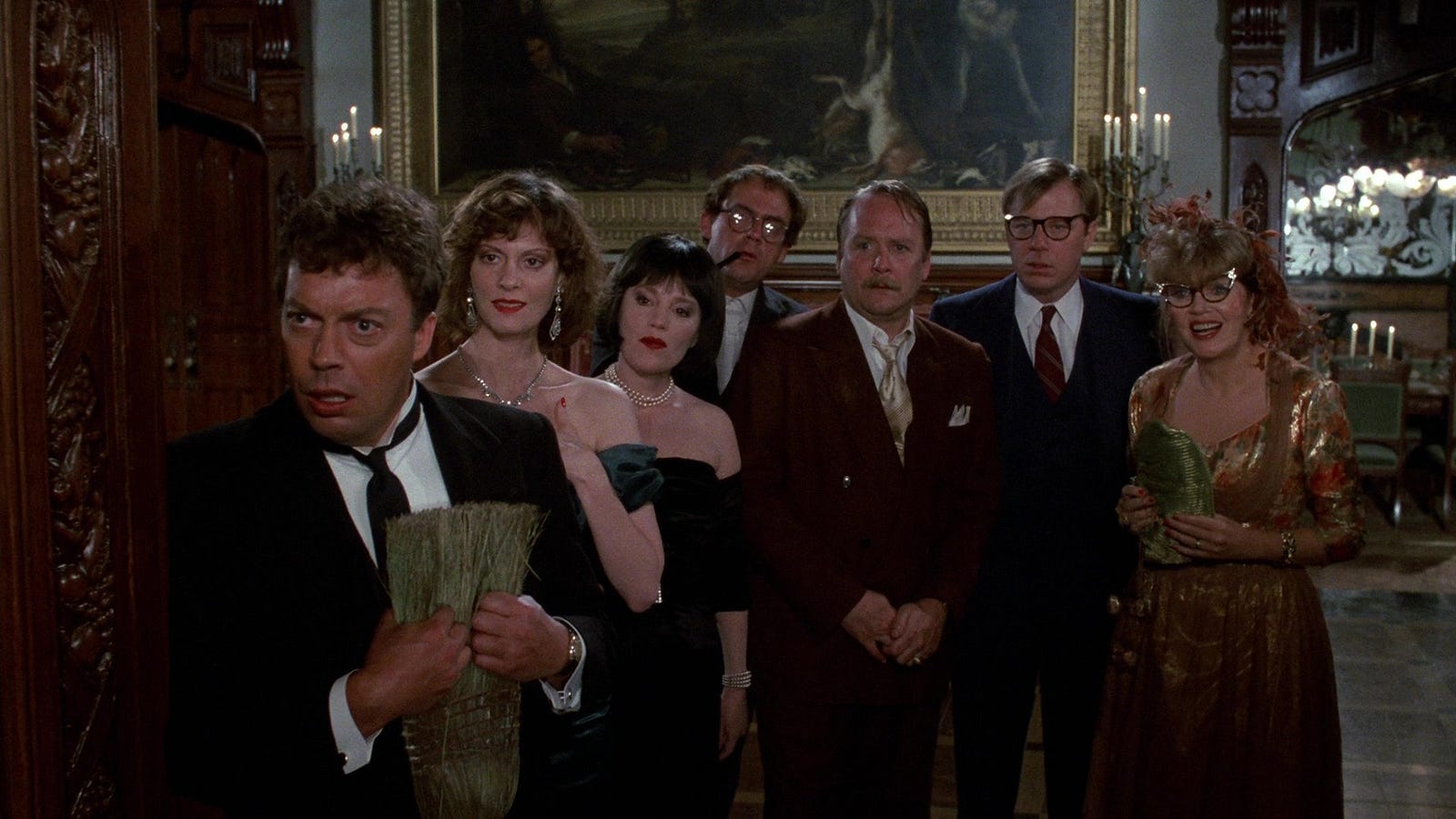
Clue is outrageously proud to be a movie based on a board game. Considering Debra Hill's education in movies, particularly horror movies, and Jonathan Lynn's pedigree in satirical theater and television, it's remarkable that neither winks at the audience nor makes fun of the material. Their dedication is reflected in the casting. With the exception of Lee Ving, the weakest link in an otherwise superbly cast film, most of the actors shared Lynn’s substantial background in TV. The American sitcom Taxi seems to have served as a royal academy of dramatic art, with Lynn casting series regular Christopher Lloyd and two actors who’d appeared in guest spots, Martin Mull and Eileen Brennan, in Clue (Andy Kaufman would've killed as Mr. Boddy, but he passed away in 1984). Lesley Ann Warren's casting as Miss Scarlet opened the door for Madeline Kahn to put her unbridled spin on the black widow Mrs. White. As funny as she is, Kahn’s quirky character has one gear. Warren has to juggle sexual charm, cunning, a veneer of innocence, verbal and physical comedy, all while wearing a corset that restricts her movement. The screenplay clears the runway for the butler in the last half hour, and Tim Curry takes off. The actor claimed that he was treated for high blood pressure during filming, and it’s remarkable that he didn't suffer a heart attack. Curry carries the last half hour of Clue on his shoulders, ripping through pages of dialogue as he sprints from room to room, running through doors and into them. Most of the cast scores at least one assist from him. Lynn’s script is loaded with zingers (Col. Mustard accuses Wadsworth, “Are you trying to make me look stupid in front of the other guests?” The butler deadpans, “You don’t need any help from me.” Mustard retorts, “That’s right!”)
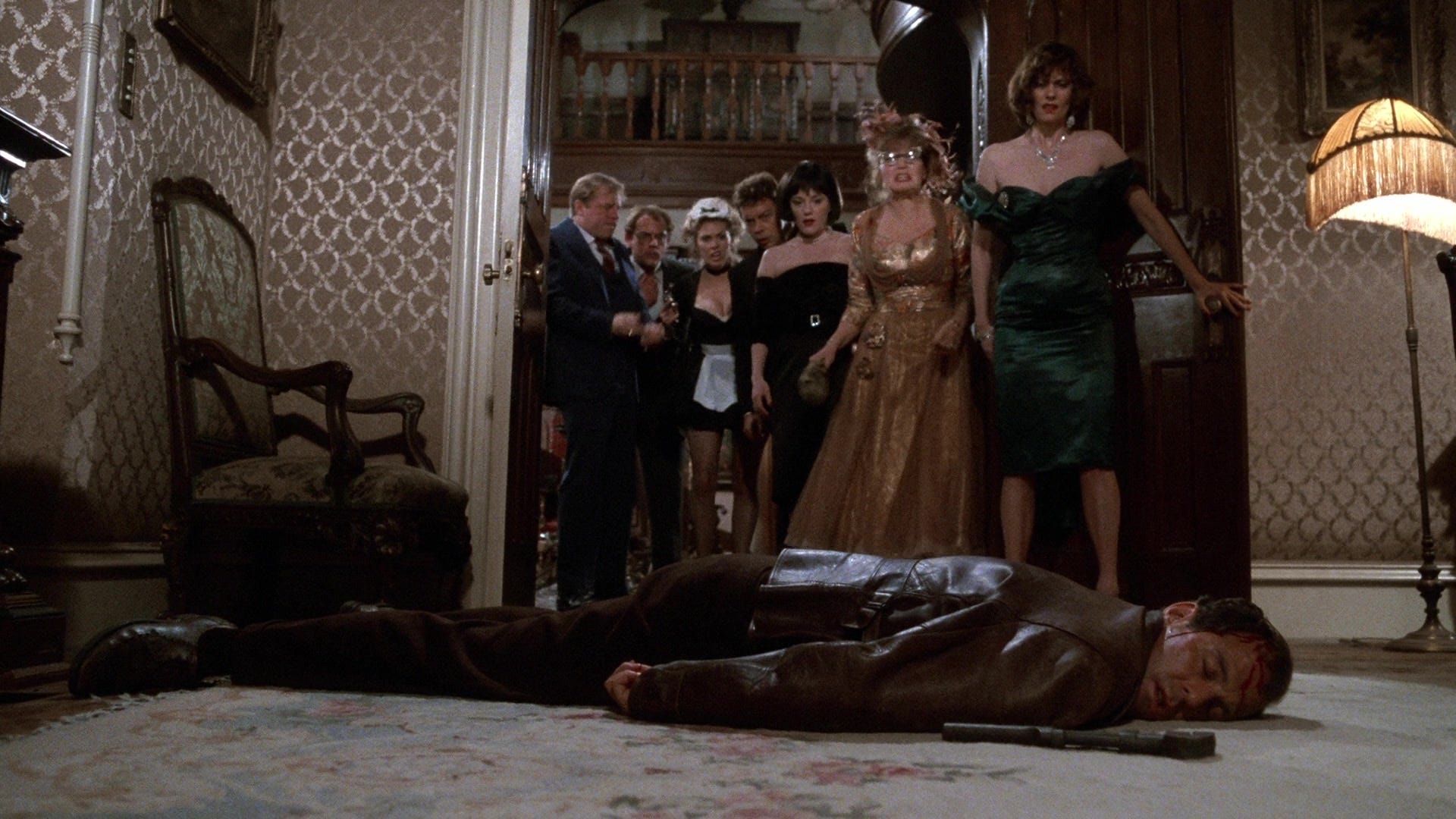
Poor packaging, not bad timing, explains the rocky reception of Clue. Parker Brothers renamed and mass-produced a board game with diminishing European sales into a huge seller in North America. Video stores, cable and basic television did the same for a movie that flopped in theaters. It plays best in a group, viewer participation adding to its enjoyment. (“I say Miss Scarlet did it. She knew about the secret passage” or “It’s Professor Plum. He had the revolver …”) Without a good songbook, there’s no salvaging Clue as a musical, but written to take place in one location virtually in real time, Lynn’s farce was perfectly tailored for the place he got his start: the theater. He never dumbs the material down, trusting that audiences are capable of keeping up. Neither Hill, Landis nor Lynn settles on turning Clue into a spoof. This is what separates it from a farce like The Naked Gun: From the Files of Police Squad! (1988), which seems downright contemptuous of having to manufacture a mystery. Instead of serving as scaffolding for jokes, mystery is the whole point of Clue. Everything else — performances, set decor, costumes — works in support of it. What makes the multiple-ending gambit ingenious is that it delivers three different movies, not merely three endings. Clue endures in a way spoofs don’t: viewers can pick any character and watch them for an hour and a half as if they were the star, the same way they would in a night at the theater. Few comedies ask that much of an audience and fewer reward them as plentifully as this one.
Video rental category: Comedy
Special interest: 24-Hour Time Frame
This production history draws on John Hatch’s What Do You Mean, Murder?: Clue and the Making of a Cult Classic (Perfect Bound Books, 2024), Seth Abramovitch’s “How the Writer-Director of 1985’s Clue Cracked the ‘Silliest Idea’ He’d Ever Heard—and Created a Cult Classic” (Hollywood Reporter, 5-12-2026), and Adam B. Vary’s “The Crazy Story of How Clue Went From Forgotten Flop to Cult Triumph” (BuzzFeed, 9-2-2013). Also cited are Nicola Upson’s “Before The Traitors, there was Cluedo“ (The Times, 10-17-2025), Louise Brierley’s “Cluedo was my father’s lockdown project” (BBC, 11-23-2025), Neal Zoren’s “Debra Hill makes a living scaring people” (Courier-Post, 2-3-1980), and Who Done It: The Clue Documentary (2023), written and directed by Jeff C. Smith.
Hey, good morning Joe! Well, here’s another one that I never saw, but now having read your background information and analysis, I am extremely interested in seeing it. What a great cast! The only root cause I can think of for my absolute blank spot in my music and movie exposure in the 80s, is that I was in school and encapsulated in digesting didactic information and applying it clinically. So I must’ve been in a little exposure cocoon … anyway, as always, great job! thanks for this one. Peace! ✌️CPZ